 Fra Noi Embrace Your Inner Italian



Sept. 21 marked the 70th anniversary of the Rocky Marciano-Archie Moore fight of 1955. It was Marciano’s last bout and final knockout of an opponent. He retired the following year with a 49-0 record, 43 of which were knockouts. He’s the only boxer to retire undefeated. Sadly, he died in a plane crash at age 46 in 1969.
Such a career should be ripe for the silver screen, but Marciano’s back story was too humdrum for Hollywood. However, the champ’s short life did make it to television in 1979 starring Tony Lo Bianco and again in 1999 starring Jon Favreau.
What Hollywood and the Big Screen really wanted was Italian guttersnipes. Instead of gentleman Rocky Marciano, the moguls chose to do a biopic of middleweight Rocky Graziano, a juvenile delinquent and Army deserter, who made for better drama (“Somebody Up There Likes Me,” starring Paul Newman in 1956). In 1980, the down-and-dirty life of middleweight boxer Jake LaMotta was introduced to American audiences in “Raging Bull.” Robert De Niro started down his cinematic road of unsavory Italian American characters as the misogynistic, violent and crooked LaMotta.
But the real Rocky inspired wannabe screenwriter Sylvester Stallone to reimagine the champ as a punch-drunk mob enforcer who rises to boxing glory as the “Italian Stallion.” That the character has a Hispanic surname may still escape Sly as well as fans of the “Rocky” series. Nevertheless, it is this fictional Rocky that fronts our sports image to new generations. (If you want the real story of Rocky Marciano, look for “Rocky Marciano: A Life Story” on YouTube, narrated by Robert Loggia.)
Hollywood thrives on flawed Italian Americans, usually painting us as curiosities or just plain evil. Al Capone, Don Corleone and Tony Soprano are now America’s top crooks, real or imaginary. Tony Manero (“Saturday Night Fever”), Joey Tribbiani (“Friends”) and Vinny Gambini (“My Cousin Vinny”) are America’s all-time loveable characters. For the kids, there are Mario and Luigi. There have been a precious few positive characters along the way, like the eccentric Lt. Columbo and the tormented Capt. Furillo of “Hill Street Blues” fame. Though flawed in their own ways, they represented our legacy of public service. I suppose we should be thankful for small favors.
Many of us enjoy these movies and TV shows even though we sometimes wished the embarrassing characters had different ethnicities. I recall my excitement when “Rocky” came out. The Italian Stallion swelled my pride because I knew he represented scores of Italian American boxers who helped propel us to assimilation and success.
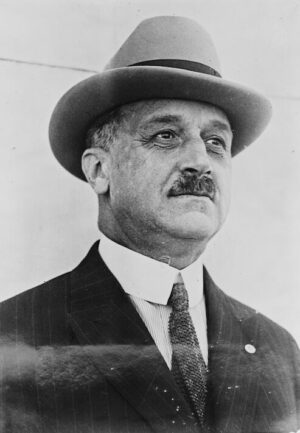
But Hollywood rarely deviates from the fictionalized side of us. The man who founded Bank of America, established branch banking and funded Walt Disney as well as the Golden Gate Bridge never inspired a major biopic. Instead, Hollywood fictionalized A.P. Giannini as a small-time shady banker with murderous sons in “House of Strangers” (1949), right down to cafone spaghetti dinners.
American war heroes Sgt. John Basilone (Medal of Honor and Navy Cross) and Capt. Don Gentile (“a one-man Air Force,” according to Gen. Eisenhower) never overcame Hollywood’s Italian criterion. Nor did they inspire Francis Ford Coppola, Martin Scorsese or David Chase to honor them. Rather, it was Steven Spielberg who acknowledged Basilone in three episodes of HBO’s “The Pacific.”
The side they hide includes federal investigator Ferdinand Pecora, who exposed Wall Street shenanigans in the 1930s that led to the Securities and Exchange Commission and the financial guardrails that protect investors today. His name is a footnote while Charles Ponzi’s is immortal. Ponzi’s scam was an estimated $250 million in today’s money. Bernie Madoff defrauded his victims of $68 billion worth. Nevertheless, with two cable movies that quickly went to the stacks, Madoff’s infamy won’t outlive Ponzi’s or Capone’s.
Interestingly, De Niro played both Capone and Madoff, but the actor’s bad-guy magic wasn’t able to rocket Bernie into Hollywood’s dubious Italo-sphere.
The article above appears in the November 2025 issue of the print version of Fra Noi. Our gorgeous, monthly magazine contains a veritable feast of news and views, profiles and features, entertainment and culture.
To view a sample copy, click here.
To subscribe, click here.