 Fra Noi Embrace Your Inner Italian


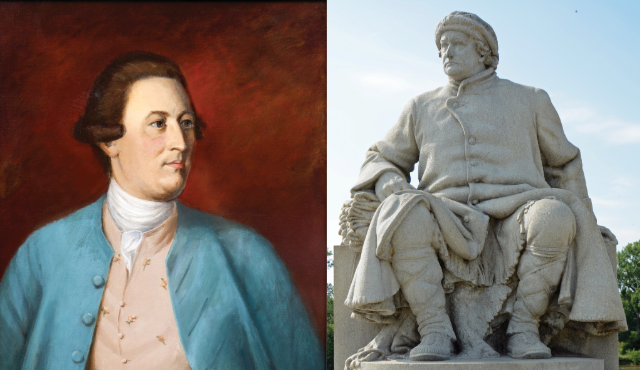
Rosario Iaconis did a splendid job in the March issue of illuminating the vast Roman legacy overlooked in Ken Burns’ documentary “The American Revolution.” Also conspicuous by their absence from the popular PBS series are the many Italians who played pivotal roles in the birth of our nation.
Iaconis made mention of the seminal contribution Filippo Mazzei made to the Revolution, noting that Thomas Jefferson derived “all men are created equal” from a 1774 essay penned by his dear friend. There’s so much more to that story.
A Tuscan physician, Mazzei moved to America in 1773 to establish agricultural experiments, particularly vineyards. He settled in Virginia, near Jefferson’s estate, and they bonded instantly.
An Italophile and student of Italian culture, music, architecture, and art, Jefferson recruited musicians from Sicily to form the first Marine Corps Band and drew inspiration for his home, Monticello, and the state capitol in Richmond from the books of iconic Italian architect Andrea Palladio.
Fluent in Italian, he loved sharing revolutionary ideas with his new neighbor, securing publication in the Virginia Gazette of the aforementioned essay, which contained the phrase, “Tutti gli uomini sono per natura egualmente liberi e indipendenti” (“All men are by nature equally free and independent.”). Sound familiar?
Writing frequently for the Gazette under the pseudonym “Furioso,” Mazzei helped convince Virginians that independence from England was possible and Europe would be sympathetic to the American cause. From 1779 to 1783, he turned passion into action, traveling throughout Italy and France, securing loans, purchasing military supplies, and rallying diplomatic support for revolution.
It took two centuries for Mazzei to gain the recognition he was due, garnering a 40-cent commemorative stamp from the U.S. Postal Service in 1980 and a congressional resolution in 1993 acknowledging him as the inspiration for the iconic phrase in the Declaration of Independence. Not a hint of that appeared in Burns’ documentary.
Another Italian-born patriot completely overlooked by Burns was Francis Vigo. Born Giuseppe Maria Francesco Vigo in Modena, Italy, he joined the Spanish army and made his fortune in the fur trade in the Louisiana Territory.
After meeting George Rogers Clark in Kaskaskia in July 1778, he decided to help Clark capture Fort Vincennes. Vigo advanced him money and supplies to keep his men from deserting, and in December of that year, he allowed himself to be captured by the British, putting his life in danger while spying for Clark.
While imprisoned, he discovered that the British did not expect a winter attack. When he was released because of his affiliation with Spain, he shared that intel with Clark, who mounted a surprise assault in February 1779 and took control of the fort. Vigo went on to establish Jefferson Academy, now known as Vincennes University, in Jasper, Indiana.
No mention was made of Vigo’s crucial role in Clark’s victory, and the annals of neglect go on and on. Other Italian heroes that Burns failed to mention include:
- The three Italian regiments — the Royal Italian Regiment, 3rd Piemonte and 13th Du Perche — that fought at Yorktown;
- The two individuals of Italian descent — William Paca and Caesar Rodney — who signed the Declaration of Independence;
- Lt. James Bracco, an army officer in the 7th Maryland Regiment, who was killed in the Battle of White Plains;
- Pascal DeAngelis, who joined the Continental Army at the age of 13 and fought throughout the war;
- Col. Richard Tagliaferro of the 2nd Virginia Regiment, who was killed in the Battle of Guilford Courthouse in North Carolina;
- Col. Cosimo De Medici, an officer in the North Carolina Light Dragons;
- Capt. Ferdinand Finizzi, born in Parma, who served with the French forces during the Revolution;
- Capt. Benjamin Tagliaferro, deputy commander of the 2nd Virginia Regiment and an assistant to George Washington;
- and Major Giovanni Belli, who served in crucial logistical roles after the Revolution, including quartermaster of the U.S. Army.
How much fuller would Burns’ portrait of our nation’s birth have been had at least a couple of these heroic figures appeared in its frame?
The above article appears in the July 2026 issue of the print version of Fra Noi. Our gorgeous, monthly magazine contains a veritable feast of news and views, profiles and features, entertainment and culture.
To view a sample copy, click here.
To subscribe, click here.