 Fra Noi Embrace Your Inner Italian


The verb fare, which means “to do” and “to make” is ubiquitous in conversational Italian, as it is found in innumerable special expressions. Fare is used to convey different types of shopping, as well as to express one’s occupation, talk about what you have (or don’t have) to do, how much an item costs, taking a photo or a trip.
Learn how to use fare to sound like a native Italian
in almost every situation!
In the last blog in this series, “Facciamo Shopping!” or “Let’s go shopping!” we learned how to describe the act of shopping in Italian. You may have noticed that there is one common denominator in the numerous Italian phrases presented. In short, whether an Italian is stepping out to buy everyday items such as groceries or clothing, or a major item such as a car, all shopping phrases start with the verb fare!
Another former blog, “The Weather in Italian,” also detailed the essential role the verb fare plays to describe the weather, or, in the Italian way of thinking, “what weather it is making.”
In fact, the Italian verb fare is so ubiquitous in everyday Italian conversation that is has already turned up on many lists of expressions in this blog series — especially blogs that focus on how to be polite while a traveler in Italy and how use command forms. The reflexive form, farsi, has been discussed a previous blog about impersonal statements.
This blog will highlight even more common uses of the ever popular Italian verb fare.
How to Conjugate Fare
Fare is an irregular Italian verb in the present tense. Only the third person singular, fa, and the second person plural, fate, follow the usual rules of conjugation for -are verbs. The regular forms are given in blue in the table below, and the irregular forms in brown. All forms should be memorized given the extensive use you will get out of this verb!
Present Tense Fare — To Do / To Make
| io | faccio | I do / make |
| tu | fai | You (familiar) do / make |
| Lei, lei, lui | fa | You (polite), she, he does / makes |
| noi | facciamo | We do /make |
| voi | fate | You all do / make |
| loro | fanno | They do /make |
Past Tense Fare:
Passato Prossimo: Fatto is the irregular past participle of fare. Avere is the helping verb for the passato prossimo.
The full conjugation is:
ho fatto, hai fatto, ha fatto,
abbiamo fatto, avete fatto, hanno fatto
Imperfetto: Fare has an irregular conjugation in the imperfetto past tense due to its irregular stem, face: facevo, facevi, faceva, facevamo, facevate, facevano
Future tense Fare: Fare is an irregular verb in the future tense. Although the stem, “f,” is regular, the “a” of the -are ending does not change to an “e,” as for the regular future -are verbs. Instead, the conjugation is: farò, farai, farà, faremo, farete, faranno.
Imperative Tense (Command Form): Fare is irregular in the imperative tense. If you need a refresher on the conjugation and use of Italian command forms, including fare, visit the blog Familiar Italian Commands.
Singular familiar: Fa! or Fai! (You do/ make it!)
Plural: Facciamo! (Let’s do it!/ Let’s make it!) Fate! (You all do/make it!)
1. Use fare to ask about someone’s line of work, and in response
- Fare is often used to ask about someone’s line of work. The response uses fare, followed by the definite article the (il, lo, la, l’, i, gli, le) before the profession.
- You may also answer a question about your profession with the verb essere, as in “Sono…” for “I am…” In this case, however, do not use the definite article.* Simply state “sono” and the type of work you do. The exceptions (and aren’t there always exceptions when dealing with the rules of language?) are “in affari” and “in pensione.”
- A note about this, though. In Italy, it can be considered rude to ask someone’s occupation right after you have met them. This information usually comes up naturally in conversation and most often is volunteered by the speaker. But, below is a question inquiring about one’s line of work using fare and a few of the many possible responses. For a more complete list of the professions in Italian, visit a previous blog in this series, “Friends in the Professions.”
| Che lavoro fa? | What work (do) you (polite) do? |
| Che lavoro fai? | What work (do) you (familiar) do? |
| Faccio il lavoratore interinale. | I am a contract (independent) worker. |
| Faccio il lavoatore volontario(a). | I am a (charity/volunteer) worker. |
| Faccio l’operatore assistenziale. | I am a healthcare worker. |
| Faccio l’operaio (specialista). | I am a factory worker (with special qualifications). |
| Faccio l’operaio del settore auto. | I am an autoworker. |
| Faccio l’impiegato. | I am an office worker. |
| Faccio il dottore. | I am a doctor. |
| Faccio l’avvocato. | I am a lawyer. |
| Faccio il/la dentista. | I am a dentist. (lit. I make work as a dentist.) |
| Sono uno studente/una studentessa. | I am a student (male/female). |
| Sono dottore, avvocato, dentista.* | I am a doctor, lawyer, dentist. (Both male and female use same endings.) |
| Sono in affari. | I work in business. |
| Sono in pensione. | I am retired. |
**Although the definite article is omitted when an individual states their profession with essere, the indefinite article “a/an” (un, uno, un’, una) is optional. “Sono dottore,” and “Sono un dottore” are technically both correct. In English, of course, the indefinite article is not omitted.
2. Use fare with the meaning of “to do”
- Fare is used frequently to talk about what someone is (or is not) doing during any given day, either in the infinitive or with the first person singular faccio.
- To tell someone you have finished a particular job, use the past tense, with the passato prossimo (avere + fatto), since the reference is to a completed action. Remember to change fatto to fatta if the “thing” that has been done is feminine, following the Italian rule for combining the direct object la with a passato prossimo verb that takes avere.
- If you have not done something in question, just begin your passato prossimo sentence with, “Non.”
- If you “were doing” something, use the imperfetto past tense to describe a general period of time.
- Facciamo, the first person plural of fare, which as you will remember can be translated as “Let’s do…” is often heard when one person makes a suggestion to another. If you need a refresher on how to use the noi command form to say “Let’s…” check out the blog “Italian for ‘Let me…’ and ‘Let’s…'”
| Ho molto da fare. | I am busy/have many (things) to do. |
| Ho altro da fare. | I have other (things) to do. |
| Non ho niente da fare oggi. | I have nothing to do today. |
| Non so cosa fare. | I don’t know what (thing) to do. |
| Che facevi?
Che faceva?
Non ho ancora fatto.
|
What were you doing? (familiar)
What were you doing? (polite) What was he/she doing?
I have not yet finished.
I did it! |
| Facciamo così! | Let’s do (it) like this! |
| Facciamo una cosa! Facciamo qualche cosa! |
Let’s do one thing! Let’s do something! |
| Facciamo alle uno, due, tre, etc…! | Let’s do it at 1, 2, 3, etc… o’clock! |
3. Use fare as “to do” or “to make” with the helping verb potere to be polite
- When the helping verb potere is used in the 1st person singular posso with fare, we get the polite question asked by the shopkeeper when entering an Italian shop, “Che cosa posso fare per Lei?”
- To be polite in return when in an Italian shop, always ask, “Posso?” for “May I?” before handling a fragile item. Use, “Posso entrare?” if you are in an unfamiliar place and are not sure if entry is allowed.
- Posso is also important verb that combines fare in order “to make” a reservation or an appointment in a polite manner.
- And, if you want to ask for something politely while in Italy, the third person singular of potere, the “polite you,” può, is also very useful when combined with fare. To read about the “Conversational Italian for Travelers” simple method with può that allows travelers to ask for whatever they need politely without conjugating, click on the link to the blog “Being Polite with Potere.”
A few examples the traveler may find helpful that combine the verbs posso, può and fare are given below. Notice in the last two examples, fare is used it’s alternate meaning of “to take,” to be discussed further in Section 4. Of course, there are many other combinations!
| Che cosa posso fare for Lei? | What can I do for you? |
| Posso? | May I? (while in a shop before touching an item) |
| Posso entrare?
Fallo/Falla entrare! |
May I enter?
Let him/her in! |
| Posso fare una prenotazione? | May I make a reservation? |
| Faccio una telefonata. | I’m making a telephone call. |
| Posso fare una foto? | May I take a photo? |
| Può fare una foto? | Could you take a photo? (of me/others to a friend or stranger) |
4. Use fare with the meaning of “to take”
- Fare is used to describe many daily activities in Italian. The English translation of these activities uses the verb “to take.”
- When talking about transportation, for instance, Italian speakers use fare, while English speakers use the verb “to take.” To mention his or her the intention to “take a drive,” an Italian might say, “Vado a fare un giro in macchina,” or, more commonly, shorten the sentence to, “Faccio un giro in macchina.” Two clever Italian expressions that refer to walking and visiting others are given in the examples below. Pepper your Italian conversation with these expressions to show that you truly understand the Italian way of ife!
- Notice also from the examples below Italian speakers use the simple present tense in many everyday situations, when English speakers would normally use the present progressive or near future tenses.
| Faccio la doccia. | I am taking a shower. |
| Faccio il bagno. | I am taking a bath. |
| Faccio un pisolino. | I (am going to) take a nap. |
| Facciamo una pausa! | Let’s take a break! |
| Faccio un giro in macchina. | I take a drive. |
| Faccio due passi. | I take a short stroll. (lit. I take two steps.) |
| Faccio un salto da Maria. | I drop by (lit. take a hop over) to Maria’s (house). |
| Faccio un viaggio a… | I take a trip to… |
4. Use farsi and fare to describe being hurt physically
- When one has hurt themselves, then farsi is the verb of choice, followed by male, as in, “Mi sono fatto(a) male,“ for “I have hurt myself./I got hurt.”
| Mi sono fatto(a) male. | I hurt myself. / I got hurt. |
| Si è fatto(a) male. | He hurt himself. / She hurt herself. |
- To describe a particular part of the body that feels badly, Italians use the formula [indirect object pronoun + fa/fanno male + noun]. For instance, to relay the fact that you have a headache in Italian, say, “Mi fa male la testa.” The literal translation is, “To me, the head is hurting,” but an English speaker would say, “I have a headache.”
Sound confusing? Well, if we think in Italian, we find that describing what part of the body hurts us is actually quite easy. In the examples below we use the same phrase, “Mi fa male,” and finish with the parts that are hurting! Just remember to change the third person singular fa into the third person plural fanno if more than one part of the body is hurting! See below:
| Mi fa male la testa. | My head hurts. |
| Mi fa male la gola. | My throat hurts. |
| Mi fa male lo stomaco. | My stomach hurts. |
| Mi fa male la schiena. | My back hurts. |
| Mi fanno male i piedi. | My feet hurt/ache. |
5. Use fare with the meanings of “to cost,” “to pretend,” “to act,” “to say,” and “to meet,” to express displeasure, “make up,” and to make impersonal statements
- Not all expressions use the literal meaning of fare; some instead stretch the meaning a bit. Fare can be used with the meanings of “to cost, to pretend, to act, to say,” and “to meet.”
- By the way, fare is also used in mathematics, especially among children. For addition: “Due più due fa quattro,” means, “Two plus two makes 4.” Fare can be used for multiplication as well: “Due per due fa quattro,” means, “Two times two makes 4.”
- A separate table with a few additional expressions is given below. Two phrases, “Mi può vedere…” and “Mi può mostrare,” were covered in last month’s blog about shopping, but are included for completeness.
- And hopefully, you will remember how answer the impersonal statement, “Come si fare?” for “How can it be done?” with “Posso farlo!” for “I can do it!” if the reference is to learning Italian!
| Fa lo spiritoso. | He/she is being funny. |
| Quanto fa? | How much (does) it cost? |
| Fa dieci euro. | It costs 10 euro. |
| Due più due fa quattro. Due per due fa quattro. |
Two plus two makes four. Two times two makes four. |
| La mucca fa “moo.” | The cow goes (says) “moo.” |
| Facciamo alle otto. | Let’s make it/do (it) (meet) at 8 (o’clock). |
| Faccio la dieta. | I am on (making) a diet. |
| Fa pure! | Go ahead! |
| Facciamo sport. | We are playing sports. |
| Fa lo stesso. | It’s all the same. |
| Non fa niente! | It’s nothing/It doesn’t matter/never mind!
You’re welcome! |
| Mi fa molto contento(a)! | It’s made me so happy! |
| Mi fa schifo!
Che fine hai fatto?
Facciamo la pace. |
It is disgusting to me!
Where the hell have you been? Let’s make up. (literally: make the peace) |
| Mi può mostrare… | Could you show me… (pol.) |
| Mi fa vedere… | Could you show me… (pol.) |
| Come si fa? | How can one do it? How can it be done? |
| Si può fare!
Posso farlo! |
One can do it! You can do it!
I can do it! |
Remember the many uses of
the Italian verb fare
and I guarantee you will use
these phrases every day!
For “All the Italian you need to enjoy your trip to Italy,”® click on the links below to purchase my Conversational Italian for Travelers books – and then listen to the audiobook “Just the Important Phrases” on your favorite streaming platform! —Kathryn Occhipinti
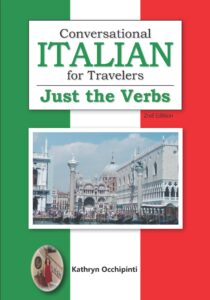
Conversational Italian for Travelers “Just the Verbs” and “Just the Grammar”
are available on Amazon.com and www.LearnTravelItalian.com

Conversational Italian for Travelers “Just the Important Phrases” pocket travel book with audio
on your favorite streaming platform from Amazon.com and www.LearnTravelItalian.com
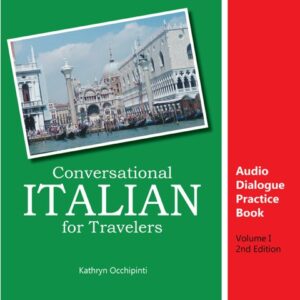
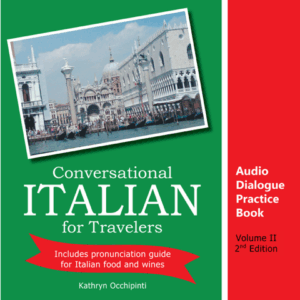
New! Practice short Italian phrases with this Audio Dialogue Practice Book.
Check out how to pronounce restaurant vocabulary in Volume 2!
Download the audio from your favorite audio platform today!
Check them out on Amazon.com and Spotify.