 Fra Noi Embrace Your Inner Italian

How do I say, “I am going shopping in Italian?” Well, that depends on the type of shopping to be done! The different Italian phrases that describe the act of “going shopping” are listed in the tables below. Notice that all Italian shopping phrases use the verb fare, which means “to do” or “to make.”
|
Grocery Shopping |
|
| fare la spesa | to do the grocery shopping to do some grocery shopping (the grocery shopping = la spesa) (groceries = la spesa / i generi alimentari) |
|
General Shopping |
|
| fare spese | to do the shopping (clothes, shoes, or other personal items) |
| fare compere | to do the shopping (any purchase = la compera) |
| fare acquisti | to do the shopping (any purchase = l’acquisto) |
| fare shopping | to do the shopping |
Now that we know fare is the verb Italians choose to describe the act of shopping, a quick mention of the conjugation of fare in the present tense is in order.
Fare is an irregular Italian verb in the present tense. Only the third person singular, fa, and the second person plural, fate, follow the usual rules of conjugation for -are verbs. The regular forms are given in blue in the table below, and the irregular forms in brown. All forms should be memorized given the extensive use you will get out of this verb!
Present Tense Fare — To Do / To Make
| io | faccio | I do / make |
| tu | fai | You (familiar) do / make |
| Lei, lei, lui | fa | You (polite), she, he does / makes |
| noi | facciamo | We do /make |
| voi | fate | You all do / make |
| loro | fanno | They do /make |
Just conjugate fare into the first person singular to tell family that you are going grocery shopping with the phrase, “Faccio la spesa.” From the table above, note that the singular Italian noun la spesa means grocery shopping. Although la spesa can also mean “groceries,” often “i generi alimentari” is used when referring to groceries, while la spesa is the only way to say “grocery shopping.” Also, in English we often insert the word “some” into the grocery shopping phrase, and say, “I am doing some grocery shopping.” But the word “some” is not inserted into the Italian phrase.
When shopping for items other than groceries, there are many Italian phrases to choose from, as noted in the “General Shopping” table. These phrases are interchangeable. Again, just conjugate fare into the first person faccio and add the shopping phrase of your choice to describe your shopping activity. If you are going shopping for a particular item, add “di” and the noun that describes what you are planning to purchase. For instance, “Faccio compere di vestiti,” for “I am going shopping for clothes.”
It should be noted, though, that while Italians “do” shopping, English speakers more often “go” shopping, and the phrases in the table above can be translated with the English verb “go” as well. To be precise, Italians would say, “Vado a fare…” or “I go to do the…” but this longer phrase is not often used in Italian.
The last phrase in the “General Shopping” table is probably the easiest for English speakers to remember, as this Italian phrase includes the English noun “shopping.” If you remember that the noi form of a verb is one way Italians say, “Let’s…” than you know that the title of this blog, “Facciamo shopping!” means, “Let’s go shopping!” If you need a refresher on how to say “let’s” in Italian, visit a previous blog in this series, Italian for “Let me…” “Let’s!”
Some examples, with fare conjugated into the first person form, faccio:
Vado a fare la spesa.
I go to do the grocery shopping.
Faccio la spesa.
I do the grocery shopping.
Faccio compere. I go (lit. do the) shopping.
Faccio acquisti. I go (lit. do the) shopping.
Faccio shopping. I go (lit. do the) shopping.
Faccio shopping di vestiti.
I go (lit. do the) shopping for clothes.
What is the etiquette when entering an Italian shop?
Although grocery shopping is a must when living in Italy for an extended period, the visitor is usually focused on other items.
In Italy, a dazzling array of stores selling designer clothes line the grand boulevards of the major cities and can even be found in the piazzas of smaller towns.
Italian clothes are always “alla moda” or “in style.” Even better, all Italian labels are also on sale in February and July.
When strolling through an Italian town, it may be intimidating to enter an Italian clothing store at first. A few simple rules of Italian etiquette can help you to feel comfortable shopping in Italy.
Most Italian shops — even designer stores — are small compared to American standards. There is usually a salesperson standing at a counter near the door. It is customary to greet the salesperson as you enter. If he or she doesn’t greet you first, a simple “Buon giorno” or “Buona sera” will do, for “Good day,” or “Good evening.”
The salesperson may then ask, “Posso aiutarla?” which is the polite phrase that means, “May I help you?”
If you prefer to look around the shop a bit by yourself, you may want to answer, “No, grazie, sto solamente dando un’occhiata,” for “No, thank you, I’m just looking around.”
Remember that shopkeepers in Italy are on site not only to help customers, but also to keep the store neat and tidy. If the salesperson remains nearby, you may want to ask, “Posso?” for “May I?” before removing fragile items from a shelf or rummaging through clothing to look for the correct size.
How do I ask an Italian salesperson to help me find the perfect outfit?
Can you say, “Saldi?” Don’t miss out! Learn Italian phrases to interact
with Italian shopkeepers and find a special outfit to bring back home.
As noted in the last section, Italian clothes go on sale in February and July, when the seasons change and stores are getting ready to restock. Frequent travelers know this and often leave room in their suitcase to take advantage of deals on major Italian brands. But even those traveling to Italy for the first time will discover many small Italian shops with reasonably priced clothing that still has that special Italian flair. Italian tailors in particular have a worldwide reputation for the precise cut of their suits that creates a seemingly effortless elegance known as “sprezzatura.”
If you plan to interact with a shopkeeper to find that special Italian dress or suit, the verb of politeness, potere, is always helpful to start a conversation. Posso is the first person of potere, and has likely been used in the first interactions, as noted in the last section to say, “May I.” When asking for help as a customer, the third person form of potere, which is può, comes into play. As noted in a previous blog, Being polite with potere, può is a helpful verb to remember when asking for assistance of any kind. As noted in the previous blog,
One simple way to use potere while traveling in Italy is to connect the “polite you” conjugation of potere, which is “può” with an action verb in the infinitive.
This will enable travelers to ask for whatever they need
with the polite phrase, “Could you…?”
When shopping, to ask a salesperson to show you a particular item, simply ask, “Mi può mostrare…?” for “Could you show me…?” and then add the item to the end of this sentence. Another way to phrase this question is, “Mi fa vedere…” which uses the verb fare conjugated in the polite “you” form given in the first section.
The second person plural form of the Italian verb avere, which is avete, is also helpful when interacting with a representative of the shop. If asking for a certain style, size, or color of clothing, use avete for the “you all” form; although addressing an individual, the question is really a broader one, directed at all those who have chosen the items for the shop. For instance, if you want a certain color dress or suit, ask, “Avete un vestito nuovo? for “Do you have a black dress?” or “Avete un abito grigio?” for “Do you have a gray suit?”
After asking this question, be prepared to state your size in Italian. In this case, the verb portare is used with the polite phrase, “Che taglia porta?” for “What size do you wear?” Note that Italian sizes differ from European and American sizes. Many times, clothing in Italy will have a tag with both European and Italian sizes, but only rarely with American sizes. It is best to look up your Italian size on the Internet before venturing out to shop.
To give your size in Italian, conjugate the verb portare in the first person to say, “Porto la taglia…” for “I take size…” If you want to sound like a native Italian, leave out the word taglia in the answer and simply give the size after the definite article la, as in, “Porto la 46.”
If the fit is just right, you can say, “Mi va bene,” which is an idiomatic expression that means, “It fits me well.” If the size is not right, you can say, “Non mi va,” for “It doesn’t fit me well.”
You may want to ask, “Avete taglie più grandi?” or “Avete taglie più piccoli?” for “Do you larger sizes?” or “Do you have smaller sizes?”
If you’d like the same item in a different color, you might ask, “Avete questo (vestito/abito) in… rosso, marrone, nero, blu, etc.” “Do you have this dress/suit in… red, brown, black, blu, etc.” A shopping trip may be a good time to learn the colors in Italian!
How do I say I’m trying on an item of clothing?
Once you’ve found an item you like, the salesperson may ask you, “Do you want to try on…” with the polite question, “Vorrei provare…?”
Putting on or trying on clothes is described in Italian with the reflexive verbs mettersi (to put on) or provarsi (to try on). In English, these activities are not reflexive. Instead, English expresses these ideas with the combination [possessive adjective + noun] after the verb. For example, “I put on my dress.” In Italian, the sentence structure is [Italian reflexive verb + definite article + noun]. If you think of the Italian formula as a method that can be used again and again, you will see it is quite easy to construct these sentences with various articles of clothing.
To describe yourself getting dressed in Italian, conjugate the verb mettersi (to put on oneself), put the reflexive pronoun mi (myself) before the verb, and follow with the article of clothing: “Mi metto il vestito.” This simple Italian sentence corresponds to the English: “I put on the dress,” “I put on my dress,” and “I put my dress on.” Notice the Italian subject pronoun is not included. To describe action in the tu (you), use “ti metti,” and so on, for all speakers.
(io) Mi metto il vestito. I put on my dress./I put my dress on./I put the dress on.
(tu) Ti metti l’anello. You put on your ring./You put your ring on.
Use the same sentence structure to describe trying on an item of clothing with provarsi:
(io) Mi provo il vestito. I put on my dress./I put my dress on./I put the dress on.
(tu) Ti provi l’anello. You put on your ring./You put your ring on.
How do I tell a friend their new Italian outfit looks good on them?
To ask a friend if your new Italian outfit looks good on you, use the phrase, “Mi sta bene?” or the phrase, “Come sto?”
To tell someone, “It looks good on you!” in Italian, follow this simple method:
Conjugate the Italian verb stare into the third person, or “it” form, which is sta, and then place an indirect object pronoun before the verb.
Remember that the direct and indirect object pronouns are the same for a familiar conversation. Mi means both me and to me, and ti means both you and to you. In short, if someone tells another, “Ti sta bene,” they are literally saying, “To you, it stays well,” with the meaning, “It looks good on you.”
And, of course, since you are wearing Italian clothing, the answer you should hear is, “Ti sta benissimo!” for “It looks wonderful on you!”
If you and your friend agree, tell the salesperson, “I’ll take it!” with “La /Lo prendo!”
Remember how to use the Italian verbs
fare and potere
in simple shopping phrases
and I guarantee you will use
these phrases while shopping in Italy!
For “All the Italian you need to enjoy your trip to Italy,”® click on the links below to purchase my Conversational Italian for Travelers books – and then listen to the audiobook “Just the Important Phrases” on your favorite streaming platform! —Kathryn Occhipinti
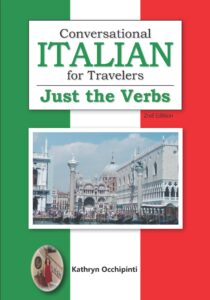
Conversational Italian for Travelers “Just the Verbs” and “Just the Grammar”
are available on Amazon.com and www.LearnTravelItalian.com

Conversational Italian for Travelers “Just the Important Phrases” pocket travel book with audio
on your favorite streaming platform from Amazon.com and www.LearnTravelItalian.com
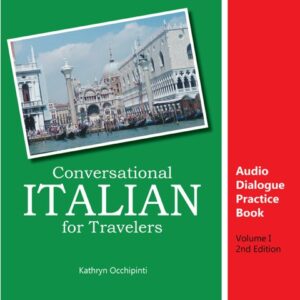
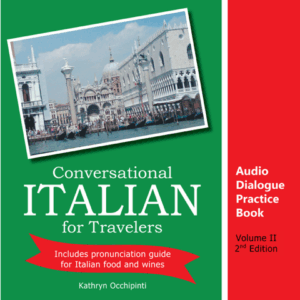
New! Practice short Italian phrases with this Audio Dialogue Practice Book.
Check out how to pronounce restaurant vocabulary in Volume 2!
Download the audio from your favorite audio platform today!
Check them out on Amazon.com and Spotify.