 Fra Noi Embrace Your Inner Italian


Midway to Italy on the Saturnia in July 1960, my mother was still enjoying her first respite from household chores in more than a decade, but my father was fed up. He quickly grew weary of our stark little cabin, where Mom rinsed our things in the sink and hung them to dry on thin ropes suspended above our heads. Accustomed to working year-round, he didn’t know how to inhabit the hours of idleness aboard a ship. It seemed his favorite activities were early morning strolls on deck, when the briny air was at its most bracing. Now that the flying fish of the coastal waters had ceased to appear, he told us of a few sightings of dolphins playing in the swirling wake of our ship. But once when I went to join him up top, I saw him staring glumly at the towering smokestack with its plume of purplish gray trailing along the sky.
Whenever a raucous horn blast signaled the passage of another ocean liner, Dad got us all up on deck to bask in the sight of fellow human beings who were at a civilized distance instead of swarming all around us. He also relished the tasty dinners we were served, but mealtime was often marred for us by the slaps doled out to the two children by the man Mom had dubbed Daddy the Second for his resemblance to my father. In fact, her running joke was beginning to grate on Daddy the First. One evening, Mom insisted we all cheer up by going to watch a film, which turned out to be the surfer movie “Gidget,” whose title stood for “girl midget.” With Sandra Dee in the title role, James Darren as Moondoggie, and Cliff Robertson as The Big Kahuna, that cinematic creampuff nearly finished my father off.
As the weather got cooler and windier, the deep ocean became less amicable, with enormous whitecaps crashing into foam against the bow. The sun hid for several days in succession while sea and clouds formed a continuum of gray. The long, slow roll-and-heave of the ship became more perceptible. The on-deck swimming pool was tarped up, and safety ropes were strung on deck, in the lounge, and in the dining room, which was much less crowded than usual.
Some passengers got sick right in front of me. I frequently had to sidestep greenish-brown puddles around the ship, giving rise to reflections such as, “I see they served hardboiled eggs this morning at the breakfast I skipped.” As a pukophobe, I was in shock, but so far, I’d managed not to contribute to the unsavory mess, thanks to the Dramamine that Mom had secured for our trip.
She and I were seriously nauseated for only a day, but my neighborhood friend Orlando told me that his father — Alfredo, a tall, skinny, taciturn man with a thin black mustache — had been violently seasick much of the time and had confined himself to their cabin. It was also too cold for him to go up on deck, since he’d neglected to pack warm clothes for a trip that, taking place in July, wouldn’t require any — or so he assumed.
Once, when I was on deck with my family, we spotted Alfredo there. He had ventured upside to get some air after requisitioning his wife’s shocking-pink sweater, whose sleeves reached only halfway up his arms. My parents managed to avoid laughing as he cursed the madman who first invented ships while he vainly tried to yank together the two sides of the tiny sweater to protect his chest from the lashing wind.
The next day Dad thought it would be a friendly gesture to go down to their cabin to see how Alfredo was feeling, so we descended to a level of the ship even below ours. After wandering around as if in a claustrophobic maze, we spotted their cabin number above their door, which they’d left ajar. Peeking inside, we saw all three of them strewn on their bunks — their limbs pointed any which way as if in distress — so we tiptoed away without a word.
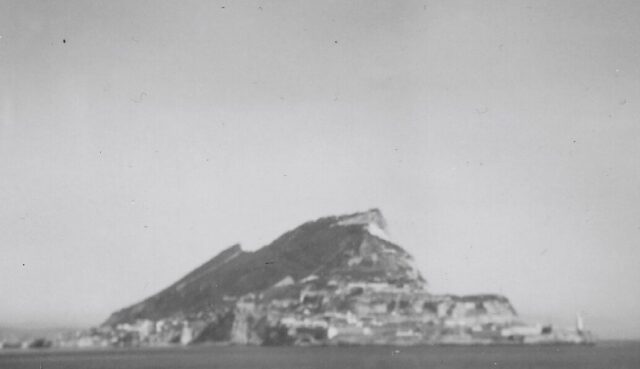
On skirting São Miguel, the largest island of the Azores, the Saturnia stopped briefly off the seaport of Ponta Delgada, allowing peddlers to row out in boats painted rose-pink and pastel-blue. Their wares included trinkets and straw handbags, and Dad managed to figure out how to use their pulleys and basket to send down a dollar and hoist up a handbag for Mom. Then, when we arrived at Gibraltar, I learned why its name became a synonym for massive strength.
Looking across the Strait of Gibraltar at the Atlas Mountains of Morocco, hazily blue in the distance, I experienced the eeriness of shifting my gaze from one continent to another just by doing an about-face. We were still 1,100 miles from Naples, but Spain was Europe, and the Mediterranean was girded by land — hence much less creepy than the open sea. It felt great to be on the last leg of our voyage.
To be continued — with an onboard accident.
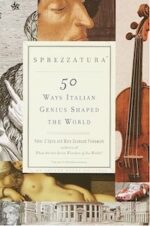 If you would like to deepen your appreciation of Italy’s magnificent achievements in literature, art, music, science, law, religion and other aspects of its civilization, consider reading my book Sprezzatura: 50 Ways Italian Genius Shaped the World. In 50 brief essays you’ll discover why, from the time of the ancient Romans to the present, Italians have been in the forefront of those who have done their work with sprezzatura — the art of making difficult things look easy. To order my book from amazon.com in paperback or Kindle, click here.