 Fra Noi Embrace Your Inner Italian


One morning on our way to Italy in summer 1960, I was playing tag with a few friends on a largely deserted deck of the Saturnia. It had rained the night before, and the gray surface still glistened with dime-sized splats of moisture. Chasing one of the boys, I slipped and fell on my back, sliding fast toward the railing. With the ship’s heaving and my own momentum, I feared shooting into the sea beneath the lowest tier of the metal rail. Bending my knees, I came to a stop when my left shin slammed against a large bolt connecting two segments of the railing. Stunned, but happy that no one was shouting “boy overboard!” I eased my pants leg up and saw blood and fat oozing out of a two-inch gash.
A middle-aged guy who saw me fall helped me limp down to the cabin, where we found my father shaving. (My mother and sister were already out and about.) One on each side, Dad and my Good Samaritan supported me to the infirmary. There, a youngish doctor used an astringent swab to make the fat withdraw between the jagged edges of the wound. After administering a tetanus shot, he reached for a curved needle to sew me up.
The fiery pain I felt when he closed the gash with a single broad stitch was due to his having neglected to inject the area with an anesthetic. Did he have none on hand, or did he just forget? After snipping the long ends of the black nylon suture, he bandaged my shin with gauze and rummaged in his storeroom until he emerged with a pair of crutches and handed them to me without showing me how to use them.
My parents were shaken by my accident, and I regretted my own stupidity in running around on a wet deck. Over the next few days I had no desire to trek all the way up to the dining room on my crutches, which I never got the hang of. Instead, I stayed in the cabin and waited for my parents to bring my meals in a covered dish after they’d eaten.
I had two visitors during my convalescence. Uncle Ernie stopped by at lunchtime the first day to chat and gift me an orange left over from his breakfast. That evening, while my family was at supper, I was thrilled by a visit from the girl I’m calling Laura, who’d heard of my plight. Proud of my sports injury, I regaled her with the details of both the accident and the subsequent medical malpractice.
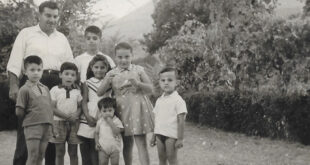
Laura’s brief visit marked the highpoint of our childish relationship and the last time I laid eyes on her. I don’t remember her real name. I don’t even remember whether she was the girl in a group photo I still have. All I remember is the emotion she aroused in me. Though I was a pathetic little Petrarch, I too ended up writing something about my Laura — as you’ve just read — even if more than six decades after the fact.
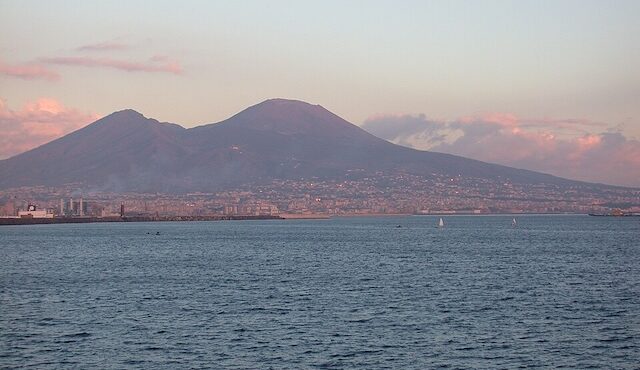
On the afternoon of our arrival in Italy, I haltingly joined my family on deck as our ship steamed into the Bay of Naples. There we gawked at the panorama, especially Mount Vesuvius, destroyer of ancient Pompeii. As the ship, hauled by a tugboat, neared its berth, it was time to head down to the cabin, find a porter for our trunk and luggage, and prepare to go ashore.
Despite the crunch of travelers who had the same thing in mind, we soon managed to get to our cabin, where Uncle Ernie was waiting for us with his suitcase, and we got an idle porter’s attention without too much difficulty. As we set out for the nearest exit, however, we were engulfed by a crowd whose eyes and expressions signaled their determination to disembark before everybody else. In the pandemonium we got separated from Dad, who fell behind to keep pace with our struggling porter.
While my mother kept glancing back for Dad and pulling my sister by the hand between bodies that kept trying to lunge past us, our major concern was that tiny Maria would get trampled or smothered. I had shed my crutches the day before but was still limping, and the bandaged gash on my leg was throbbing. After we got shoved against a wall in the dank, ill-lit corridor, Uncle Ernie spotted the open door of an abandoned cabin, so the four of us took refuge inside it while the hordes inched past.
When we thought the worst was over, we squeezed our way out again and discovered there had just been a lull in the stampede. Passengers were shouting in protest against the very chaos they were spawning, grim-faced porters pushed their laden carts through the wall of backs and rumps, and red-faced babies shrieked in their parents’ arms.
Since our ordeal began, I had been fending off suitcase blows from my injury, but now a frenzied man slammed his valise into my bad leg, and I felt something warm and cool at the same time ooze down my left shin. At the sound of my groan, old Uncle Ernie sprang into action. Hoisting my sister onto his shoulders, he powered his way through the clot of swarming bodies so that Mom and I could advance through the void created by the swath of his body before it filled up again. Soon afterward, she spotted my father not far behind, and he and the porter joined up with us at the end of the corridor.
“Where the hell did you go?” Dad shouted at Mom, who didn’t bother responding to his rhetorical question.
Before inching down the exterior stairs with my family, I pulled up my pants leg and saw that the bandage on my shin bore a scarlet memento of the fellow who’d banged my leg with his suitcase. Limping along, I stepped out into the glaring Neapolitan afternoon.
NEXT MONTH: Quite an assemblage of relatives!
 If you would like to deepen your appreciation of Italy’s magnificent achievements in literature, art, music, science, law, religion and other aspects of its civilization, consider reading my book Sprezzatura: 50 Ways Italian Genius Shaped the World. In 50 brief essays you’ll discover why, from the time of the ancient Romans to the present, Italians have been in the forefront of those who have done their work with sprezzatura — the art of making difficult things look easy. To order my book from amazon.com in paperback or Kindle, click here.

Dear Pete,
I truly enjoyed this episode. The perspective of a precocious young boy whose observations of his surroundings and people encountered are endearing and precise with description. Your memory of that era and the adventures experienced are unforgettable to me because I personally know (knew) the cast of characters in most of your anecdotes. Thank you for your work!
Affectionately,
Cousin Adriana
Cara Adriana–
Many thanks for your comment. As long ago as those events occurred, I nonetheless feel close to them because of the wonderful people and vivid landscapes I got to experience in that formative experience of childhood–a long trip to the country of our family’s origin. It’s a land that you, too, know and love well.
Best wishes to you,
Cousin Pete