 Fra Noi Embrace Your Inner Italian


My parents had several good reasons for the scrimping and saving they did in the late ’50s in the Bronx. I learned about one of them when, on a spring evening of 1960, my father came into my room with a question:
“You want to go to Italy with us?”
As cautious as Dad was, he had decided to take a summer-long unpaid leave from his construction job in the days when workers like him received no vacation time. My parents, my 5-year-old sister and my 9-year-old self would soon embark on a lengthy adventure.
Mom and Dad hadn’t seen their parents in more than a decade, as well as those of their siblings who hadn’t immigrated to New York in the interim. They also wanted to introduce little Maria and me to them all. My father’s agreement with the owner of his company — the white-gloved Mr. Collins — was that, if there was need for a laborer when he got back, he’d have a job. If not, not. My parents had saved up for this vacation for years, so they were going to stay in Italy long enough to make it worth their while.
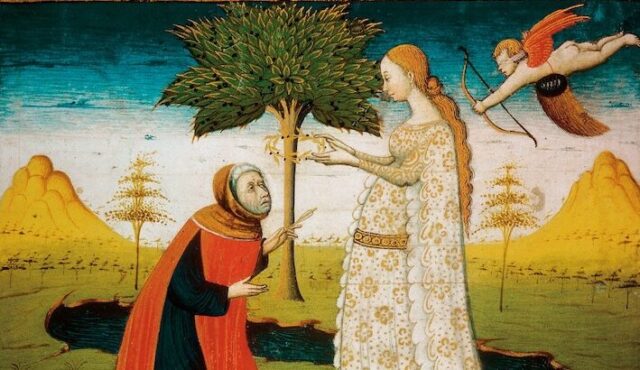
Shortly after my father’s rhetorical question to me, someone gave us an English-language pamphlet on Italian culture that caught my attention with its simple color drawings in the wide margins, so I leafed through it several times. All I remember was a drawing of Petrarch — Francesco Petrarca — and the text’s description of him as an Italian scholar who wrote exquisite poems about his hopeless love for Laura, a married woman who went on to die of the bubonic plague in 1348. I already knew that Italians such as Columbus had accomplished incredibly difficult feats, but Petrarch was the first Italian writer I learned about. I imagined he’d made his mark in the world while sitting at a desk and, as it were, doing his homework. It was an activity I could relate to.
Then, one evening, an Italian couple visited us. They had in tow a pert girl my age who made much of a coin bank she’d recently gotten as a gift and allowed me to examine. It was a three-dimensional rendering of the map of Italy, about 10 inches tall and done in black plastic. She called it “lo stivale” — the boot — an expression, I learned, by which Italians referred to their country’s shape. Along with Petrarch and Laura, that boot-shaped coin bank helped pique my curiosity for the ancestral land I was soon to visit.
Before we left, my mother got a haircut that was too short and a perm that was too curly from a chatty woman who came to our apartment with a wooden case stuffed to bursting with her equipment. I packed just about everything I owned into our steamer trunk: several books, some Superman comics, an issue of Sports Illustrated, the shoebox with all my baseball cards, a deck of Italian and of American playing cards, my softball bat, my baseball glove, a battered softball, a few Spaldeens, a little toy tool kit and my portable radio, which I foolishly thought would pick up broadcasts of Yankee games when we got to Italy.
Soon, Dad’s uncle Ernie arrived from Lock Haven, Pennsylvania, with a single large suitcase. When Dad had phoned him to say we were going to Italy, he decided to come with us and visit his two sisters, one of whom was my grandmother. Early next day, June 30, 1960, we all squeezed into a cab headed for Manhattan, climbed aboard our ship of the Italian Line at Pier 84 on West 44th, and followed our baggage handler to our respective cabins.
The four of us and Uncle Ernie then met on deck where, to the bassoonish blasts of the ship’s horn, we sailed down the regal Hudson and into the broad basin of New York’s magnificent harbor. It would take 10 days to get to Naples by sea, but a transatlantic flight was too expensive at that time. The only person I knew who’d flown to Italy was my esteemed art teacher, young Mr. Pulcino in his sharp suit the color of his sapphire eyes, but he was “a professional.” In addition, some of our relatives and friends were skittish about traveling in what was considered a fairly perilous mode of transportation.
I got a kick out of the Manhattan skyline, which I’d seen only a few times on Sunday morning jaunts with my father aboard the Staten Island Ferry or out to the Statue of Liberty. Now, when we’d all had enough of the squawking seagulls, the ceaseless whirr of the pennants fluttering on ropes overhead and our fellow passengers shoving their way to the railings for a better view, I followed my parents, sister and uncle down several labyrinthine passageways in search of our cabins.
To be continued …

Bravo, Mr. D’Epiro, on this transatlantic excursion, and the childhood memories that would last a lifetime. Never so fortunate to have traveled beyond our own border, I look forward to reading your following details of the journey and the family you met when you were so young and impressionable. Thank you.
Thank you for your comment, sir. That long trip to the land of my ancestors was a life-changing experience for me, as I hope to convey in my next posts.
Dear cugino Pierino,
Loved reliving your preparation of your first trip to visit our grandparents in Esperia in 1960. Your trip prompted my parents to venture there with 3 young daughters in 1962. I was 5 years old and remember so much of that eye opening trip. Thank you for bringing up memories of those days. Eager to read the next episode!
NB- We have a few photos of your 1960 trip….
Grazie, cugina Adriana–I had forgotten that your family had followed with an Italian viaggio of your own so soon after ours. No wonder you went on to teach high school Italian! Those trips of ours happened so long ago, yet they’re still so vivid in our memories. We were both so lucky that we got to experience that wonderful culture so early in life.
Well Pete, you did it… I’m one who reads, only, what and when I want to.. I also know an expression, leave them wanting for more… When I Got To The Point, “to be continued” I was hoping to scroll down a page or two for a conclusion, only to realize, I have to wait for and search for the next installment… Bravissimo my dear friend. Great as always…
Thanks very much, Mike. Despite the snow, next month will arrive much sooner than we think, so please be patient if I take a few more installments to present a story that has a lot of branching elements.
Dear Mike–Thanks very much for your comment, but at our stage of life you should know that the month you’ll have to wait goes very fast.