 Fra Noi Embrace Your Inner Italian


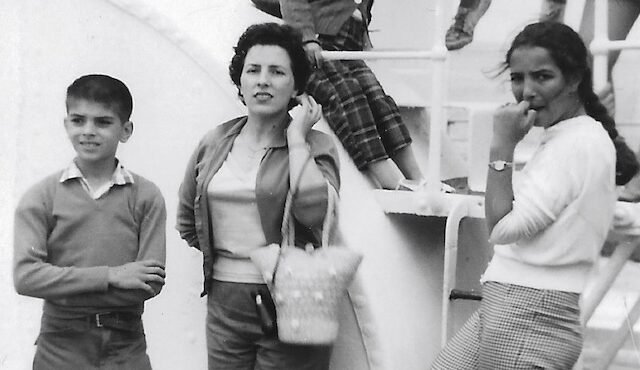
I last wrote about how, aboard the Italian Line’s Saturnia on my family’s way to Italy when I was 9, I found myself attracted to one of the girls who was (at the very least) 13. Tall and shapely, with a bronze complexion, she had a braid of thick black hair resting on her shoulders. She wore a ladylike wristwatch but, in an attempt to shake off the torpor of being cooped up on the ship, she ran wild with the rest of us kids on deck like a feverish Amazon until her cheeks bloomed kiss-me red.
She seemed to grant more signs of her favor to me than to the older, more aggressive boys, whose hands were all over her in our games, and when she slapped my upper arm affectionately hard to tag me “it,” I felt as I once did on unplugging an appliance with wet fingers too close to the socket.
I resolved that if, as I’d recently learned, the great Italian poet Petrarch could harbor a secret love for a woman named Laura, I could do the same with my own version — which is what I’ll call her, since I’ve long forgotten her name.
One day when Laura and my friends weren’t up on deck, I began exploring the branching passageways of the ship. I was soon intrigued by the closed doors with stern bilingual warnings to the effect that beyond lay the airy happy realms forbidden to us and populated by the fortunate few in cabin class and first class. I didn’t have the courage to transgress, so I ended up drifting toward the lounge — familiar territory, since my mother had taken my sister and me there the night before to have a glass of Coke after my father said he wanted to turn in early.
It was after lunch and, in contrast to the bustle I had experienced there before, the spacious, red-draped room was patronized only by three gaunt, elderly Italian men playing cards at a small wooden table off in a corner. I didn’t have the 15 cents I needed for a Coke, so I wandered toward the men and sat down on a bench from where I could watch their game and overhear what they were saying.
Almost immediately one of them turned to me and asked in Italian whether I knew how to play briscola because they needed a fourth person for a game of partners. I was delighted to oblige, so I moved to their table, was claimed as a partner by one of them, and got dealt in. I don’t recall how long we played, but I remember my partner was annoyed that I threw down cards without conferring with him. He wanted a less impulsive partner, one who made a move only after responding to questions like:
“You got a load?”
“How about some small points you can lay on me?”
“Got any trumps?”
“Can you beat that card in the same suit?”
“Can you pick up with a baby trump?”
“If I put down a load, can you beat the seven?”
Being 9, I preferred to play whatever card I thought best without taking into account what my partner was holding, and that is not an ideal strategy for four-handed briscola.
Then my father walked into the lounge looking for somebody that had to be me. When he spotted me, he walked over, nodded to the men with a smile, and told me he’d been looking all over for me on deck. Somewhat worried, I pushed back my chair and said goodbye to the card players, but as I headed for the door beside Dad I saw that he seemed amused.
“He was in the big bar,” he informed my mother when we found her on deck, “sitting with three guys about 70 years old — Sicilians, I think — who were playing cards.”
“Really? How come?”
“He was playing cards like he was one of them.”
“He likes to listen to what older people say,” she said, and then with a glance in my direction, she added, “But he shouldn’t tell us he’s going one place and then he wanders off somewhere else.”
That evening, we realized something startling about my father’s onboard lookalike. It was several days into the voyage, and we had seen him give his son, his daughter, or both of them at least one slap every time we ate dinner. We failed to understand how that man could consistently find a justification for chastisement at what should be the most relaxed and carefree occasion of the day.
Though that family of four sat at a nearby table, we couldn’t hear them talk and thus had no sense of the precipitating factors. It was like watching a silent Punch-and-Judy show in which the only suspense consisted in wondering when Punch would lash out without ever knowing why. The man’s wife didn’t seem distressed by her husband’s actions. On the contrary, while sentences were being executed, we could see her nodding in apparent agreement with the man’s actions. The other diners around them hardly seemed to notice what was going on at that table, either because it was too depressing or embarrassing, or they just didn’t consider it that unusual. Remember, this was 1960.
As for my own plight, romantic or otherwise, there was no way to play my favorite sports of stickball or softball aboard the Saturnia, so I tried shuffleboard up on deck, but I stank at it. It was a boring game anyway — except, of course, when Laura played.
NEXT MONTH: How ocean traveling can be challenging, for all sorts of reasons.
 If you would like to deepen your appreciation of Italy’s magnificent achievements in literature, art, music, science, law, religion and other aspects of its civilization, consider reading my book “Sprezzatura: 50 Ways Italian Genius Shaped the World.” In 50 brief essays you’ll discover why, from the time of the ancient Romans to the present, Italians have been in the forefront of those who have done their work with sprezzatura—the art of making difficult things look easy. To order, click here.