 Fra Noi Embrace Your Inner Italian


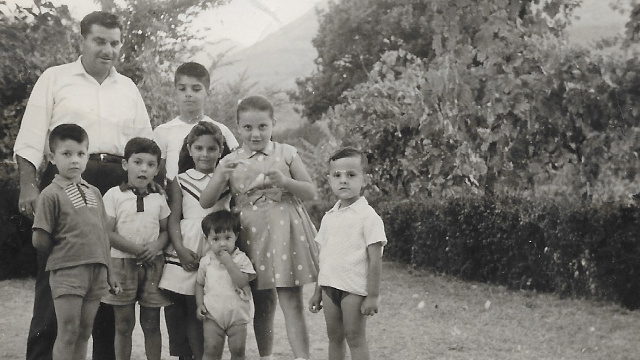
While we were in Italy, we spent alternating weeks at the nearby farms of my two sets of grandparents. At each place, I was able to spend a lot of time with my young cousins who lived locally or in Rome and came to stay with us with their mothers during the week. My Roman uncles came out when they could on the weekends, often decked out in short-sleeved white shirts and brown gabardine pants. Rome was only a 90-minute drive north, but one uncle, Mario the Evangelist minister, lived with my aunt and three kids in Taranto — 200 miles away — so he came out less frequently to join us and his family. Since he had lent us his car for the whole summer (at the “request” of his father-in-law, my Grandpa Luigi, who had bought it for him), Mario chicly rolled in on his Vespa whenever he visited.
Soon after Dad had driven the four of us to Grandpa Luigi’s in Mario’s borrowed car, the latter’s two sons, Silvano (7) and Gigino (6), ran up to me while I was looking around outside. Both yelled, in standard Italian, “Massimo has taken your ‘matite!’”
I had no idea what “matite” were, but from my cousins’ alarmed state I figured that matite were as important as major body parts, so I answered, “Show me where Massimo is.”
My cousins sped off toward the rear of my grandparents’ broad two-story stone house, coming to a halt in front of a cowshed. Following them there, I saw a 5-year-old in a white sailor’s cap and droopy drawers clumsily flinging something onto the low edge of the shed’s red-tiled sloped roof. What the hell was Massimo doing?
On the roof, I saw two small bunches of my pencils wrapped in rubber bands, just as I’d packed them. So that’s what matite were — just plain old pencils. But why did Massimo — a cousin of mine as well as of the two brothers who had gleefully betrayed him — try to get rid of my pencils? From this vast distance in time I can only speculate that it was probably jealousy at seeing his mother hug and kiss me when we arrived that had driven him to search the luggage in our bedroom until he found something he assumed was mine. Since matite were nothing crucial to my happiness, I just fished my pencils off the roof, smirked at the feisty little guy and went about my business.
My first language at home in the Bronx had been my parents’ southern Italian dialect, Ciociaro, which was close enough to standard Italian to enable me to understand and be understood by my cousins. Nonetheless, I was unfamiliar with certain words, like matite (plural of matita), because my parents called a pencil a “lapis,” which is also standard Italian. Much more frequently, however, they just said “penzilluh,” which is an example of Italglish — a linguistic amalgam of Italian and English.
Ital-glish arose when Italian immigrants of previous generations began adopting some common English words into their various dialects of Italian soon after arriving in the United States. While continuing to speak their dialects with family and friends, they often incorporated into their speech many conveniently simple English words that sometimes indicated things or concepts somehow different from their Italian counterparts. In addition, the pronunciation of those adopted words was usually modified to be friendlier to Italian mouths. Since the great majority of Italian words end in vowels, Italians often have difficulties pronouncing English, which has so many words ending with clipped consonant sounds. Often, the solution was to add an unaccented “ah” or “uh” ending to the English word and also to modify some pesky internal vowels whose precise sounds don’t exist in Italian.
Some common examples of Italglish from my childhood are “lunjah” (“lunch,” whereas the standard Italian equivalent, “pranzo,” can also mean “dinner” or an afternoon main meal of the day), giobba (job), rufuh (roof); selluh (cellar); bossah (boss), bookah (book), sida-walkuh (sidewalk), mattaratz (mattress) and frenga-frootuh (frankfurter). The Italglish word for bathroom — bah-kowz — reflected a time in America when the toilet was often a privy outside a dwelling: a “backhouse.”
One of my favorite cousins at Grandpa Luigi’s was the older sister of my little pencil nemesis: Jolanda, who was 8. Smart, good-natured and pony-tailed, she’d often lead the younger kids in singing and enacting an Italian nursery rhyme that was all about horses, pears, chickens, school, wolves, mountains and chestnuts. I had no trouble following the simple Italian words of her song and loved to watch the small fry, as I dubbed them, cavort and dance around to the lyrics.
If my parents hadn’t spoken their dialect of Italian at home during our childhood, my younger sister Maria and I wouldn’t have been able to understand and converse with my cousins and all the many relatives we encountered on our visit in summer of 1960. That months-long exposure to people who spoke nothing but Italian greatly enhanced our understanding of what it meant to be — and indeed to feel — Italian, despite our American birth. For both of us, it was like walking through a doorway into a newly enhanced dimension.
NEXT MONTH: Dad’s folks down on the farm
 If you would like to deepen your appreciation of Italy’s magnificent achievements in literature, art, music, science, law, religion and other aspects of its civilization, consider reading my book Sprezzatura: 50 Ways Italian Genius Shaped the World. In 50 brief essays you’ll discover why, from the time of the ancient Romans to the present, Italians have been in the forefront of those who have done their work with sprezzatura — the art of making difficult things look easy. To order my book from amazon.com in paperback or Kindle, click here.