 Fra Noi Embrace Your Inner Italian


On the late afternoon of our arrival in Italy in July 1960, my weary family and I found ourselves at the house of my maternal grandparents. It was time to settle down to a banquet that had doubtlessly taken my newly-met aunts and great-aunts a prodigious number of hours to prepare. In the company of a dozen adults and a gaggle of kids, I partook of prosciutto e melone, a savory soup with tiny meatballs, homemade manicotti, chickens that had been scavenging carefree in the yard that morning, roast rabbit with diced rosemary potatoes, and a “contorni” of assorted vegetables fried in tangy gold-green olive oil. All was washed down with sparkling water and my grandfather Luigi’s sweet white wine.
Capping the hours-long meal was a multi-layer vanilla and chocolate cream cake, patchily frosted with silvery icing, topped with green and red sprinkles and spiked with rum. That wobbly concoction was the creamiest cake I’d ever tasted.
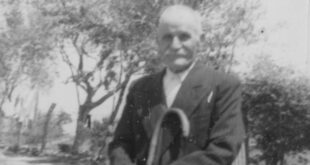
After dark, my two uncles who’d picked us up at the port in Naples drove my immediate family and my paternal grandparents — Pietro and Luisella — to the latter’s house. That was in a higher and more isolated part of Esperia, a town of 4,000 at 1,200 feet that was named for what the ancient Greeks called the southern portion of the Italian boot: Hesperia (“Westland”).
I settled into the back of Uncle Mario’s car with Grandpa Pietro while Dad sat up front. As we sped through the unilluminated countryside on a narrow road devoid of cars, we passed a small graveyard rife with asymmetrical crosses crumbling with age. The only sounds were the churning of gears, the rush of warm tree-scented air through the open windows, and the barking of watchdogs.
I was astounded by the stars of my first Italian nighttime. Back in the Bronx, the heavens were just smog and streetlight pollution. In Italy I first laid eyes on the sublime Milky Way and the vistas of galaxies beyond it.
Touching my knee, Grandpa Pietro said, “Hudson River,” and nodded, smiling, toward the narrow shiny-black stream on our left. I thought that handsome man I was named after might have been showing off his English, but I now realize that he, once a proud inhabitant of New York City, was expressing amused dismay at his shrunken milieu.
We arrived in about 20 minutes and plopped down in Pietro and Luisella’s kitchen, bathed in the garish yellow light of an overhead gas lamp. After my uncles left and my grandparents began wilting, the four of us, stupefied with fatigue, climbed a staircase by the light of a candleholder my mother held before us.
With no electricity in the house, the candle served as the only light in the bedroom we shared and was soon snuffed out. My ears rang with an unfamiliar silence until my father began gently snoring. Though my still-healing shin hurt, and the bedding was rougher than I was used to, I lost consciousness within a few minutes.
When I ventured outside the next morning, the air — devoid of gasoline fumes at that elevation — intoxicated me with the fragrance of dewy greenery. After the Bronx, even the background whiffs of farm animals couldn’t spoil the heady perfume of that shimmery landscape’s abundant vegetation. Grandpa Pietro, in an old fedora and with a white handkerchief around his neck, was already off in the fields, accompanied by his Dalmatian Fifi, who’d been admonished the night before to leave the new folks alone.
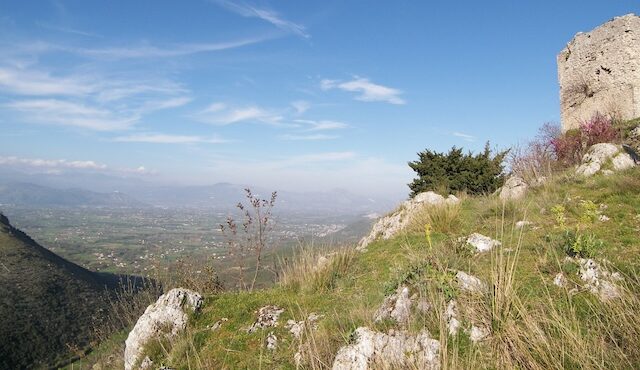
Located halfway between Rome and Naples, very near the beaches of the Tyrrhenian Sea, Esperia sits in southernmost Lazio. I soon learned the town is surmounted by the ruins of a castle built in 1103 by a Norman knight, Guglielmo de Blosseville, who was briefly duke of nearby Gaeta.
Mountains ringed the horizon of Pietro and Luisella’s hilly and picturesque farm with a gently flowing cold spring that gave its name to the property: Fontana a Cannella (Fountain Spout). My grandparents’ land comprised several terraced cultivated fields hemmed in by walls of rounded stones. The string beans, lettuce and other leafy crops were abundant because of Pietro’s assiduous irrigation, and the tomatoes and peppers were ripening. The corn and wheat had quite a while to go before harvest, but the stonier fallow areas were already parched from unrelenting summer sunshine. The studded paddles of prickly pear plants variegated the landscape, providing a hint of desert. Gnarled olive trees sported green leaves that revealed silvery undersides when the breeze moved among them.
The barn, at a side of the house, was home to two white cows, Violetta and Biancuccia, and a snot-nosed nameless sheep in its own pen. Two tough-looking black pigs with hairy ears, also anonymous and fairly indistinguishable, had separate quarters walled off from the barn. Their tiny yard was predictably muddy and closed off by a waist-high wooden gate. I laughed at the sight of the grunting pigs shouldering one another from the trough, which still contained some breakfast slops. Each seemed determined to hog it all in a ruthless zero-sum game.
And I, who’d never been farther than Jones Beach, 40 miles from home, now found myself a hundred times more remote than that. I gazed all around at this vivid new landscape and loved everything I saw.
NEXT MONTH: Language issues and meeting the clan
 If you would like to deepen your appreciation of Italy’s magnificent achievements in literature, art, music, science, law, religion and other aspects of its civilization, consider reading my book Sprezzatura: 50 Ways Italian Genius Shaped the World. In 50 brief essays you’ll discover why, from the time of the ancient Romans to the present, Italians have been in the forefront of those who have done their work with sprezzatura — the art of making difficult things look easy. To order my book from amazon.com in paperback or Kindle, click here.

Hey, Cousin Pete!
Your “True Welcome” story took me back to the few times we spent at Nonno and Nonna’s farmhouse. Your description is detailed to accuracy. Everything you described through observation there is spot on and gives me much joy to recall the memory of staying there and appreciation that you were able to evoke a bittersweet longing of the good old days of our childhood innocence. Thank you for taking the time to recall such amazing snapshots of our heritage and our family with genuine warmth and keen remembrances. The best to you,
Love, Adriana
Dear Cousin Adriana–
Thank you very much for your encouragement to continue recording some of my recollections of that almost mythical time in our lives. I do try to be as faithful as I can to my memories of a summer-long visit that etched itself in my mind so deeply. You and I were extremely lucky to have experienced a kind of double life: an American one resting on an Italian substrate. That’s quite a powerful combination of cultural influences.
Love,
Cousin Pete