 Fra Noi Embrace Your Inner Italian


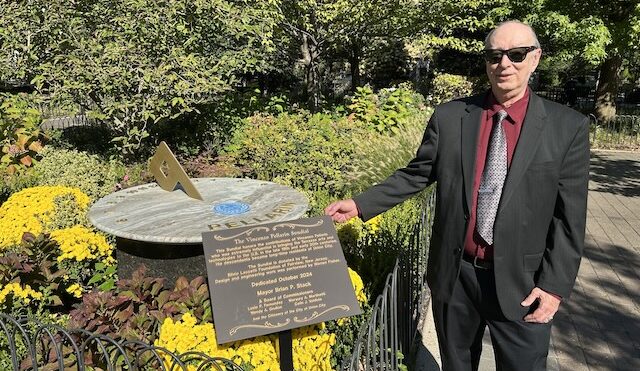
A retired university professor, Silvio Laccetti created a foundation to support educational and cultural initiatives, and to inspire others to do the same.
The nonprofit Silvio Laccetti Foundation recognizes individuals and schools in a variety of academic areas and gives out unique donations like public statues.
One of its awards, named after Italian general Giuseppe Garibaldi, honors high school seniors who have excelled in promoting the Italian-American legacy. There are also awards in classical studies, STEM, sportsmanship and leadership.
The man behind the enterprise, Silvio Laccetti, taught history and social sciences at Stevens Institute of Technology in Hoboken, New Jersey, until his retirement in 2008. He is a retired syndicated national columnist and holds bachelor’s, master’s and doctoral degrees from Columbia University.
Laccetti talks to Fra Noi about his drive to establish the foundation, its contributions and how he manages to self-fund the initiative.
ELENA FERRARIN: Tell us about your Italian heritage. Where did your family come from?
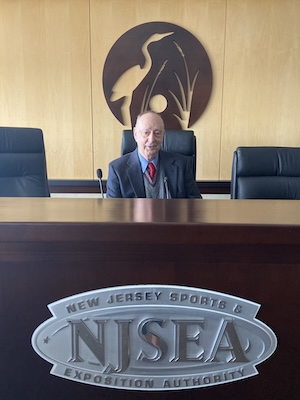
SILVIO LACCETTI: I grew up in Fairview, New Jersey, in the late 1940s through 1960s. At that time, the town had a large Italian-American population and one of the first Italian-American mayors in the country. My family came from the Naples area on my mother’s side (San Gennaro) and Abruzzo on my father’s (Vasto).
EF: What does your Italian identity mean to you?
SL: My Italian identity is a major component of my public and private persona. I have always been proud of my heritage. This became especially true upon entering college, when I left behind the Italian-American community I lived in. I proudly wore my most unusual name in all circumstances thereafter.
EF: Why did you want to become a teacher?
SL: I was a science/engineering major who loved historical studies, and eventually I switched my major to history. After graduation, I considered going to law school (I had a full scholarship to do so) but decided to pursue doctoral studies in history. A teaching career was the most usual path for such a course of studies.
EF: What was your philosophy about teaching?
SL: My aim was not so much to impart knowledge, but to present knowledge to students in a challenging format through which they could learn and grow in personal terms. My teaching was as much about the individual students as it was about covering course material.
EF: Did you ever hold other school roles?
SL: At various times, I was a faculty advisor to a fraternity, the director of the hockey program and nascent swimming program. More importantly, I had a significant work-study program in which students worked in various grant-funded programs aimed at ameliorating urban problems in the area. Additionally, when I became a national columnist, I offered joint authorship to students who had the skills to write editorials. A number of these articles addressed Italian-American issues.
EF: Where did the idea of creating the foundation come from?
SL: As I approached my retirement, I considered various avenues through which I could continue my work as an “advocate.” Creating an educational foundation seemed to maximize my opportunities and afford me the widest scope of activity. After long consideration and planning, when the time was ready and finances were in place, I established the Silvio Laccetti Foundation in 2016 as a nonprofit 501(c)(3) entity.
EF: Why not just support an existing one? It must have been a lot of work to create one from scratch.
SL: My foundation could become involved in many areas related to my special interests. Other foundations had their own, sometimes narrower, missions. And I like to be independent. Creating the foundation did require lots of effort, but I was ably assisted by my original trustees, and others who contributed time and specialized skills.
EF: How do you manage to self-fund the foundation on a teacher’s salary?
SL: True, a teacher’s salary is not a hefty one. However, I owe my good fortune to the wise investments made by TIAA (Teachers Insurance and Annuity Association of America), the teachers’ pension association, which took full advantage of stock market rises in the 1980s, 1990s and the 21st century. Also, my foundation is fairly modest. You don’t need hundreds of thousands to do good!
EF: What kind of awards do you give?
SL: Over the years, we have given between 70 and 80 awards. Most are in the form of original art plaques; some have been grants of money. Other awards have been very costly, such as a statue donated to Original Little League in Williamsport, Pennsylvania. We seek to work with entities that can support the goals of our projects. We found a valuable partner in the Garibaldi Meucci Museum of Staten Island for the Garibaldi Award. In all our programs, especially the WorldCast program, we worked very closely with the education attaché at the Italian consulate in New York City. We also enjoyed good public relations from local newspapers and Italian-American oriented publications. From time to time, the New York Giants joined us in giving out sports leadership awards.
EF: What is WorldCast?
SL: It is a global environmental seminar for high school students, and the program I am most proud of. We ran four extremely successful events, the one in 2023 having been the absolute best in my opinion. It was broadcast live across the world, and students and parents were thrilled and nervous to take part.
EF: The foundation also gives out unique donations, like a sculpted flag made of rare woods for the township of Parsippany, New Jersey. How did this come about?
SL: One of my trustees is an excellent woodworker whose pieces have been featured in advertisements and museums. I asked him about creating a flag in wood to donate to his township, and he eagerly took up the challenge.
EF: It also donated the 4-foot marble sundial at Ellsworth Park in Union City as a tribute to 20th century artist Vincenzo Pellarin, who introduced terrazzo and mosaic art to the United States. Why did you choose Pellarin?
SL: One of my college friends was John Pellarin, whose family had a terrazzo and mosaic establishment in Italy and Belgium. In doing some research I discovered how important his family was in the international history of mosaics and terrazzo. His grandfather was a historical personage. All this came after the death of my friend, while I was seeking a way to pay tribute to him. His grandfather Vincenzo was a historical personage.
EF: What are your future projects?
SL: One more flag, for the 250th anniversary of the United States, destination unknown as of now; several more sundials; and other awards to high school students, as we learn of special accomplishments. My philosophy with what I do, generally, is to set an example. I am just one person and my hope is that larger groups and organizations can implement on a wider scale. That’s why I do the things I do.
The above article appears in the March 2026 issue of the print version of Fra Noi. Our gorgeous, monthly magazine contains a veritable feast of news and views, profiles and features, entertainment and culture.
To view a sample copy, click here.
To subscribe, click here.