 Fra Noi Embrace Your Inner Italian


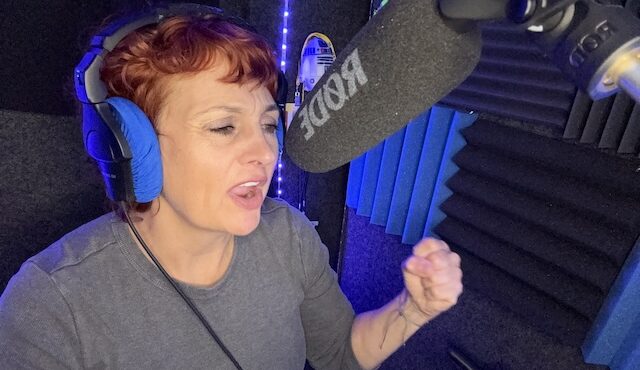
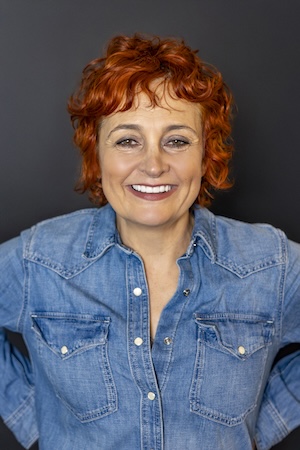
A veteran actor of stage and screen, Susan Vinciotti Bonito has made a name for herself in the burgeoning world of audiobooks.
Growing up in Italy, Susan Vinciotti Bonito dreamed of becoming an actor but decided to study economics to please her father. Then, in the late 1980s, she decided to pursue her passion.
Vinciotti Bonito now lives with her husband and son in Santa Monica, California, where she works out of her broadcast-quality studio voicing characters for audiobooks, video games and commercials.
Her narration of Jhumpa Lahiri’s novel “Whereabouts” earned her an AudioFile Magazine Earphones Award in 2021. She is also a theater, film and TV actor.
Vinciotti Bonito talks to Fra Noi about her craft and what it takes to find success as a narrator.
EF: What prompted the move to Los Angeles?
SVB: While at university in Venice, I found myself questioning my future. I had to make a difficult choice: remain in business school, enduring each moment without passion, or take a bold step toward my dream of studying theater and becoming an actor. I decided to listen to my heart. I began researching acting coaches in Los Angeles, which led me to the Stella Adler Conservatory of Acting.
EF: Did you always want to be an actor?
 SVB: Yes, since I was a little girl. What really inspired me was seeing a production of “The Tempest” with Vittorio Gassman at the Piccolo Teatro di Milano during a school trip. I was hooked. I was in my first play at age 11, and I felt very comfortable and at home under the stage lights.
EF: You co-founded Orpheus Theatre Group with fellow alumni of the Stella Adler Academy of Acting. Which productions are you especially proud of?
SVB: It was the early ‘90s and my fellow actor friends and I practically lived at the theater. We couldn’t get enough of working on the great playwrights like Tennessee Williams, Anton Checkov, Ibsen, etc., so we started producing our own shows, built sets, made our costumes and props. I have very fond memories of our productions of Anton Checkov’s “The Seagull” and “The Three Sisters,” but every show was special in different ways.
EF: Do you have a preferred language between English and Italian?
SVB: I think in both languages, but the process is so fluid that I often don’t realize which language I’m actually thinking in. If I’m upset about something, I instinctively revert to speaking Italian, to which I am connected on a deeply visceral level.
EF: How does one become successful at audiobook narration?
SVB: Success as a narrator doesn’t follow a set formula, but strong acting skills are essential. Many top narrators come from theater or film and excel at portraying unique characters and conveying their emotions while staying true to the author’s intent. In today’s industry, most narrators are expected to record from home, so you have to invest in a home studio with high quality gear. You also have to be able to learn the basic audio editing software, so you can deliver audio that is clear, with no background noise, and edit out mistakes. You have to practice, practice, practice. Read aloud every day, take workshops and invest in one-on-one coaching. A successful narrator has to also run his own small business, connect with audiobook production companies and publishers to audition for their roster. Networking is key, so joining professional organizations like APA (Audio Publishers Association) and PANA (Professional Audiobook Narrators Association) are very helpful.
EF: What are some of the challenges of the trade?
SVB: The biggest challenge is maintaining the stamina needed to narrate for several hours straight. I often compare it to running a marathon. Audiobooks can take many hours of focused performance, so you must have both vocal and mental stamina to get through long recording sessions. The increased use of AI is threatening our entire voiceover industry. Luckily, for listeners who value a nuanced, heartfelt performed story, the human narrator remains the best option.
SVB: You won an AudioFile Earphones Award for Jhumpa Lahiri’s novel “Whereabouts.” What was special about that narration?
SVB: I felt an immediate connection with the story of the main character: a woman questioning her place in the world, in an unnamed Italian city, and the feeling of estrangement in her own town. I’ve felt the same way when visiting my hometown after being away for several years.
EF: Would you ever want to narrate an audiobook in Italian?
SVB: I’d love to narrate an entire book in Italian. I’m extremely proud of “The Letter Carrier” audiobook because it has multiple characters with dialogue both in English and Italian, with some French spoken by the main protagonist.
EF: Which do you prefer for acting — theater, film or TV — and why?
SVB: Theater was my first love and always will be. The excitement I get from performing for a live audience, the uniqueness of each show, the fact that there are no second takes like in film make it truly special.
EF: Which acting roles are you especially proud of?
SVB: I have just completed postproduction on a short film titled “Flora” that I directed over the course of three weeks in Sweden last year. It is produced by Film i Dalarna and Linda Hunter, who also wrote the script. I played a few small roles while mainly concentrating on directing my first film. I take great pride in the film, as it explores what it means to become an artist through Flora’s journey as the central character. We are now in the process of submitting to festivals in both Europe and the United States.
EF: Do you still act?
SVB: Yes, I act on stage or on camera whenever I can. Voice acting is fundamentally a form of acting specializing on only using your voice, which makes it even more challenging. You need to capture emotional truth, but in a more intimate and controlled setting.
EF: You have also voiced for video games. What is that like? Anything that was especially fun?
VB: I absolutely love video games because the characters are epic and the stakes are usually very high. I had a blast playing Vesta, a military commander in World War Z: Aftermath Rome, who leads troops in missions to fight hordes of zombies through sites like the Colosseum and Vatican City.
EF: You have also voiced for commercials. Anything that readers might recognize?
SVB: I’ve done spots for St. Germain/Bacardi, Acuvue, Panzanella and Maison Yoshiki at Milano Fashion Week, among others.
EF: Tell us about your memoir.
SVB: I’m working on a memoir about my life growing up in Italy with my father. It’s a coming-of-age story set in Milan during a time of historical upheaval heightened by the assassination of Former Italian Prime Minister Aldo Moro in 1978. A complex political climate that mirrors the difficult, yet loving, relationship I had with my father.
The above article appears in the February 2026 issue of the print version of Fra Noi. Our gorgeous, monthly magazine contains a veritable feast of news and views, profiles and features, entertainment and culture.
To view a sample copy, click here.
To subscribe, click here.