 Fra Noi Embrace Your Inner Italian


It has been years since I had a daily newspaper delivered to my house. I stopped it because A) I would have a week’s worth of papers that hadn’t been read, which made the entire exercise futile; B) I don’t care what happens in the Chicago City Council, since I don’t live in Chicago; and C) I find out most news on social media as it happens, rather than wait until the next day.
My dad thought he was scooping the news organizations and Facebook when he would call me to tell me about the latest event. I had a hard time breaking to him that I knew about it several days ago. But he was not a creature of social media, so he thought he knew something I didn’t know.
The one thing I thought I would miss in the paper was the death notice section. I have a huge number of distant relatives in Chicagoland and around the country, and I am not closely related enough to be directly notified when a distant relative passes away. The only way I would find out would be in the paper.
But as with just about everything else, things change and not always for the better.
Many areas of social interaction have changed in the past few years or decades, and you should keep these changes in mind when looking for old Zia Francesca. I find out about some distant relatives who pass away via Facebook. Most elderly people don’t use Facebook themselves. When they get too old to contact people the old-fashioned ways (letter, phone call, Christmas card) we lose touch sometimes. Then we get surprised when we find out the person passed three years ago. If we stay in touch on Facebook with their children or grandchildren, most likely one of them will post something about their loss. Or a few years later, they’ll post about a “Heavenly Birthday” and you didn’t know the person was gone.
What are these changes? Let’s review.
- Families lived closer to each other in “the good ol’ days.” When someone passed away, frequently all close relatives lived nearby, or even in the same building. I noticed that very few Italians were in Chicago newspaper death notices until after World War II. They rarely had to reach out to distant suburbs to let everyone know. Wakes lasted 2-3 days and people had time to travel to town if they heard about a passing.
- As people moved to the suburbs, it was harder to reach everyone, so the newspaper notice was a good way. The “so sorry I forgot to call you to tell you, but we were so busy” excuse, while perfectly valid, could be avoided by posting a notice in the major newspapers.
- When the internet became more common, you could send a “blast” e-mail to your entire address list, to avoid “I forgot you. I’m so sorry.” As a result, a bunch of strangers were notified who never met the person, but that was better than forgetting someone.
- Thanks to internet and social media becoming more common, many people did as I did and canceled their newspaper subscriptions, so costs went up, especially for posting death notices. The funeral homes started to set up websites in the 2000s to make a memorial page for the departed, which would then contain an obituary. This memorial page did a few things.
- First, you had to Google the person to find the right funeral home. How would you know, since no one reached out to tell you in the first place?
- Since the family didn’t have to pay by the word, they could write a nice biography of their loved one, which might have a lot more detail than the usual newspaper list of surviving relatives. “Pop-pop loved sailing and would take his grandsons out on the lake whenever he could.” “Nonna made the world’s best lasagna. No contest! If you want the recipe, you have to come to the wake!”
- People posted a lot of photos, hopefully. I lost a cousin in Alaska, and was able to add a bunch of photos to my collection. Frequently you could download the photo slide show that was used at the wake but would also be posted on-line.
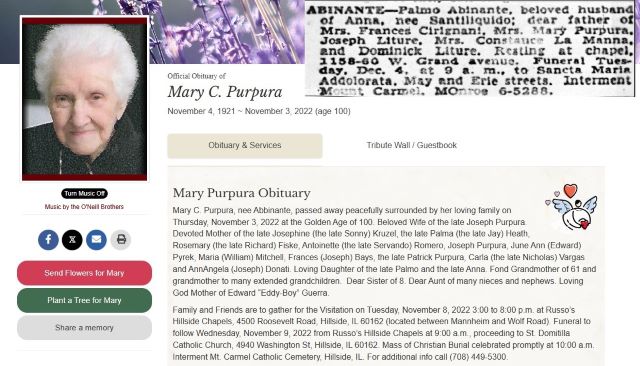
- The funeral home memorial page frequently shows both the dates of birth and death, so you can use the date of birth to be sure you have the correct Vito Russo, and you can enter the correct date of death in your computer even though you would have to wait at least 25 years to order a copy of the death certificate. $17 to get the date exactly right!
- Even before COVID made the wake difficult to have, costs for wakes went up also, which made the three-day 3 p.m to 9pm wake replaced by the one-night-only wake, or even the “morning of the funeral” wake.
- Up to Vatican II, Catholics were forbidden to cremate. It took some time after the 1960s before the older folks were gone and their children started to be cremated. This reduced costs, helped the environment, and sometimes it eliminated the wake. Some people will wake first, then cremate, but not everyone. If they chose to cremate without a wake, they could schedule a memorial service or dinner at a later date when it wasn’t snowing so much.
- It is more difficult to visit the final resting place of someone who has been cremated. The family can choose to keep the urn at home. They can scatter the ashes in the lake or on the 18th hole of his favorite golf course. The only way to find out is to either look in the Catholic Cemetery web site (www.catholiccemeterieschicago.org) or ask the surviving family, which is not easy to do when they just lost someone.
- Again, COVID did not make this the standard, but many people have eliminated the wake altogether. Maybe a short service at the cemetery and lunch and that’s that.
- In the old days, people frequently went to the cemetery, to the exact grave site, and watched the casket lowered into the ground. I honestly cannot remember the last time I went to a funeral and saw the casket lowered. It is almost always a couple of prayers at the cemetery chapel. The death notices and memorial pages very frequently conclude with “Interment private,” which is a perfectly valid wish of the family, but it prevents the rest of us from knowing which cemetery to visit later on.
- If the family is less religious than they used to be, they might not choose to put their loved one in the usual cemeteries where the rest of the family is.
I use death notices and obituaries as a tool to construct complete families in my tree. Not every notice is complete, however.
Some people choose to only list survivors rather than the ten deceased siblings and their deceased spouses.
Not to put too fine a point on it, but sometimes the death notice or memorial page is a place people use to get careful revenge against that one sibling nobody talks to, by omitting them from the list of relatives. A former spouse who left the family? I understand that one, and sometimes the former spouse is listed if the split was amicable. (It is tough to find the later married surnames of women who divorced your relative and remarried.)
Most people do not list parents of an elderly deceased person. Those parents might have died decades earlier. My great-grand-aunt “Zi Zi Deline” who was the baby of her family, died at 89 and her funeral home “mass card” was replaced by a folded card with a full biography listing her three deceased spouses, her deceased son, and her long-deceased parents!
In order to be sure I have the right person, I like to search for both husband and wife on the same Google search. However, sometimes the wife’s maiden name is omitted, which means that when you search for “Vito Russo Anna Angiuli” and they leave off the “Angiuli” you might have the wrong Vito Russo. Some other Vito married to some other Anna. Nothing is worse than calling Anna to express your condolences and she says “oh, he’s right here” and hands Vito the phone!
If you know the names of the kids, you have a better chance of being 100% sure. Sometimes I try to search “Vito Russo Anna Johnson Theodopolous Tenerelli Schwartz” to only find Vito Russo whose daughters used those married surnames. In the modern era when divorce is more common, and people remarry or change back to the maiden surname, you might get some wrong. But if you get 3 out of 4 married surnames, you’ll probably have the right Vito. If they all divorced and changed their names, you’ll probably not find his notice.
One final tip is that if you find a notice or memorial page, please save it to your computer. There is no guarantee these pages will be out there in ten years. If the funeral home closes (that doesn’t happen often but we don’t know) or they move old memorial pages off the site, we might lose access to that great bio of Pop-Pop.