 Fra Noi Embrace Your Inner Italian


There are normal, obvious places we can go, to improve our genealogy skills and to find information to advance our research. We have the many websitess that I talk about all the time, and you don’t even have to leave your house! Those same sites may have additional data if you travel to a FamilySearch Center. (formerly known as a Family History Center. Don’t ask me why they changed the name!) You can try to find other researchers on FamilySearch in the Tree who are working on your town(s) or families. You can try to find researchers on social media who might be more experienced. You can visit living relatives and learn about relatives who are no longer with us. You can visit the cemetery to find dates on the gravestones. You can join genealogy groups in the area and attend meetings to find out the latest techniques and methods. All of these are typically local and within driving distance.
Not everyone will be willing to hop an airplane or ride a Metra for eight hours to add to their skill set, but for those of you who have run out of ideas, or if you just want to learn other genealogical things that you don’t think you need, there are large national conferences that draw thousands of attendees and hundreds of vendors hawking genealogical websites, books, maps and many other items you never thought of.
You might have attended a small conference with several local speakers, a box lunch, and people you know. If you have ever been to a huge business conference at McCormick Place, for example, imagine that, but with nothing but genealogy vendors and speakers. It’s a much bigger scale and can be overwhelming the first time.
There used to be more national conferences in the past. 9-11 hurt that business, particularly because a national conference was all set to start the following week, and many of the speakers couldn’t fly in due to the air restrictions of that week. Covid didn’t help either. But there are some different choices of conferences and locations that are worth a little time researching whether you ought to go.
Keep in mind that some of these conferences now offer Zoom video of the presentations, and this is very convenient for those who are not able to travel during the week of the conference, or not willing or able to spend the money on the trip. You can experience some of the presentations without the hassle of travel, but you miss out on interacting with other attendees and asking in-person questions of the presenters. It’s just not the same. Also, some presenters, usually the most well-known, do not permit Zoom or video of their presentations to protect their ability to present the same content at other conferences. Unless you attend in-person, you won’t be able to see the “best of the best”.
Each conference has a specific focus, which may or may not be the type of research you are doing. For example, a conference in southern Illinois may be subtitled “Migration to California”. This does not mean that all the speakers are talking about migration, but they will work to get the people who have written books on the subject to all be at this conference, and those who can’t find their great-great-grandfather who disappeared from Peoria and never died, can attend this conference with the knowledge that the people who know most about this topic can give them some help. “The people from Peoria in the 1850s who left the area either went west to California to find gold, or maybe went to Salt Lake City to join a Mormon group there.” “Oh, I never thought of that!” However, be assured that no large-scale conference will have ONLY one topic. If they do, then maybe you want to skip that one if you have no one who migrated from Peoria to California in the 1850s.
The format of these conferences is typically the same, even if the content is very different. You will receive a booklet with a schedule (or there will be an app on your phone with the schedule on it). There will be a keynote address in a large hall, meant to be viewed by everyone. These are usually more general and not too specific on research methodology. “Our genealogy resources are growing bigger than ever!” might be a keynote topic. Frequently there is an announcement of some new websites update or some new product that will revolutionize the genealogy industry. After that, there might be five, ten or more different classrooms with different presenters and topics. The biggest hassle of the entire experience is that you have to choose which one you want to see. Use the app to decide which presentation can be viewed from home after the conference, and which other one(s) cannot, and choose accordingly so you can see both on different days/times. These conferences rarely ever have the same presenter with the same topic more than once at the conference, so you either have to go in person, or you have to watch the video later on.
There might be 2-3 sessions (with five or ten or more in different rooms) from morning until lunch. Conferences almost always have food vendors on-site, and local options for those who want to get something else to eat. Then there might be 2-3 more presentations after lunch. I will tell you here and now that you will be exhausted by having presentations all day.
Then there is day two or even day three of the same conference!
Once in a while, there will be a point in the schedule where you do not want to see any of the ten presentations going on between 10am and 11am that day. You can go visit the “Exhibit Hall” where the vendors are. It’s a giant flea market of nothing but genealogy stuff! Huge vendor booths for the major websites. There are many smaller booths of book sellers, antique map sellers, t-shirt and coffee mug sellers. (“Genealogy: Playing Hide and Seek with Dead People!”) This is not only a place to buy that genealogy t-shirt you always wanted (and at a “show discount” price) but you can go to the booth for the software you use, and talk to their people one-on-one. I have been able to get several websitess to make improvements based on my suggestions. Given how difficult it is to reach a human on a tech support phone call these days, the conference is a great way to avoid the AI phone system and talk to someone who knows what you’re talking about. There are also some of the booths that have small presentations for 10-20 people every hour, mostly to promote their products.
So now that I sold you on attending, where can you find these conferences? Each conference is either A) always in Salt Lake City, or B) in a different city every year. You can check their websites to see when their conference will be not too far from where you live, if you want to plan it that way. If the conference is in a city with a major genealogy library (SLC, Fort Wayne Indiana etc.) you can go to those libraries to do some research after the presentations are done for the day, or stay an extra day after the conference is over. It can be tempting to go the library while the conference is going on, but I do not recommend it. You paid for the conference, and you should attend everything you can to get full value. You can always go to the Allen County Public Library in Fort Wayne when there is no conference going on, if you’re going there to do research on your own.
Each conference is at a large site with a bunch of rooms, and the conference organizers try to guess how many people want to see the speaker or the topic in question. They schedule that session in a room that holds 100 people, and when you register, you need to give them a clue which sessions you think you might attend. (They do not hold you to this plan, but they use it to estimate.) When they find out they have 425 people who want to see this session in person, they might change rooms before the conference starts so they can accommodate everyone.
Are these conferences free? Maybe if you only register “on-line”. If you cannot travel to the conference, you can register for only the on-line sessions, which is still a great deal. You can see dozens of presentations on your own time, and if you’re profoundly bored, you can turn it off and the speaker will not be offended that you walked out! However, for the right to see the presentations that are only “in-person” and the exhibit hall etc, conferences can have a registration fee, but its usually well worth it.
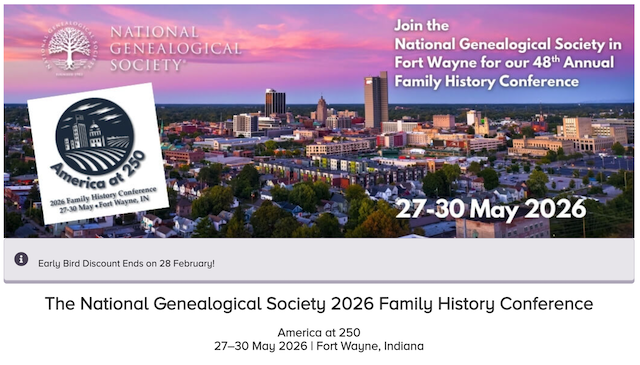
One good place to look is www.ngsgenealogy.org. NGS is the National Genealogical Society and they draw many of the best speakers from around the US and the rest of the world. They have an annual conference just like I described above. The 2026 conference is in Fort Wayne Indiana May 27-30. It looks like the 2027 conference is in Madison Wisconsin.
Another excellent conference is RootsTech, which is held every year in Salt Lake City. www.familysearch.org/en/rootstech/registration This year is scheduled from March 5-7. RootsTech is centered on technology uses for genealogy and has become the largest genealogy conference in the US. If RootsTech has concluded by the time you read this, there will hopefully be another column about my experience there. There is a lot of overlap between NGS and RootsTech, so you can find out research techniques that have nothing to do with websitess. Some people are perfectly happy to go to a library or an archive and look at papers by hand. Nothing wrong with that. Many sources have never been published on the internet.
Please be advised that most presenters do not want you to video or audio record their presentations, so don’t count on recording them, and viewing it again later. If a presenter says that its ok to record, fine. Most are very picky about this.
You will have a syllabus (either on-line or a paper copy) with notes of what they teach. I used my phone to type notes of what I learned that was particularly important, so I remember to try when I get home.
I highly recommend that you attend 1-2 sessions that have NOTHING to do with what you are researching. Obviously I focus 99% on Italian genealogy. But I do have relatives in parts of the US that I don’t know much about. Then there are places like Germany and Wales that I have not one person born there in my entire tree. I wouldn’t miss a critical session on something I specifically need help with, but if there’s nothing else to do, go to a session on Peoria Migration to the West. No matter what else happens at the conference, you will have learned something.
If all this is too daunting, I suggest you find a local conference on a smaller scale. You can drive there. There will be 4 or 5 speakers who are very knowledgeable. You might run into your “genealogy peeps” who are also attending. It will probably cost a lot less unless they flew speakers in from across the country. And you still might learn something. There will be a few tables of genealogy societies and a couple of t-shirt and coffee mug vendors, but none of the major websites developers will be in the exhibit hall.
To find out more about these smaller conferences, go to the facebook page for local genealogy groups in the area and “Like” them even if you’re not a member and you don’t attend meetings. You will then get word about the conferences they recommend.
If you decide to go to one of the big Nationals, see if you have any researchers you know who are also going. When I went two years ago, I met up with a half-dozen fellow Illinoisans and we actually split the schedule up between us. “Dan if you go to the Scottish Research, I’ll go to the Peoria Migration, and Pat can go to the FamilySearch Wiki talk.” Then we would meet after and exchange notes on what we learned. And you’ll always have someone to eat lunch with. If the tables are “public” and you have to share with strangers, that’s a great way to meet people. I have friends from all over the country that have nothing in common with me except that we go to genealogy conferences!
Send any questions to Dan at d.niemiec@comcast.net and please put “Fra Noi” in the subject.