 Fra Noi Embrace Your Inner Italian


Not everybody wants to spend 30 years trying to take their family tree back to Adam and Eve. Or Vito and Nunzia.
After spending 30 plus years doing this, I understand how they feel. I feel the same way about taking up a musical instrument. I’ll never be good enough or have time to learn enough to be any good at it, so why put all that time and energy into it.
I know plenty of people who simply don’t care about family that they never met, or about their ancestral history. Despite how close-knit Italian families typically are, I know friends who happen to be Italian who don’t know what town or province their ancestors came from, and they just aren’t interested.
That’s a shame.
If you don’t know how to do something, it is human nature to think that it’s incredibly difficult to do, therefore stick to the things already well known. I’m guilty of this mindset too. But the point of all this is to say that thanks to Italian records available and indexed on the internet, you don’t have to be a 30-year veteran to get your family tree back a few generations. Not everyone will get bit by the bug and keep going, but you can learn a lot in a short period of time.
I have frequently told you in these columns that you need a blank genealogy chart that looks like the NCAA Sweet 16. If you’re feeling ambitious, get one with 64 spots for your ancestors. Just google “blank ancestry chart” and choose a chart that looks good to you. Save it, in case you need to start over. Print it, so you can write on it when you find something. It is important to have an up-to-the-minute list of what you have found, so you don’t get confused.
Fill in what you know. Naturally parents, grandparents, and great-grandparents if you know their names. If you don’t, that’s ok. If there’s a nasty bad ancestor who left your family and no one knows anything about them, that’s ok too. Do what you can.
All I want to discuss today is the task of tracing the ancestry back as far as the records will allow you, without leaving your laptop. Some of you may not get far, if there are not many records available from your area in Italy. You’ll find that soon enough.
You need to know where to find specific types of vital information that will help you get the next set of parents. Let’s say that you never met your grandparents, because they never came to America. How do you find their names?
If your parents are still living, just ask them. Simple. If your parents are deceased, you ought to have their parents’ names on a death certificate. What about their parents?
The parents of the bride and groom, including maiden names, are always listed on an Italian marriage record. Hopefully by going back that far, you’re looking for Italian records.
Not every record that exists has been indexed, but the best thing to do is give it a try. Search for the marriage of your grandparents, for example, by doing the following:
1.Log into www.familysearch.org
2.Click Search, then click Records
3.In the box to the right, click “More Options”

4.Click “Type” then click the box next to “Marriage”.
5.In the name at the top, type the groom’s first and last names.
6.Click “Spouse” and type the first and maiden last name of the bride.
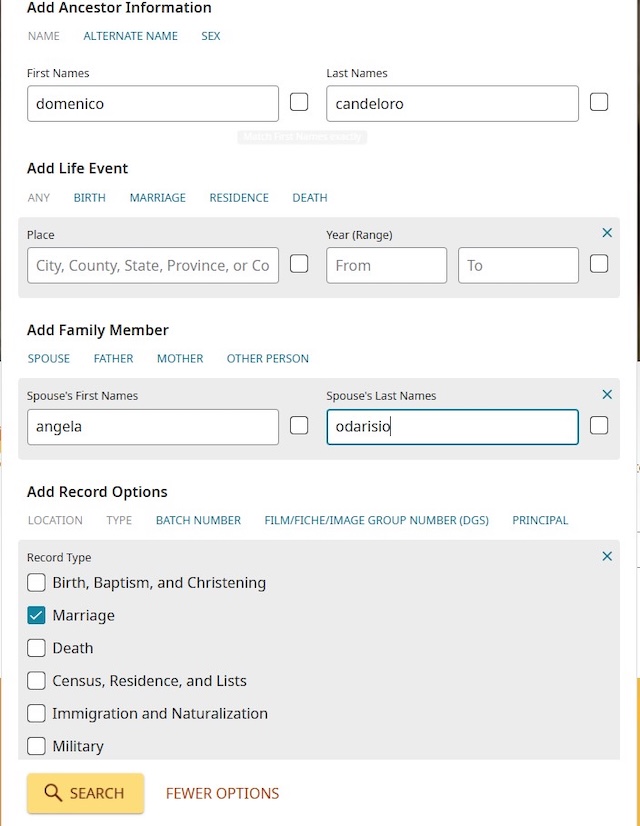
7.Click “Search”. You might get zero hits. You might get 47,312 hits.
a.If you get zero hits, replace some of the vowels in the names with ? wild card.
b.If you get 47,312 hits, click on “Marriage” under Add Life Event, and enter a town, province, or region if you know them. You can also put a range of marriage years that make sense. When were your aunts and uncles born? Pick some years prior to those births if you can.
8.If you have less than 100 hits, you can scan and find the couple you are looking for.

9.Click the down arrow by “Document Information” to show the digital folder number and image number.


10.Click the name underlined to see the record detail screen. Do a screen shot by holding the Windows key and pressing “PrtScn”

11.Even if you cannot view the image, the index shows you parents names of both the groom and the bride, which gives you four more ancestors than you had before.
12.Repeat this procedure for any other ancestor couple you have.
This seems like it goes forever, but eventually you will not be able to find the marriage of ancestor couples. It might be before there are civil records. It might be that they never indexed the records. That’s ok. Do the best you can. It’s not a contest.
As you write the names of these couples on your blank chart, you’ll have a list of all the ancestor couples you can find on the first go-around. Now, you should try to find the details about those families.
For each couple on your chart, do the following similar procedure:
1.Familysearch.org. “Search” “Records” “More Options” just like before
2.Click “Type” and select “Birth” and “Death” (If you’re feeling lucky, click “Marriage” too.)
3.Leave the first and last name blank.
4.Under “Add Family Member”, click “Father” and type in his first and last names.
5.Click “Mother” and type in her first and maiden last names.
6.Click “Search” and see what happens.
7.Again, you might get zero hits, or 83,209 hits.
a.If you get zero hits, change some vowels to “?” wild cards.
b.If you get too many hits, click the boxes next to their names, so you only get exact results.
8.Look at the search results. You can see those that make sense because they are from the right town, or the right range of years. If you’re looking for the children of a couple who married in 1899, and you find the same couple but the kids were born in the 1820s and 1830s, then it’s not the right couple and those kids don’t belong.
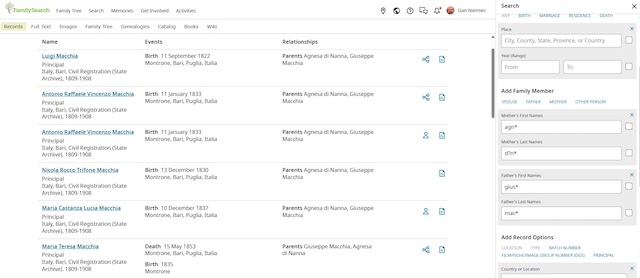
9.For each search result that has the right parents and the year makes sense, click the to see the detail screen.
10.Click the down arrow by “Document Information” to show the digital folder number and image number.
11.Take your screen shot. (These can be found in the Captures or Screenshots folder on your computer.)
12.If FamilySearch will allow you to view the image, click on the thumbnail image

If you cannot view the image itself, you may have to go to Antenati (www.antenati.cultura.gov.it) and find it there. Many Italian records are indexed on FamilySearch but can only be viewed on Antenati due to contractual agreements.
I will never ask you to skip looking at the actual records and just rely on the index, but now that the index has millions of additional records, you can do a lot more without becoming an Italian language expert. After you build the basic tree, you can go back to the Italian civil records and get more details and fill in the dates of birth, marriage and death.
Some of you might remember that I have done columns before about getting started with a basic tree, but it is so much easier to use the indexes.
See my earlier columns at franoi.com/roots for tips on working with wild cards if you find too many or too few search results (hits).