 Fra Noi Embrace Your Inner Italian


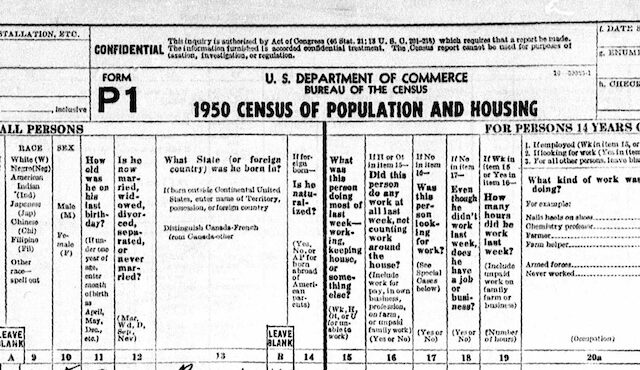
There are two events that take place every ten years. The first one is that I get the chance to finally take a nap! The other is the United States Federal Census.
The Census is used to measure how many people are in each area of the country, and then to divvy up the federal funds to do the most good. The Constitution requires it, and a census has been done every ten years since 1790.
U.S. Census records contain many pieces of data that help us, and there are many problems. We can find out the country of birth of the members of a family, which is important to track down birth records for the Italian-born siblings by looking in the right country. When you see the fourth sibling born in Illinois, you can tell that between child 3 and child 4, the family left Italy to come to America.
Census records cannot be 100% accurate or complete for many reasons. When people were at work, neighbors or other tenants in their building would give info to the census takers, and it might be very inaccurate. Families might have been missed altogether. Children who were born in 1901 and died in 1909, for example, never appear in the federal census at all. Lastly, if the census taker was not fluent in the language of the people in that neighborhood, the spelling of the names might be way off, to say the least. The census bureau did try to get bi-lingual census takers to work every ten years, but they couldn’t always find qualified people.
The early census records, from 1790-1840 don’t tell us very much. It records the name of the head of household, and a count of the number of adult males, females, children, and slaves. If you had family in the US during those early years, you may never get a list of all children of that family.
Once the census was 1850 to the present, every name was supposed to be recorded, so there are no more counts like before. Each person who was counted is identified by name, age, sex, color, profession, birthplace, handicaps, and of course their street address.
Let’s cover a few of these:
– The age is in years, unless it is a baby under the age of one year. Only 1900 lists the month and year of birth, and these are often wrong. The ages are often wrong too!
– The birthplace only shows the US state of birth, not the town. It also only shows the nation of birth, if not born in the US. So do NOT expect to find the tiny town of birth in Italy, or even the province or region. You’ll find “Italy”, “Illinois” or wherever else they came from. Naturally if you have relatives born in various areas of Europe that changed hands, such as Poland, you might have the same person born in Poland in one census and Germany in another.
– In order for the US government to know how to allocate resources, they needed to know who was blind, deaf, insane or “idiotic”. Sorry but those were the terms back in that less-enlightened era.
Anyone who has done genealogy for more than a year or two is aware of the great fire….not of 1871….the fire of 1921 that destroyed the entire 1890 US Census. A few scraps exist but if you want to hear 10,000 genealogists groan all at the same time, mention the year “1890”!
Each census asks different questions, usually because of events of the previous ten years. Due to the number of immigrants coming through New York and many other ports in the 1900-1909 era, the 1910 census asked more detail about the number of years in the US etc. The 1930 census asked if the person owned a radio, which practically no one owned in 1920. Maybe Marconi!
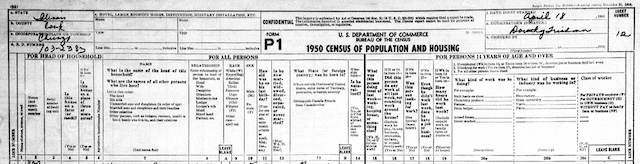
Though the census was taken right through 2020, we are not allowed to see anything from 1960 to date. The latest US Census available for our research in 1950, due to a law restricting release of the census for 72 years to protect privacy. Yes, if YOU were born before April 1st, 1950, you are probably in a census record and you can find it on-line.
If you want to learn from the census, you should try to find each family you want to learn about, and find them in each census that makes sense. My parents were born in the 1930s so they are in the 1950 census as teenagers, 1940 as kids, and neither is in 1930. My grandparents are in the 1930 census as young married couples, 1920 as kids, and only one grandparent was in the 1910 as a small child. The other three grandparents were not in the US yet.
Great grandma Abbinante died in 1949 so she missed 1950, but her husband Palmo barely made it. Use the known dates of arrival in the US, and their death years, to know if they are in that census year. Usually the census was taken in April, so that may decide if a relative was in the census or not. If you unexpectedly find your ancestor in the US and they weren’t supposed to be there, it could mean one of two possibilities. Either you found the wrong person, or you found that your ancestor went back and forth to Italy.
Let’s say you look for the same family in every census and you do not know much yet. My great-grandparents married in Italy in 1907.
1890: census doesn’t exist
1900: No reason to search – they married in 1907.
1910: Palmo was in the US in 1910 working, but I cannot find him in the census. Wife Anna was in Italy with her kids.
1920: Palmo and wife Anna were in the 1920 census on 507 N. Ashland (near Grand Ave.). Children Joseph, Nick, Dominick, Tony, and Frances. Mary wasn’t born yet. They lived in a building with the family of Phil and Maggie Moretti. Maggie (known to our family as Cooma (Comara) Michelin’) ended up being godmother to my Mom, even though I can find no genealogical link between the Moretti’s and Abbinante’s. The census failed to mention that Joseph, Nick and Dominick were born with the surname “Liturri” to my great-grandmother and her first husband. Those kids were never named Abbinante. The census takers were told to count everyone, but they used ditto marks to repeat the surname, so since the head of household was “Abbinante”, all the kids were called “Abbinante” even though the first three were not. If your family has a multiple marriage, and a Brady-bunch family, it may explain why you can’t find some of your relatives as children – check under both surnames.

1930: Palmo and Anna were in the 1930 census with younger children Frances and Mary at 1355 W. Grand Ave. They lived with “cousin” Nick Pompilio aged 57. Nick and Tony died of TB in the 1920s. Dominick and Joe were now married and lived elsewhere.
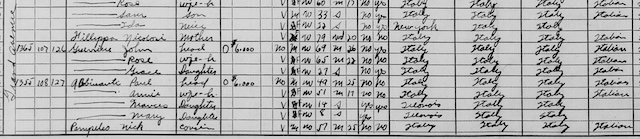
1940: I finally found Palmo Abbinante in the index spelled Ablemutto! And when I see the handwriting, I’m not surprised! There is a little X with a circle around it next to Palmo’s name, which indicated that he was the person who gave the information about the entire family to the census taker. 1940 was the first year they marked the “informant”. This helps us measure the reliability of the information. If the informant was the upstairs tenant, the data on Abbinante might be far less accurate. They are at 1411 W. Grand this time. Frances was on her own and Mary was married to Joseph Purpura who are enumerated with Palmo and Anna. Cousin Nick died in 1933.
Look closely and see that Joseph Purpura’s relationship to the head of household is “sonshgashgsajdg” It should say “son-in-law”. His daughter Josephine should say “Granddaughter” but it says she is the 2 year old daughter of a couple who were 59 and 61 years of age!

1950: Palmo is found in the index under the name Palmo Francesch. No kidding! He is at 1124 S. Richmond. His wife Anna had died in 1949. There are a Greek family and a Russian family in the building. He lived alone on the first floor. The family of Frank and Theresa Leo live in the building, who were in their 20s at the time and are very distantly related to Palmo. I wonder why Palmo wasn’t living with any of his children.

Since I know Palmo died in 1951, and also because the 1960 census won’t be released until 2032, that ends the census of my great-grandparents family.
What have we learned from my one family?
– Names are misspelled in the index so poorly that it was almost impossible to find them. All census records back then were handwritten. The government probably didn’t care too much WHO you were as long as everyone was counted. Census takers were paid by the number of people, to give them incentive to go back and try to find the folks who were missed the first time.
– Some of his children got stuck with their step-father’s surname
– Not in the same address – they moved at least every ten years. They could have moved more frequently, but the census only shows where they lived that one day every ten years.
– Some of the kids were born in Italy and some in Illinois. One child lived for two months in 1918 and thus never appears in a census. One daughter moved from Italy to Illinois, married at 16, and only appears in the census with her husband.
Keep in mind that each census has different questions, so you will need to read the headings at the top of the page to see that one column is “number of years married” and another is “number of marriages” and another is “number of years in USA”.



Now that I told you want you can find, where do you look?
The census is on many genealogy web sites. The most common are the actual census site, data.census.gov, but the easiest to use are good ol’ www.familysearch.org and good ol’ www.ancestry.com. Each one uses a different screen to search, but the keys are:
- Don’t be too picky about the spellings – use wild cards. (Not one Palmo Abbinante turned up even though there were several in the US)
- Don’t be too picky about the age. Use a wide range of birth years unless you get too many search results. Then narrow it down.
- If the site allows it, search for one person and also search a spouse at the same time. Both Familysearch and Ancestry allow this. Then you can try “Palmo” no surname, and spouse “Ann*”. Only couples with both names will show up.
- If you have to use a lot of wild cards, fill in the birthplace with “Italy” or “Illinois” to weed all the Abbotts out of your search for Abbinante.
- In Ancestry, find the census search page before you start.
- In Familysearch, search “Records” and click “Type” and check the box “Census, Residences and lists”. Use “Residence” and limit to “Illinois” or wherever, and the year of that census “1940” through “1940”.
You may find some surprises in the census that will raise new questions. I found a relative born two years before her parent’s marriage. I also found my mother’s mother listed twice. She is with her second husband and their two children at one address, and she is listed with her first married surname, with her six children, at another address! Hint: She wasn’t living with her first set of children, but they told the census taker she lived there so the kids wouldn’t be split up and sent away.
Keep in mind that the on-line indexing on all the sites comes from a computer generated list that was not quite AI but pretty close. This means you might have trouble finding your Ablemutto family……Abbinante!
Good luck – write to me at d.niemiec@comcast.net and please put Fra Noi in the subject.