 Fra Noi Embrace Your Inner Italian


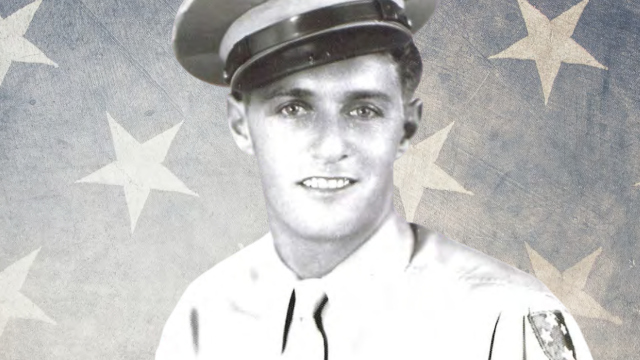
Having lived a sheltered life in the serenity of Veneto and the bustle of Chicago, Natale Cusinato was thrown into the teeth of battle as a member of the U.S. Army’s famed Americal Division during World War II.
Natale Cusinato was born in Chicago in April 1917, the son of Italian immigrants seeking opportunity in America. However, the promise of the American Dream proved difficult to sustain. Struggling with language, cultural barriers and economic hardship, his family eventually returned to Cittadella, a medieval walled city in the province of Padua, about 40 miles west of Venice. There, they lived as farmers, modestly but with resilience. Life centered on hard work, close family bonds and tradition. Compared to the sprawling industrial landscape of Chicago, rural Veneto offered familiarity, if not prosperity.
As war spread across Europe, the Cusinato family faced a defining choice. Because Natale had been born in the United States, he could return to America and avoid conscription into the Italian army. The decision was made, and he was sent back — alone — to an America that was at peace.
Returning to the Chicago that he had left as a small child was difficult. He boarded with an Italian-speaking family and found work at Radio Steel, known for producing the Radio Flyer wagon. He spoke little English, worked steadily and kept to himself.
But the world was moving toward war.
On April 14, 1941 — just one day after his 24th birthday — Cusinato enlisted in the Illinois National Guard. Months later, after the attack on Pearl Harbor, the United States entered the conflict. His new lot in life would see him carried across the Pacific to some of the war’s most unforgiving battlefields, far from the placid farmlands of Veneto or the bustle of Chicago.
Cusinato served as a Private First Class and rifleman in Company K of “The Fighting” 132nd Infantry Regiment. With roots in earlier conflicts, including the Civil War and World War I, the regiment became part of the Americal Division, a rare unit formed overseas from National Guard elements across the country. (America plus New Caledonia, the island in the Pacific where the division was formed, hence Americal.) One must wonder at the mixture of units, with National Guardsmen from Illinois, North Dakota and Massachusetts.)
In December 1942, the division landed on Guadalcanal in the Solomon Islands, the start of America’s first major offensive in the Pacific. It was the same island on which another Italian American, Marine Gunnery Sergeant John Basilone, earned the Medal of Honor earlier in the campaign. Americal was the first U.S. Army ground unit in offensive combat in World War II.
By then, after six months of combat, the fighting had shifted inland to the dense jungle and steep ridges around Mount Austen. The position had to be taken because the Japanese guns on the hill could target the American runway.
The battlefield was disorienting and dangerous. Thick vegetation reduced visibility to just a few yards. The heat was stifling, the terrain uneven and movement slow. Ridges forced units into predictable paths — routes the Japanese had prepared to defend.
Enemy positions were difficult to detect. Japanese troops constructed low bunkers dug into hillsides, reinforced with logs and concealed beneath earth and foliage. From even short distances, they disappeared into the terrain.
Machine guns created interlocking fields of fire, covering likely approaches. Advancing troops could suddenly be pinned down by fire from positions they could barely see.
For riflemen like Cusinato, advance meant moving slowly — sometimes crawling — watching for the smallest sign of danger.
Engagements were often fought at less than 50 yards. Grenades, rifle fire and automatic weapons decided outcomes in seconds.
On Dec. 24, 1942 — Christmas Eve — Cusinato was wounded during one of these assaults on what the Japanese called the Mountain of Blood.
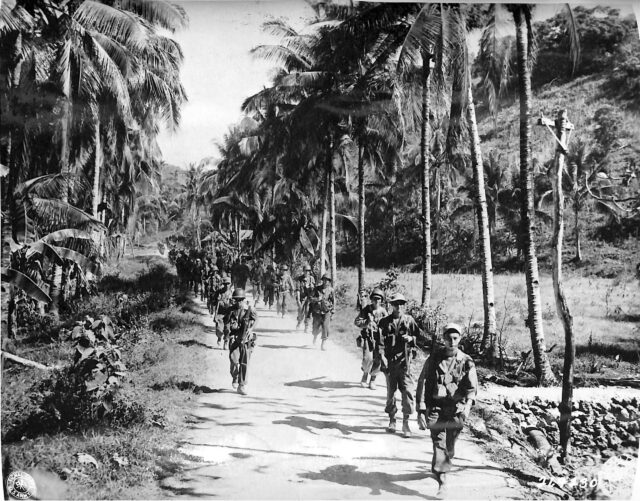
Cusinato’s first name is the Italian word for Christmas, but there was no holiday to mark the day. The jungle echoed with rifle and machine-gun fire, smoke hanging in the humid air. For those on the line, time was measured only in survival.
Wounded, he was evacuated. Guadalcanal had introduced him to the harsh reality of jungle warfare and fanatical resistance.
By 1945, the Americal Division was fighting in the Philippines. On Cebu, the landings were dangerous — beaches were seeded with mines and hidden explosives. Encountering densely packed minefields, the unit lost 10 of its first 15 landing vehicles. Inland, Japanese forces held fortified hill positions that were taken through frontal assaults and flanking maneuvers with naval gunfire support.
During one engagement on April 10, Cusinato was wounded again. Despite the pain, he fought on.
When the gunner next to him was killed, Cusinato stepped in and took up the fallen soldier’s 20-pound Browning Automatic Rifle. Gunners were often primary targets that led to high casualty rates. The heavy weapon was known for its reliability and suppressive fire.
Wounded and exposed, he delivered sustained fire against enemy assaults, helping his unit hold ground. For hours, he unloaded 20-round magazines into the enemy until relief arrived.
For this action, he was awarded the Bronze Star Medal with Valor — one of two he received — along with two Purple Hearts.
As with many of the soldiers, Cusinato contracted malaria twice while serving in the jungles of the South Pacific.
After his time in service, Cusinato returned to Chicago and resumed his work at Radio Steel. Like many veterans, he spoke little of the war. He endured violence, loss and the constant threat of death — and survived, though not without unseen wounds.
“For a man who spoke little English, the experience of war must have been isolating as well as terrifying,” his son Angelo says. “He never fully left the battlefield behind.”
At the time, there were no widely understood terms like PTSD. What we now recognize as profound psychological trauma was expected to be borne in silence. Those who returned home were told, in effect, to move on — to carry their memories quietly and rebuild their lives.
Yet traces remained. Small details — like the way he slept, always keeping one leg outside the blanket — suggested a man who never fully left the battlefield behind.
Natale Cusinato passed away in May 1967 at the age of 50. He is buried in St. Joseph Catholic Cemetery in River Grove.
His journey — from Grand Avenue to Guadalcanal and to Cebu — reflects a broader American story: of immigrant families whose sons valiantly served their new country. It’s a legacy defined not by recognition, but by resilience and quiet courage.
Natale’s proud legacy of military service is being carried on by his great-grandson, also named Natale, who is training to be a Navy Corpman at Naval Air Station Pensacola in Florida.
Research on Natale Cusinato’s military service and unit was conducted by Erin Faith Allen of Fortitude Investigative War Research. Specializing in archival reconstruction and wartime histories, her work brings together military records, unit histories and personal accounts to preserve the experiences of individual soldiers. For more, click here.
The above article appears in the October 2026 issue of the print version of Fra Noi. Our gorgeous, monthly magazine contains a veritable feast of news and views, profiles and features, entertainment and culture.
To view a sample copy, click here.
To subscribe, click here.