 Fra Noi Embrace Your Inner Italian


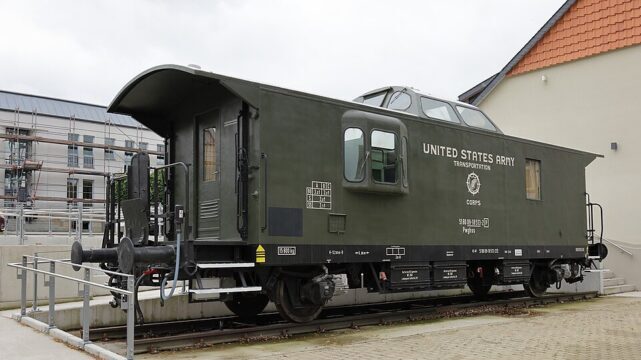
After being pigeonholed as a personnel clerk by the Army during the Vietnam War, Al Bertolani was able to parlay his pre-military experience into a position as a railroad conductor.
One of four children, Al Bertolani was born in Chicago to Albert and Florence Sweeney Bertolani. The family lived in an apartment on Harrison and Claremont Streets. His paternal grandparents, who had emigrated from Lucca in Tuscany, lived below them on the first floor.
Family gathered at his grandparents’ home weekly, and Bertolani’s grandmother spent days preparing Sunday dinner for her 10 children and their growing families. “I remember my dad telling me each family used to give my poor grandmother a dollar,” says Bertolani. “She had to scrounge around to find enough food at a price to feed them.”
When he was 5, Bertolani’s family moved in with his maternal grandparents above their saloon on Cicero Avenue. Bertolani attended Resurrection Grade School, continued to St. Mel High School and graduated in 1964. He studied at the University of Illinois-Urbana for one year before finding employment with Chicago & North Western Railroad as a train conductor.
Bertolani worked there until October 1970, when he was drafted into the U.S. Army. He had previous deferments but was reclassified 1A with a 289 lottery number at 25 years old. He was surprised, as were his parents. “We were in the middle of Vietnam,” Bertolani says. “They weren’t too happy about it.”
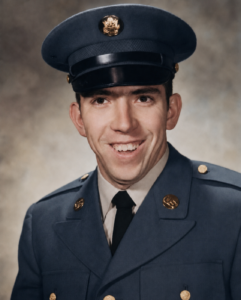
He completed basic training at Fort Lewis, Tacoma, Washington. “It rained or snowed every day I was in basic,” remembers Bertolani, “except the day we graduated, and that was the first time I was able to see Mt. Rainier.”
After basic, Bertolani was awarded a civilian Military Occupational Specialty (MOS) as conductor due to his experience with Chicago & North Western Railroad. He was assigned to Fort Eustis, Virginia, the only base in the U.S. with a railroad.
Bertolani signed in at Headquarters Company, and because of his college background they wanted to place him as personnel clerk, but Bertolani preferred railroad work. The officer told him: “You don’t want to go over to that railroad battalion. They’ll have you polishing that steam engine and doing maintenance on the track and everything.” Bertolani says, “I said, ‘Yeah, that’s what I know, that’s where I want to go’.”
He was assigned as a personnel clerk anyway. Bertolani interviewed incoming military personnel, checking that all necessary paperwork was in their 201 file, the Official Military Personnel File. “I had to make sure everything was in there,” says Bertolani.
While at Ft. Eustis, Bertolani married his fiancée, Pamela Witthoft, in Williamsburg. Virginia. They had barely settled into their apartment when Bertolani received orders for Germany in November 1971.
Bertolani arrived at the Frankfort base and was once again assigned as a personnel clerk. “I strongly objected,” says Bertolani. He spoke with his colonel and said, “I’d like to be a train conductor. If you’re not gonna make me a train conductor, I’m gonna write to my senator.”
Bertolani was a Specialist 4 and needed to be a sergeant to work as a train conductor. Because of his five years of experience on the Chicago & North Western Railroad, Bertolani’s colonel said, “Well, we’ll try you out.”
After training, Bertolani became the conductor on the duty train. They ran two trains out of the Frankfort terminal daily, one to Bremerhaven, the other to Berlin, both traveling overnight. “If you went to Bremerhaven, then you’d go to Berlin and if you went to Berlin then you’d go to Bremerhaven, so you made like a triangle,” Bertolani says.
He and his wife found lodging in Sossenheim, and Bertolani reported to the main station in Frankfurt for duty, wearing his Class One uniform. “I had to make sure my boots were spit-shined,” says Bertolani.
The train carried 50-60 passengers, including military personnel or their families, and everyone was assigned a sleeping berth. “I’d be the one that collected all the documents, either the passports of the dependents or the military ID of the military, and I had them in a satchel,” Bertolani says. “I’d make sure there was one for each person and each person had a compartment; make sure there was nobody riding on the train that wasn’t supposed to be.”
On the Berlin train, an officer from Berlin met the train in Helmstedt, Germany, at the border between East and West Germany. “I had to turn over all the documents of everyone on the train to the officer, and he would go in and meet with a Russian officer who would look over the documents,” Bertolani says. The officer boarded the train, remaining on it until it reached Berlin. Arriving in the morning, the train had a layover until leaving for Bremerhaven at night.
The train to Bremerhaven arrived in the morning, laying over for the day and leaving for Berlin in the evening. The train carried the mail on the leg between Bremerhaven and Berlin. “I had an MP escort guarding the mail and a mailman,” says Bertolani.
Bertolani remembers traveling through the east zone of Germany and seeing the Berlin Wall. “That Berlin Wall was the most curious thing I ever experienced in my entire life,” he says. “I don’t know how to explain it.”
Bertolani and his wife received permission to enter East Berlin. “When you went from West Berlin, at Checkpoint Charlie into East Berlin, it was like day and night,” Bertolani says. “It looked like the war just ended … this was 1972, there was still rubble left, buildings that hadn’t been rebuilt!”
While on leave, Bertolani, his wife and a visiting relative drove to Rome in his Fiat. “We went down through Germany, Austria, Vicenza and along the east coast,” Bertolani says. “And came back up the west coast to Monaco, France, Switzerland and back to Germany.”
The war in Vietnam was winding down, draftees were getting out early and Bertolani was to leave Germany in June 1972. Knowing he would be promoted to sergeant very soon, Bertolani filed a letter of intent to reenlist and extended his stay in Germany. He received his promotion, pulled his reenlistment papers and left Germany. As a Sergeant E5, the government paid all expenses to fly his wife and their belongings back home.
Bertolani and his wife arrived in New York, where he was discharged in August 1972. They returned to the Chicago area, eventually settling in Lombard. Bertolani went back to the Chicago & North Western Railroad, working as the local grievance chairman for the United Transportation Union for 25 years and retiring as conductor in 2006.
Bertolani is a longtime member of the Elmhurst American Legion, serving as finance officer for more than 20 years. He and his wife have three children and four grandchildren.
Reflecting on his time in Army, Bertolani says, “It was a good experience.” Many of his friends ended up in Vietnam and some never returned. “Those that did come back, there wasn’t a one of them that wasn’t effected in some way or another,” Bertolani says, “Going on in life, I really knew how lucky I was.”
The above article appears in the September 2026 issue of the print version of Fra Noi. Our gorgeous, monthly magazine contains a veritable feast of news and views, profiles and features, entertainment and culture.
To view a sample copy, click here.
To subscribe, click here.