 Fra Noi Embrace Your Inner Italian


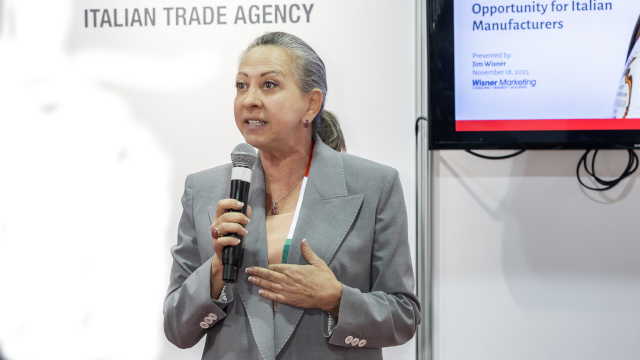
Working for the Italian Trade Agency since she was a university student, Paola De Faveri has devoted her career to helping Italian companies go international.
The Italian Trade Agency (ITA) is the Italian governmental agency that supports the business development of Italian companies abroad and works to promote foreign investment in Italy.
ITA operates through a network of 69 offices and 18 satellite offices in 74 countries. The Chicago office is led by Paola De Faveri, a native of Rome who has worked for ITA for nearly 40 years.
De Faveri talked to Fra Noi about the agency, its focus and the state of trade between Italy and the United States.
ELENA FERRARIN: You started working for ITA in 1987 while you were a university student. What led to your first job there?
PAOLA DE FAVERI: At that time, ITA had offices not only abroad but also throughout Italy. My first job was at ITA’s office in Venice. I chose ITA because I wanted to engage in marketing and promotion at an international level, with the possibility of professional experience in different countries.
EF: You’ve been with ITA for nearly 40 years. What would you like the public to know about the agency?
PDF: ITA is a unique organization among Italian institutions, as we provide custom-made services to Italian companies, tailored to their needs, at a cost vs. value that would not normally be found in the market. We are mainly “facilitators” in providing contacts to support companies’ efforts in internationalizing their activities. This is made possible by years of presence in foreign markets, where our trade analysts specialize in this kind of approach across all different sectors.
EF: Is there anything about ITA and its programs that you wish the public was more aware of?
PDF: ITA’s promotional activities are supported by annual plans developed in conjunction with Italian industrial associations, as they represent companies across various sectors: consumer goods, machinery and technologies, and food and wine being the major ones. At ITA Chicago, we concentrate on advanced machinery and industrial technologies, with a strong focus on automotive and mobility. We also strongly support large-scale retail distribution within the food and wine industry, and the publishing sector.
EF: In your current role, you support Italian companies’ internationalization efforts into the U.S. market, specifically in the mechanical and technology sectors. How do you do that?
PDF: We act through two main categories of services: support in entering the market by providing contacts and scouting, and the organization of promotional activities, typically participation in international fairs in the U.S. We organize 12 to 15 participations for Italian companies each year, acquiring the exhibit space and offering participants a turnkey service. We also oversee the Machines Italia project for the U.S. market, representing 15 different industrial sectors, and promoting them through various initiatives throughout the USA. Two key partnerships acquired through the Machines Italia project are with the ARM Institute and with A3-Association for Advancing Automation. The value of these partnerships encompasses market research, industry data and trends, opportunities to engage with leading manufacturers, and promotional avenues to showcase Italy as a “solution provider” for many of their system-integration needs, serving as a powerful advertising channel to promote the project’s communication campaigns via newsletters and a dedicated portal.
EF: How do you promote foreign investments in Italy? What are some of the challenges?
PDF: We recently started this promotional activity in our Chicago office. The challenge is to showcase our beautiful country not only as a place of great food, art and culture, but also as a qualified environment for developing industrial activities. There are many drivers we can address. While the bureaucratic system may sometimes discourage some, the incentives offered, the level of our academic institutions and the quality of life are certainly among the main positive forces that have been attracting investors to Italy over the years.
EF: What is the state of Italian trade with the United States? What products are most likely to flow each way?
PDF: In the first five months of 2026, the exchange of goods between the United States and Italy reached $49.9 billion, a 7% increase compared to the same period in 2025. Italy maintains a trade surplus, though it has narrowed significantly: from $18.1 billion in the first five months of 2025 to $11.4 billion in 2026. Italy has moved from 13th to 12th place among U.S. suppliers, holding a 2.1% market share. The sectoral picture is mixed. The machinery sector grew by 7.5%, confirming its role as the anchor of Italian exports, representing 30% of total annual Italian exports to the United States. The fashion sector remained steady. All other major sectors declined: chemicals and pharmaceuticals, transport equipment, agri-food and beverages, semifinished goods and furniture, and construction. Demand for advanced technologies continues to rise, driven by reshoring, automation, digital transformation and the need to modernize production systems. Italian companies are deeply engaged in this evolution, and the Italian industry continues to play a leading role in robotics, automation, CNC (computer numerical control) machining, additive manufacturing and digital manufacturing. What distinguishes Italy is the combination of innovation, precision and creativity — an approach that makes our technologies not only advanced, but also practical, flexible and immediately applicable for U.S. manufacturers. The U.S. robotics and industrial automation market is poised for sustained expansion through 2030. Structural labor shortages, industrial policy and technological innovation are reshaping production processes across all major sectors. For Italian companies, the alignment between Italian engineering strengths and U.S. market needs creates a powerful opportunity. With the right strategy, the next five years represent a window of exceptional potential.
EF: Your job brought you to live in New York City, Los Angeles and Sydney. What is the state of Italian trade with Australia? Is it much different than in the United States?
PDF: The U.S. is a manufacturing country with an advanced and structured economy, which makes it challenging for foreign companies to enter. Australia is a “Western” environment in a very diverse hemisphere. During the last 20 years, Australia has successfully developed a model based on importing products that would be more expensive to produce internally, which has prevented the further development of stronger manufacturing industries in certain sectors.
EF: What are your plans for the future?
PDF: I will remain in Chicago for the next three or so years, and I plan on focusing on automation, robotics, mechatronics and advanced manufacturing to expand our operations, as these are key evolving sectors.
The above article appears in the November 2026 issue of the print version of Fra Noi. Our gorgeous, monthly magazine contains a veritable feast of news and views, profiles and features, entertainment and culture.
To view a sample copy, click here.
To subscribe, click here.