 Fra Noi Embrace Your Inner Italian


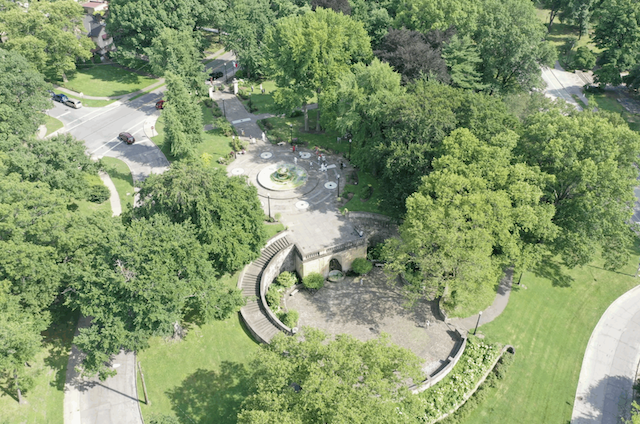
Little known outside of Cleveland, the Italian Cultural Garden has been celebrating Italy’s contribution to the world on a grand scale for nearly a century.
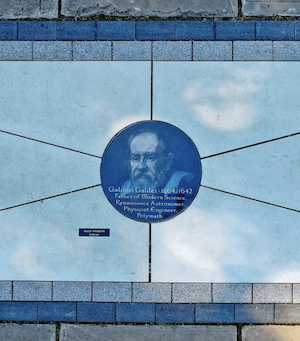
Michelangelo, Vinci, Dante, Galileo, Marconi, Virgil, Palladio, Giotto, Petrarch, Verdi, Ovidio, Donatello, Bernini.
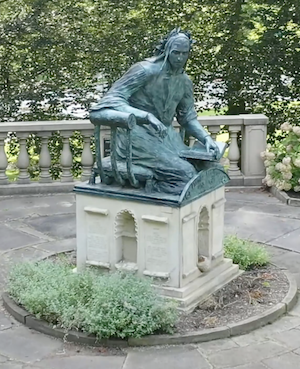
Outside of Cleveland, not many know that a monument honoring these Italian greats is located in the city’s Rockefeller Park. Their statues and carved images are immortalized in the Italian Cultural Garden, a Renaissance-style monument listed in the National Register of Historic Places.
Dedicated in 1930, this public space was the center of Italian activities in Cleveland in the 1930s and 1940s. On Oct. 12, 1935, it served as the starting point of the Columbus Day Parade in Cleveland.
The city of Cleveland owns the land and monument, while the nonprofit Italian Cultural Garden Foundation serves as its steward and caretaker.
Joyce Mariani, executive director of the Italian Cultural Garden Foundation, talks to Fra Noi about the monument, and why it is such a special place.
ELENA FERRARIN: Tell us about the monument’s history.
JOYCE MARIANI: This monument to Italy honors Italy’s cultural greats in the arts and letters, and the arts and sciences. It was dedicated Oct. 12,1930, as “a symbol of the contribution of Italian culture to American democracy.” The Italian government sent the bust of Virgil. The city of Cleveland had offered eight ethnic communities land donated by John D. Rockefeller. The creator of the Italian Cultural Garden was Philip Garbo from Cefalù, Sicily, who enlisted the help of his friends Basilico Ianni and Alessandro DeMaioribus. All three came here as immigrants and became successful. Garbo became president of the Italian Fresco & Decorating Co., DeMaioribus became the head of the Cleveland City Council, and Ianni became an architect. Ianni drew the plans for the lower-level amphitheater. They worked for 10 years to build the cultural monument that cost $100,000.
EF: How did you first get involved with the Italian Cultural Garden?
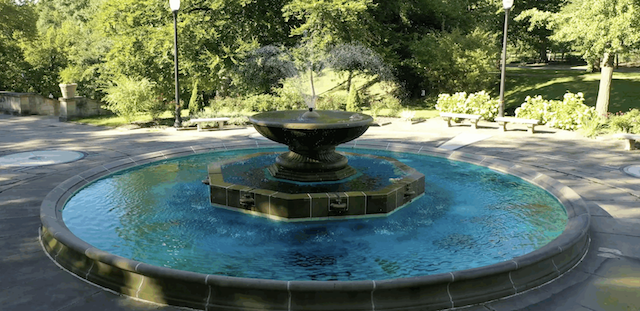
JM: My work began in 2007 with plans for an ongoing $1.5 million restoration (of which more than $600,000 has been completed). After studying in Florence, Italy, I lived and worked in Rome. When I came back to Cleveland, I started the Cleveland Italian Film Festival, the first independent film festival to showcase Italian award-winning films in Cleveland-area theaters. The first year was a sold-out success. My aim was to expand it and make it my profession. One day a friend, Gino Colage, told me about an Italian garden he tended. He invited me to a dinner during which a former editor of the Cleveland Plain Dealer said to me, “Your Italian community should be fixing up that beautiful public space.” Ten days later, another non-Italian said to me, “What’s wrong with your community? Why aren’t they fixing that place up?” I decided to see it. I stood at the entrance in amazement, as I gazed on its Renaissance design and a large fountain modeled after the fountain in Villa Medici in Rome, two large winding staircases leading down to a lower-level amphitheater, and another large fountain.
EF: You decided to contribute financially early on, right?
JM: I saw the upper-level fountain needed restoration and decided to donate the profits from my film festival to repair the main feature. Then I decided to donate my salary and profits for two years, because more restorations were needed. The more I researched its history, the more fascinated I became. I researched old microfilm from 1900 onward and discovered that in 1937 a Pantheon structure calling for “one hundred Italian cultural men and women” was planned but never completed. I think it was destiny that led me to this work.
EF: What does your role consist of?
JM: Since many did not know (the monument) existed or its complete history, a great part of my work has been bringing public awareness of its historical importance and meaning. A large part of what I do is fundraising for the addition of new cultural figures, maintenance and the continuing restoration. We dedicated the large statue of Dante Alighieri and newer cultural figures such as Donatello, Bernini, Ovidio and Palladio. I also serve as artistic director and producer of the annual “Opera in the Italian Garden” featuring opera, ballet and Italian songs. This concert was created by the founders in the 1930s to share two of Italy’s most important cultural arts, opera and ballet. I felt it important to revive it, and today it draws large crowds each year.
EF: How did you bring public awareness to the monument?
JM: With passion. With my initial inexperience in fundraising, people would often say, “Your passion convinced me.” I realized that if you really believe in something, others will tap into your dream. I enlisted the media, wrote articles, and established social and digital presence. When I first began introducing this largely unknown public space, I met with people one-on-one. Coffeehouses were my office, and I had appointments all day long. Today a major part is video conferencing, and social and digital media and events.
EF: Does the city play any role in decisions regarding the Italian Cultural Garden?
JM: Whenever we decide to add a new cultural figure, or the proposed future Pantheon structure, we present the plans to the Cleveland Landmarks Commission for approval.
EF: At the monument’s dedication in 1930, congratulatory telegrams arrived from dignitaries such as President Herbert Hoover, Italian conductor Arturo Toscanini and Nobel Prize winner Guglielmo Marconi. Are these documents kept somewhere?
JM: As of today, they are only noted in historical publications. But I did discover a set of old architectural drawings that were encapsulated and are now online.
To send a tax-deductible donation to the Italian Cultural Garden, mail a check to: Italian Cultural Garden, 1284 Som Center Road, #316, Cleveland, Ohio 44124. For information, call 216-916-7780.
The above article appears in the July 2026 issue of the print version of Fra Noi. Our gorgeous, monthly magazine contains a veritable feast of news and views, profiles and features, entertainment and culture.
To view a sample copy, click here.
To subscribe, click here.