 Fra Noi Embrace Your Inner Italian



Having lived through the Nazi occupation of Italy during World War II as a child, Edward Pasquesi helped keep the North Koreans on the far side of the 38th Parallel after the Korean War.
The middle of three children, Edward Pasquesi was born in Bomporto, Italy, to Angelo and Antonietta Santi Pasquesi. His parents had been working on a farm in the Modena valley and returned to Cadagnolo, their family village in the Apennine Mountains, when Pasquesi was 4 or 5 years old. “We were poor, but we really didn’t know it,” he says.
Pasquesi lived among relatives from both sides of the family. He has vivid wartime memories of when the Germans occupied Cadagnolo and lived in their houses. “As a child, growing up in that, you didn’t really think of the danger,” he says. Battles between the partisans and Germans were routine. “At night, Allied planes would fly over and drop supplies to the partisans up in the woods, and the German flares would light up the skies, and you would see parachutes dropping the supplies,” Pasquesi says.
The Germans had Russian prisoners they used as slave laborers. “I remember us kids playing with a big Russian prisoner. He would give us piggyback rides,” Pasquesi says. “My mother would tell me, ‘Stay away from the Russians, they have lice.’”
One day, Cadagnolo was caught in the crossfire during a battle between partisans and a German convoy. Pasquesi’s family left their village and ran up a dry mountain stream bed to escape. “We could hear the sound of bullets whizzing through the trees above us,” says Pasquesi. They spent the night in the fields as German troops set fire to houses and barns, fortunately none in Cadagnolo. The family returned to their home in the quiet of the morning. “I remember my grandfather carrying me,” Pasquesi says. “There were chicken heads practically all over the place,” he remembers. “At that point, the German supply lines were cut off and they were killing all the animals for food.”
The war left the area depressed, and Pasquesi’s father left in search of work, eventually moving the family to Liege, Belgium, when Pasquesi was 11 years old, settling into a small Italian community. “As a child, it was an exciting experience,” Pasquesi says.
He attended Catholic schools in Cadagnolo and Liege and graduated from a Catholic seminary before the family immigrated to the United States when Pasquesi was 17 years old. They lived in Highwood, near family. “We were excited about coming to the U.S.: better living, but also the opportunity,” he says.
Pasquesi first worked at a golf course and then as a butcher at Jewel Foods. He became a U.S. citizen after the required four years and was drafted into the U.S. Army soon afterward. His parents were not too happy. “For me, I just wanted the experience,” Pasquesi says. “At the time, it was normal for young men to serve in the military.”
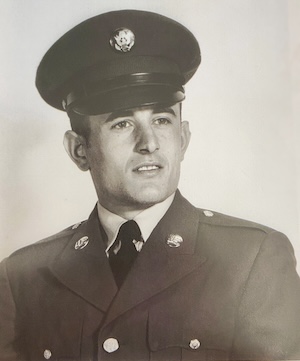 He completed basic training at Fort Ord, California, and continued to advanced training, learning reconnaissance and leadership skills. Pasquesi was assigned to the 1st Battalion/12th Cavalry Regiment and deployed to Korea in 1962. He completed heavy mortar and demolition training and volunteered for the parachuting skydiving group. “I loved it,” he says.
Pasquesi was stationed at Blue Lancer Valley, one of several small forts a few miles from the Demilitarized Zone. He lived in a Quonset hut with 12 other soldiers. The weather was challenging at times, with the harsh winter and monsoon season, but the fort had amenities such as a bar, craft shop, and movie theater and occasional special entertainment, including Bob Hope. “They treated us pretty well,” Pasquesi says.
Pasquesi performed numerous jobs at the DMZ, part of that time as squad leader. He maintained defense posts, bunkers and fences. “We’d put on barbed wire and repair the fencing along the DMZ,” Pasquesi says. “We did that carefully, not to step over on the other side for fear of being shot.”
He also manned observation posts overlooking North Korea and reported any activity to his superiors. Pasquesi led his squad on patrols mostly during the day. “Sometime at night, we would set up listening posts on our side of the DMZ, watching for infiltrators from the North,” he says.
The soldiers encountered local children while out on patrols and especially when jumping out of airplanes. “Sometimes when you’re landing, they were right there,” Pasquesi says. “They always warned us be careful of the kids.”
During one daybreak patrol, Pasquesi and his men approached a village and spotted a dog in the rice paddy. Suddenly a small boy came running, shouting, “Shoot dog, shoot dog.” Of course, they did not shoot the dog. “They ate dogs,” Pasquesi says. “That’s just to tell you how poor they were.”
During the Cuban Missile Crisis in fall 1962, Pasquesi’s unit went on high alert and camped out for two weeks near a village. A chow truck came daily to drop off food, and the kids always came around. “We’d give them some of our food.” Milk was always plentiful, which the soldiers also shared with the children. One day, the soldiers kept a case of chocolate milk, placing it in a nearby stream to keep it cool. “And of course, what do you expect, when we went back the chocolate milk was gone,” Pasquesi says. “When I think about that country, the progress they have made from then to now is amazing.”
Pasquesi occasionally visited local villages and Seoul on weekends when he was off duty and never encountered any problems with the locals, “They were good to us, and we were good to them,” he says. Korea was still considered a war zone, so Pasquesi spent his two weeks of R & R in Japan.
Pasquesi completed his 12-month stint in Korea and returned to the States, where he was stationed at Fort Carson, Colorado. He continued skydiving as well as participating in training maneuvers and war games. He was discharged in February 1964 as Sgt. E5, returned home and fulfilled his two-year obligation in the Army Reserve, reporting to Fort McCoy, Wisconsin, for his annual training. Pasquesi worked at Jewel and then in construction before buying an Ace Hardware store in Highland Park. “I always had the ambition to have my own business,” he says.
That ambition led to the opening of Pasquesi Home and Gardens in Lake Bluff, currently celebrating its 50-year anniversary. Pasquesi married Marie Unterbrink in 1966, and they have three children and seven grandchildren. Nowadays, Pasquesi’s children pretty much run the business, and he goes in several days a week. “At 86, it’s pretty nice to have a place to go,” he says.
Reflecting on his time in the Army, Pasquesi says, “It was a good experience for me, and I am very proud to have served. I am so thankful for this country of ours; I’m thankful for the opportunity that this country has given my family and me.”
The article above appears in the September 2025 issue of the print version of Fra Noi. Our gorgeous, monthly magazine contains a veritable feast of news and views, profiles and features, entertainment and culture. To subscribe, click here.