 Fra Noi Embrace Your Inner Italian


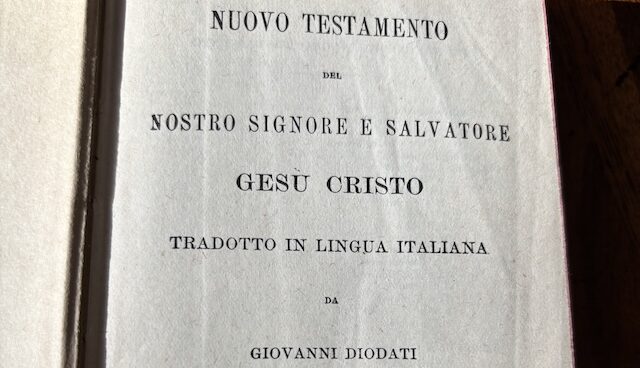
I have my Grandmother Anna Anzalone Tinaglia’s old Italian “La Sacra Bibbia” from when she lived in the North Side neighborhood once known as Little Sicily. Her copy is well-worn and annotated by her. It’s from the American Bible Society, which gave out Bibles to new immigrants in America. It is a translation by G. Diodati, an Italian Protestant. It isn’t sanctioned by the Catholic Church, and for centuries it was prohibited.
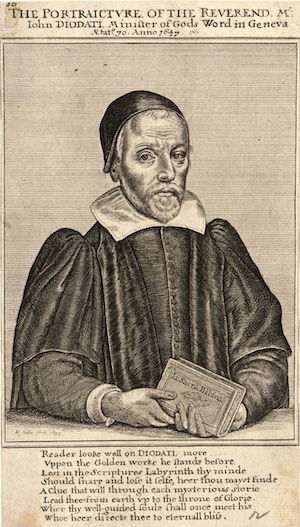 Giovanni Diodati was born in 1576 in Switzerland to a noble Protestant family from Lucca. Protestant exiles, his family had fled the Inquisition to find refuge in the Protestant stronghold of Geneva. The Diodatis had pride in their noble lineage and a fierce commitment to the Reformation, having left all behind to freely practice their faith. Raised in the safe Swiss cradle of faith and scholarship, Diodati became a towering figure in the Protestant world, leaving an indelible mark as the first to translate the Bible into Italian directly from its Hebrew, Latin, Syriac and Greek sources.
From his youth, Giovanni displayed an extraordinary aptitude for languages and theology. His father ensured he was steeped in the intellectual rigor of Geneva’s Protestant culture. By 1594, he received his doctorate in theology. His brilliance caught the eye of Theodore Beza, the successor to John Calvin, who recommended him for a professorship of Hebrew at the age of 21. This position showcased his ability to interpret the sacred texts that underpinned the Reformation’s battle cry of sola scriptura — scripture alone. By 1606, he was a theology professor and ordained pastor. His sermons were considered eloquent, bold and unyielding in their Protestant conviction. However, he burned to spread the word to his Italian homeland, where freedom to read the Bible or debate theology was forbidden by the Inquisition.
In his 20s, Diodati completed his magnum opus: a translation of the Bible into Italian. Unlike earlier efforts that leaned on the Vulgate, he dove into the original languages to craft a text that rang with clarity and fidelity. His 1607 edition became the cornerstone of Italian Protestantism. The preeminent English Bible, the King James, didn’t appear until 1611 and was the work of 50 translators. His peers marveled at its literary grace. Critics claimed that it was a paraphrase, but even they could not deny its accuracy. Far ahead of its time, his translation had notes in the margins so the meaning of the Bible would be made clear to as many Italians as possible. The proof of its quality is that it has been in print for more than 400 years!
 His ambitions stretched beyond translation. In 1614, he embarked on a mission to France to strengthen Protestantism. Diodati dreamed of sparking a Reformation in Venice, the most liberal Italian state, which had been excommunicated by the pope. Traveling under an assumed name for his safety, he tried to reach the people who would be open to the reformed faith. But he met opposition from the Inquisition, which used spies to intercept his Bibles, aware of the transformative impact that scriptures in the hands of the common people might have. He relinquished his university post in 1645 and died in 1649.
John Milton, the famous English poet of “Paradise Lost,” who met him in Geneva in 1639, found in him a kindred spirit, a scholar-poet of scripture. Though he never saw Italy embrace Protestantism, Diodati’s Bible broke the silence of centuries, giving Italians a voice to hear God’s Word in their beautiful language. His life — a blend of exile, genius and unwavering faith — stands as a triumph on behalf of his Lord and Savior, Jesus Christ.
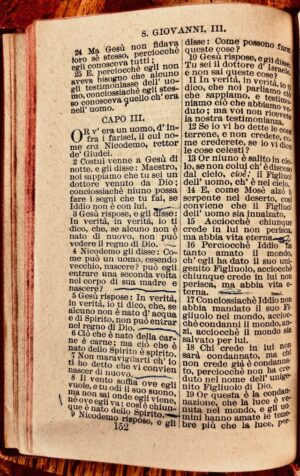
One verse my grandmother underlined was: Giovanni Capo III.16 “Perciòcche Iddio ha tanto amato il mondo, ch’ egli ha dato il suo unigenito Figliuolo, acciocché chiunque crede in lui non perisca, ma abbia vita eterna.” “For God so loved the world, that he gave his only begotten Son, that whosoever believeth in him should not perish, but have eternal life.”
The article above appears in the October 2025 issue of the print version of Fra Noi. Our gorgeous, monthly magazine contains a veritable feast of news and views, profiles and features, entertainment and culture.
To view a sample copy, click here.
To subscribe, click here.

As a side note, it was Moody Church where she was given that bible and it helped comfort her after the death of a child.