 Fra Noi Embrace Your Inner Italian


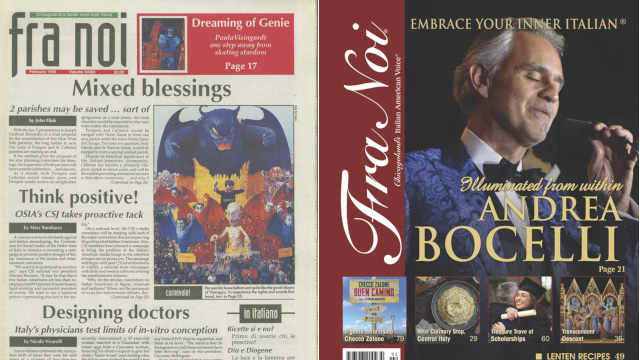
When I was hired in 1990 to save Fra Noi, I knew exactly what I was getting myself into and what I had to do. That’s because I briefly served as its managing editor five years earlier, when it was ably helmed by one of my personal heroes, Jim Ylisela.
Fra Noi had been bleeding red ink and readers for a while as a glorified newsletter for Villa Scalabrini when Fr. Cozzi, who ran both, hired Jim to stanch the flow.
A gifted writer and editor, Jim quickly transformed Fra Noi into a newspaper of record for the Chicago-area Italian-American community, leaving the Villa in the editorial dust in the process. He had taken me under his wing a couple of years earlier, when I was all promise and no skill, and he continued to mentor me at Fra Noi.
I had a wonderful time getting to know the community and immersing myself in my heritage during my year and a half as managing editor. And the lessons I learned under Jim’s tutelage turned me into something resembling a journalist.
Armed with those experiences, I left to pursue a master’s degree at Northwestern University’s Medill School of Journalism, where I spent my final quarter as the business manager in the school’s magazine publishing program.
Meanwhile, Jim had moved on to greener pastures, and Fra Noi had slipped back into its previous sorry state as a house organ for the Villa, losing $200,000 and 50 percent of its readership in the two years before I was brought back into the picture.
On the editorial front, I picked up where Jim left off. Gradually assembling a team of skilled and passionate correspondents capable of writing on a wide range of topics, I crafted a publication that served as both a mirror in which the community could see itself and a window through which it could view the larger Italian and Italian-American world.
To cut costs, I deployed then-cutting-edge technologies like faxing, e-mailing, scanning and desktop publishing. And, to boost revenues, I launched an ongoing campaign to convince advertisers that Fra Noi wasn’t just a business investment but an investment in our heritage as well.
In 1993, I hired college sophomore Mary Racila to lay out the newspaper. She took the opportunity and ran with it, growing into the position of creative director and riding herd on Fra Noi’s ever-evolving design.
My first decade as editor had more than its share of challenges.
When Catholic Charities assumed control of Villa Scalabrini and Casa San Carlo in the mid-’80s, they took a dim view of Fra Noi’s worth and placed it on the chopping block.
Luckily, Fr. Cozzi took Fra Noi with him when he and Catholic Charities parted ways in the early ’90s. And when he formed an independent charity to raise funds for the Villa while publishing Fra Noi, things were looking up.
Unfortunately, however, Fr. Cozzi was unable to make a go of his charity, and though Fra Noi was making slow but steady progress toward break-even, the publication was once again in peril.
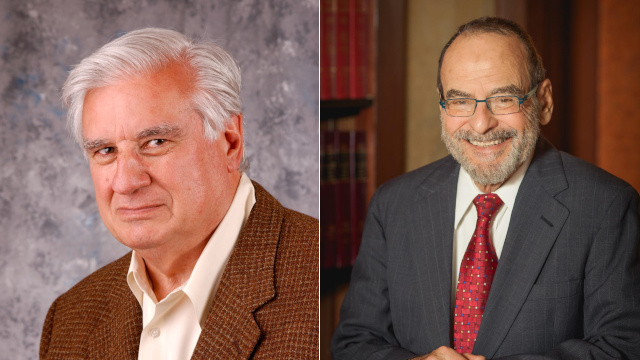
That’s when a group of community leaders spearheaded by Anthony Fornelli and Anthony Spina stepped in to save the day. They acquired Fra Noi and its accumulated debt in 1995, incorporated it in November and lent their financial support until the enterprise was self-sustaining.
Buoyed by a supportive board, dedicated advertisers and devoted readers, Fra Noi has managed to pay its bills through lush times and lean for more than a quarter century. And our compelling editorial mix has sustained a miraculously stable readership despite having no funds to speak of for circulation promotion.
The intervening years have brought four design makeovers, including a quantum leap from a newsprint tabloid to a glossy magazine. And now we stand on the brink of yet another transformation … But that’s a story for the next issue.
The above article appears in the September 2026 issue of the print version of Fra Noi. Our gorgeous, monthly magazine contains a veritable feast of news and views, profiles and features, entertainment and culture.
To view a sample copy, click here.
To subscribe, click here.