 Fra Noi Embrace Your Inner Italian


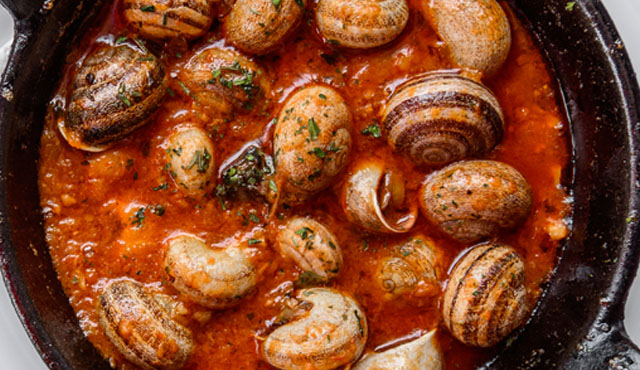
Not too many Italian restaurants in this country offer snails in tomato sauce these days, but if they did, they’d probably try to gussy up their appeal — and justify an exorbitant charge — with a menu description something like this:
Succulent twin-horned free-range escargots, humanely hand-harvested, smothered to perfection by ebullition in eau de pluie, served en coquille in a talented duet with a golden shower of dulcet ragù to create a symphonic ravage transfigured by gagas of sliced garlic and frissons of cheekily fresh basilicum leaves, the ensemble providing an artisanal dipping sauce nonpareil.
Of course, the reality of what Italians call lumache is a lot humbler than that pretentious word salad, even if my parents’ Ciociaro dialect endowed snails with the magical flying carpet name of shahmaroog. In contrast, note the simplicity of the method my father adhered to when prepping the snails Mom cooked, though I wouldn’t recommend trying this in the 21st-century home:
1) Dump 5 pounds of live snails in bathtub.
2) Let several inches warm water flow into tub.
3) Pour in generous amounts vinegar and salt and stir snails briskly by hand.
4) After snails vomit (you will see much bubbly white foam), rinse and deposit in large pot vehemently boiling water.
5) All snails that fail to retreat into their shells (their horns should not be visible) are already dead and should be discarded forthwith.
My father’s role in snail preparation was limited to buying them at a fish market in the Bronx’s Little Italy, driving them home while they slithered all over the bag he’d stowed in the trunk, and washing them and getting them to empty the contents of their primitive stomachs in our bathtub. Mom’s task was to prepare the tomato sauce that, flavored with whole fresh basil leaves, lots of garlic and a dash of red pepper, would derive a peculiar zest from the phlegmy little gastropods’ smoky flavor. The snails would then be served over ziti.
Between forkfuls of pasta we turned our attention to the snails themselves, snagging them out of their shells with toothpicks (or, for recalcitrant cases, safety pins) and making sure to pluck off and discard yu mazz — the sooty rear end that constituted their excretory system. After eating the front part, we sucked the tangy sauce off the shells. At meal’s end, the pile of empty shells overflowing Dad’s plate suggested a mound of diminutive skulls left behind by some barbarian conqueror to warn his foes of the futility of further resistance.
Besides snails — and dozens of savory meat, poultry, pasta, and vegetable dishes — Mom cooked a lot of scrumptious seafood, too, especially at Christmastime: baccalà salad with olive oil, garlic, and parsley; tangy fried eels; striped bass, flounder, tuna, sole; crabs, stuffed clams, octopus, eels, an occasional lobster; and zuppa di pesce with shrimp, clams, mussels, calamari, whiting, halibut, porgy, and snapper, all stewed to perfection in a spicy tomato sauce.
Dad caught some of the seafood we ate, but I was never a decent companion for him on his frequent fishing excursions. I refused to cut up worms or impale them on hooks — and it pained me that he would fish for half an hour with part of a worm whose former half was still wriggling in the bait box.
I did enjoy casting as far as I could, but I once got my line seriously bollixed up with that of another fisherman who didn’t take it well. My only catch ever was a small fish (after Dad had baited the hook for me with half a bloodworm), but it slithered away among the jagged rocks we were fishing off as I tried to reel it in.
Much less traumatic for me was the bloodless sport of trapping crabs with a pair of cubical metal cages that had been smeared with some cat-food tuna as bait and whose four sides would drop down after my father flung the cages in the water by an attached rope. I also enjoyed our fishing trips for shiners. Dad used a large tuna-fish-baited metal-mesh scoop he’d fashioned from discarded window screens to capture those tiny fish. After he cleaned them, Mom made a piquant shiner pie with the fish, Italian bread and zesty laurel leaves on top. Yum!
But overindulgence was sometimes a problem for hearty eaters like us. For that, the wonderworking White Diet (la dieta in bianco) came to the rescue, providing the cure for just about any gastrointestinal ailment — diarrhea, constipation, acid indigestion, heartburn, bellyache, liver complaints — and even certain infectious processes manifesting themselves as fever. The White Diet was dead easy to implement, since it was a simple substitution diet: seafood instead of meat, white clam sauce on your pasta instead of tomato sauce, and white wine instead of red. It may not have worked better than just waiting it out, but it did provide an excuse to vary the tomato sauce regimen that was king in our very traditional Southern Italian cuisine.