 Fra Noi Embrace Your Inner Italian


Today I would like to talk about citizenship.
A hot button topic to be sure, but for genealogists, the documents filed for citizenship can be a great source of information about our relatives and can tell some parts of their story when they are no longer here to tell it themselves.
Chicagoans have a number of resources on good ol’ Familysearch.org. There are also resources on Ancestry.com if you’re a subscriber or if you’re using a library’s free subscription.
Before 1929, a person could file for citizenship in several different courts. These are:
Cook County Circuit Court
Cook County Superior Court
United States District Court, Northern District
There are a few other courts that cover Chicagoland but they are minimal.
After 1929, all citizenship applications went through the US District Court.
How do you find out which court to check? It is very important to know the court and it is very easy to find. FamilySearch gives us two large indexes that overlap. There is a Soundex index that covers 1840-1950, which includes all three courts mentioned above. It also contains some smaller courts covering southern Wisconsin and eastern Iowa and some counties in Illinois south of Cook. The second index covers 1926-1979 but only covers the “Eastern Division” of the Northern District and does not include all those other counties.
You should “Search” “Records” from the FamilySearch home page and limit your search to record Type “Immigration and Naturalization”. Unfortunately, this record type includes passenger lists and this can give you too many search results. Those results may have a sub-heading “Immigration” or “Naturalization” but it’s not always right. There may be search results that say “Immigration – Illinois”….. Unless you fly into O’Hare, or float in through Lake Michigan, how can you immigrate to Illinois? When you get too many results, you may have to hold CTRL and press “F” to search the web page, and type “Petition” or “Naturalization” in order to find the kind of result you want.
If you find a result in the two overlapping indexes I mentioned above, you will see a 3×5 card on the image. They look similar but you need the right information from them. Keep in mind that if you’re looking for your relatives in other cities, some of the info below will apply but the index cards are specific to that city or court system.
The older cards (1840-1950)
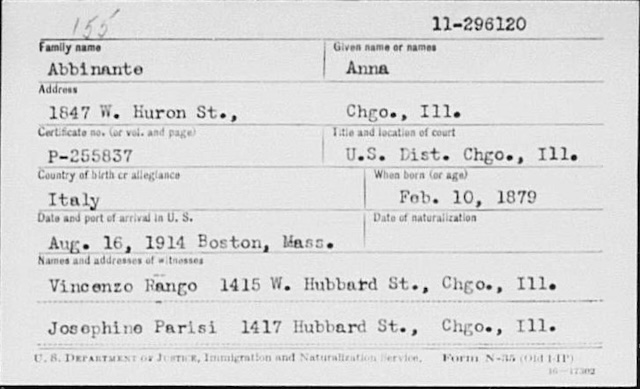
This card gives enough information to identify that this is your relative. You get the name, address, birth date (unfortunately the card does not list the town of origin.) and even two witnesses, who may be relatives too.
The key information is the “Certificate no. (or vol. and page)” which contains a number with a “P” next to it. “P” means “Petition” and this is the critical number to find the right one. Next to that is the “Title and location of court” which is the second critical piece of information to help you find the right documents.
The later cards (1926-1979)
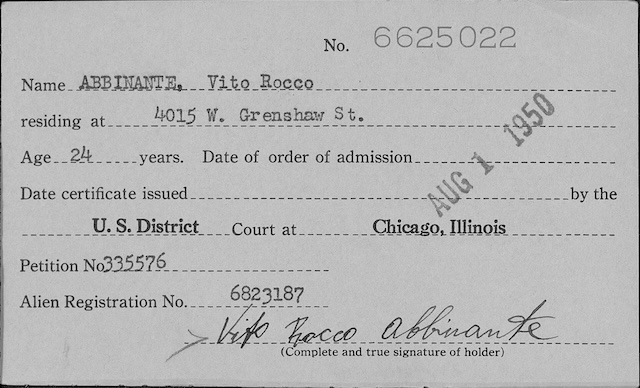
These cards have different information. The name and address are there but now they only give you the age instead of the birth date. The court is almost always “U.S. District Court at Chicago Illinois” and the petition number is shown below. The date of naturalization is often stamped on the card, which you need to use to subtract the age to help you decide if you have the correct Vito Rocco Abbinante.
You may find the same person in both card indexes if they became a citizen in the years that overlap.
Use the catalog on www.familysearch.org to find the documents. Do “Search”, “catalog”. Then click “Keywords”. If your court is U.S. District Chicago, use this link to get to all the petitions:
https://www.familysearch.org/en/search/collection/2212212
If the court is the Circuit Court of Cook County Illinois, use this link:
https://www.familysearch.org/en/search/catalog/koha:233427
If the court is Superior Court of Cook County Illinois, use this link:
https://www.familysearch.org/en/search/catalog/koha:40549
Within any of those links, go through the films listed looking for a petition number range that contains your P-number.
When you find the film/folder with the petition you need, you will typically find three documents but sometimes more. The “Big Three” are:
-Certificate of Arrival
-Declaration of Intention
-Petition for Naturalization
If you find other pages, they might be “Oath of Allegiance” which was used during or just after wartime. There may also be pages describing that the person’s naturalization was rejected or cancelled, usually due to them returning to Italy. “Repatriation” is the word you’ll see on those pages, but they are not found frequently.
What do we find in the “Big Three”?
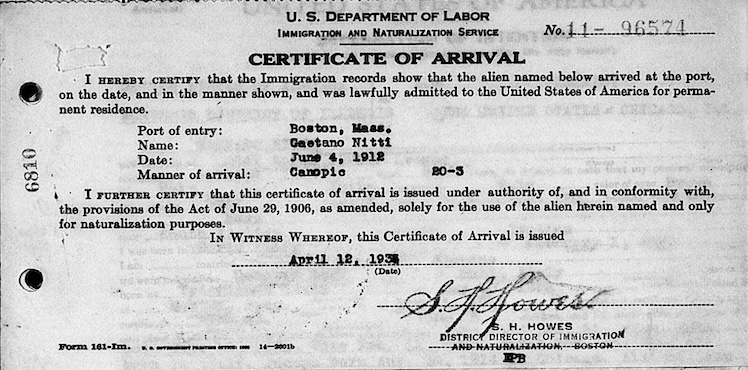
The Certificate of Arrival is a small paper that lists:
-The name the person used when they came to America
oThis could be a maiden name for a woman who was not yet married when she came to America, and would be different from the married name they now use while applying for citizenship
-The port of entry, frequently New York but sometimes Boston or others
-The date the ship arrived
-The name of the ship
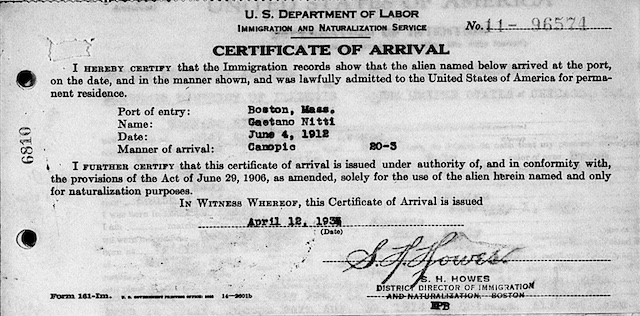
Sadly this is not a copy of the actual passenger list, but it gives you everything you need to know in order to hunt down a copy.
Next, the Declaration of Intention is the “first papers” they filed to tell the government that they would like to be a citizen of the United States. There is some identifying information such as birth date and birth place. Maybe the name of their spouse. Older copies are handwritten, which makes it tough to read. Later copies are typed, and sometimes you get a photo of the person. A lot of us may not have a photo of our person at that time in their life, so this is an extra side benefit.
{{{{{ Nitti Gaetano 1870 dec of intent with photo }}}}}
If you go through census records and find your person’s citizenship status and it says “PA”, this does not mean they were from Pennsylvania….it means they filed their first PApers. In many cases, they actually didn’t, but they told the census taker that they did. I’m guessing that many of our immigrant ancestors were scared of this government person coming to their home every ten years to ask them who lived there. Maybe they went through that in the old country and nothing good ever came of that visit. Now here it is again but in America and they don’t know if this is someone who might deport one or more members of the family. So they said “We filed our papers, we’re legit.” All I’m saying is that you shouldn’t blindly trust the census as a report of the immigration status.
The final step in the process of becoming a citizen was the Petition for Naturalization. Not everyone completed this step. There are a variety of reasons. Some of them changed their mind about staying in America. (Italy had more immigrants return from America back to Italy than any European nation. Perhaps 30-50%.) Some only intended to work here long enough to make enough money to live comfortably in Italy. Some were persuaded that the streets were “paved with gold” but when they arrived and settled here, they found the streets were actually paved with…..well, we had a lot more horses back then.
The Petition for Naturalization has more family detail (though no photos).
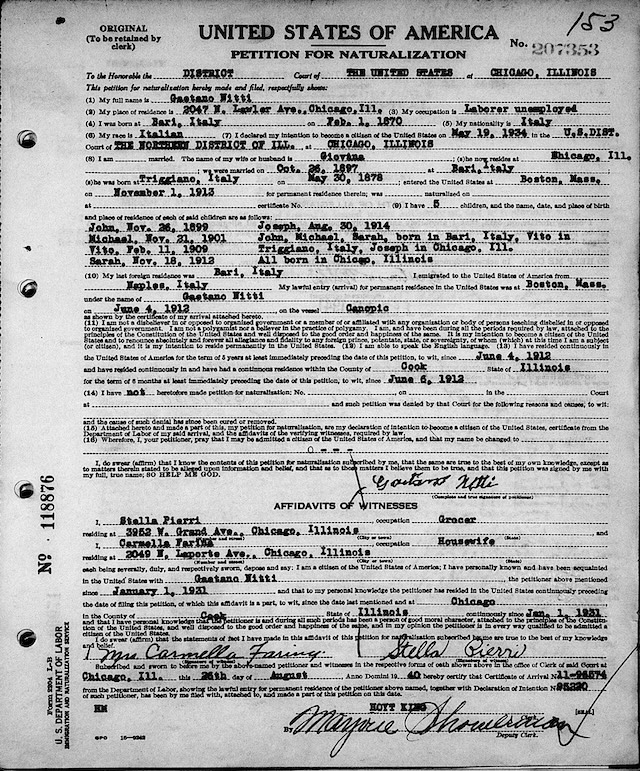
The petition gives us a wealth of information. However, buyer beware. This data was supplied by the emigrant themselves and may not be 100% accurate.
-Name
-Birth date
-Birth place (these can be spelled horribly wrong – nobody checked)
-Address
-Spouse’s name
-Spouse’s birth date and birth place (see above)
-Marriage date and place
-List of living children, birth dates, birth place(s) and where they reside at the time of the application. These children may be receiving citizenship along with their parent. So if you cannot find your grandfather’s citizenship in all these resources, they might have been “grandfathered” in when your great-grandfather became a citizenship.
-Witnesses and addresses.
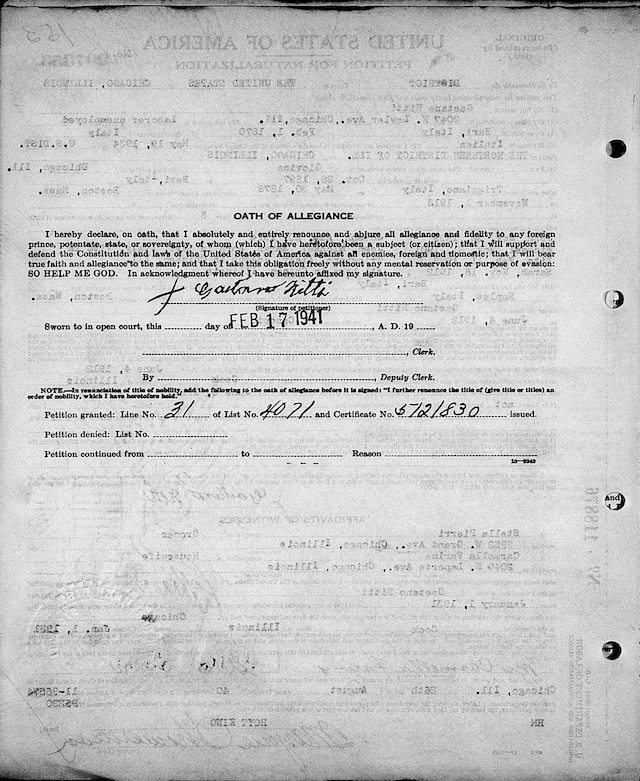
The second page is usually the signature, or their mark “X”. It also contains the date of naturalization, and sometimes the person renouncing the King of Italy or whoever the monarch was for the country they are staying away from.
You will also see a certificate number but unfortunately, they never filmed the certificates.
Keep in mind that before 1922, usually when the husband became a citizen, the wife also became a citizen. They call it “derivative” citizenship. After 1922, the wife had to apply on their own.
If you do not find your immigrant ancestor at all, there are some possible reasons for it.
1.They did not think they would stay in America, so they never applied.
2.They died too young and never got around to it.
3.They could have lived in another city and did their paperwork there instead of Chicago.
4.I have noticed some people who never became citizens but those people had sons serving in World War II. With the stars in the window, everyone knew this family gave plenty to their adopted homeland.
Let me know how your search went! E-mail me at d.niemiec@comcast.net and please put “Citizenship” in the subject.