 Fra Noi Embrace Your Inner Italian


Even beginning Italian students tend to notice how similar many Italian words are to English. This is because most words used today in modern Italian, and many words in English, have their roots in the Latin language spoken long ago by the Romans.*
In linguistic terms, words in two different languages that have a common origin and a similar meaning are called “cognates.” Given the close relationship between languages that cognates foster, these words can be thought of as “true friends.” This is good news for English speakers learning Italian as a second language; recognizing these words can greatly increase one’s vocabulary with very little effort!
In general, when two words are cognates, the stem of each word will provide a clue to the actual meaning. The ending of each word in both languages will also follow a common pattern.
For instance, the ending –tà in Italian is equivalent to the ending –ty for English nouns. All Italian nouns that end in –tà are feminine and invariable; therefore, these words will take the definite article la for the singular form and le for the plural form while the ending remains –à. (Remember that a definite article is the word for “the.”) For instance, one city is la città and many cities is le città.
Some common examples are given below. Notice that some Italian nouns have several different, but related, meanings in English.
città = city
communità = community
elettricità = electricity
facoltà = faculty department or course of study/ability/power
festività = religious holiday
identità = identity
località = locality/place/small town
nazionalità = nationality
ospitalità = hospitality
società = society/company (business)
specialità = specialty
unità = unity
università = university
For some –ire verbs, the –ire ending will be equivalent to the ending –ish for English verbs.
finire = to finish
punire = to punish
Many English and Italian adjectives are also cognates, or “friends.” See below for some adjectives we use every day.
The ending –ale in Italian is equivalent to the ending –al in English.
originale = original
personale = personal
speciale = special
tradizionale = traditional
The ending –ico in Italian is equivalent to the ending –ical or -isty in English.
classico = classical
fisiologico = physiological
politico = political
tecnico = technical
tipico = typical
turistico = touristy
The ending –etto in Italian is equivalent to the ending –ect in English.
corretto = correct
dialetto = dialect
diretto = direct
perfetto = perfect
The ending –atto in Italian is equivalent to the ending –act in English.
contatto = contact (to touch)/to know someone (in a business)
contratto = contract
fatto = fact
tratto = tract of land/pamphlet
tratto digestivo = digestive tract
*This is just a small sample of Italian language friends that English speakers will surely encounter. It is estimated that approximately 30% of English words originate directly from Latin. If words spoken in English with origins in other Latin-based languages are included, this figure may climb to as much as 60%. How many more can you think of?
English speakers —
listen closely to Italian words
and you will find many Italian language friends
called cognates that you will use every day!
For “All the Italian you need to enjoy your trip to Italy,”® click on the links below to purchase my Conversational Italian for Travelers books – and then listen to the audiobook “Just the Important Phrases” on your favorite streaming platform! —Kathryn Occhipinti


Conversational Italian for Travelers “Just the Important Phrases” pocket travel book with audio
on your favorite streaming platform from Amazon.com and www.LearnTravelItalian.com
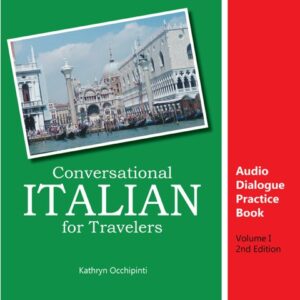
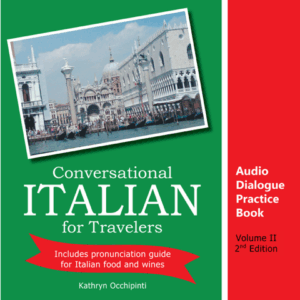
New! Practice short Italian phrases with this Audio Dialogue Practice Book.
Check out how to pronounce restaurant vocabulary in Volume 2!
Download the audio from your favorite audio platform today!
Check them out on Amazon.com and Spotify.