 Fra Noi Embrace Your Inner Italian


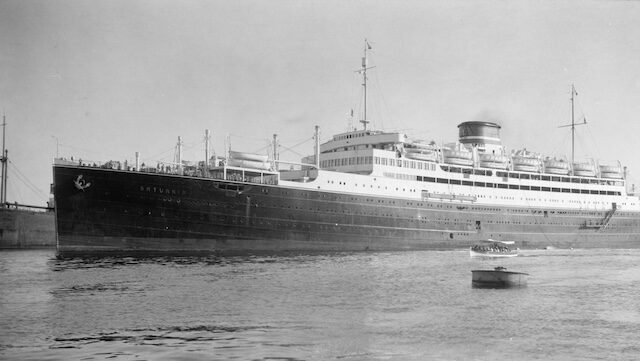
In early July 1960, my parents, sister, great-uncle Ernie and I sailed from New York City on a ship of the Italian Line, the “Saturnia.” Its name evoked Italy as the land of Saturn, where the old god, father of Jupiter, ushered in the Golden Age with his reign. The hulk itself, however, built in 1927 and only five years from the scrapheap, didn’t quite do that for us, especially in tourist class. A little sink garishly illuminated by an overhead light was the focal point of our cabin, which was below deck, so forget about the portholes I’d been looking forward to. The tepid air pumped into the cramped compartment contained a hint of recycled belches.
We were trying out our narrow bunks for size, two of them stacked against each side wall of the cabin, and beginning to think of a snooze after our dawn awakening and morning exertions. Then an amplified voice out in the corridor startled us:
“LA SECONDA COLAZIONE PER I SIGNORI PASSEGGERI DI CLASSE TURISTICA È SERVITA — PRIMO TURNO!)
Basically, “Lunch is served for the lordly passengers of tourist class — first seating.” There were two shifts for the meals in the tourist class dining room, and we had signed on for the later one. Since near-septuagenarian Uncle Ernie had opted for the corresponding early bird specials, we would never get to eat with him, but now he stopped by our cabin on his way to his 11:30 lunch to see how we’d settled in.
“Tony, Virginia, dear children,” he boomed from the doorway — sturdy and hale, Panama-hatted, white-suited. “Good, good, everything is good — a little crowded, I see, but you won’t be spending much time down here except to sleep anyway.”
When, an hour later, we heard the announcement for our group to go to lunch, we followed the signs up to the sprawling and chintzy dining room, which smelled not unpleasantly of mass-produced Italian food and more faintly of must. Nothing untoward happened at that first meal and we ate with enthusiasm. At dinner that evening, however, we noticed something amusing about the family of four assigned to one of the many tables surrounding ours.
They were Italians from Malta, as we eventually discovered, and were headed there after they got to Naples. The couple had a boy a little younger than me and a girl about my sister’s age — the children and their mother all slender and dark-haired like me, my sister, and Mom. But the man’s resemblance to my father was uncanny. Yes, he was shorter, rounder in face and form, ruddier of complexion and with a thicker and darker mustache, but he and Dad were cut from the same cloth.
All of us, even my father, noticed the eerie likeness. It was like watching a stage set a dozen feet away with four actors impersonating us, mimicking a family eating its dinner aboard an ocean liner. We tried not to snicker too obviously, and I wondered whether the doppelganger family was aware of looking into the same mirror as we were. Toward the end of the meal, however, when the family was engaged in some conversation that we couldn’t overhear in the hubbub of the packed room, the man’s face darkened before he delivered a sharp slap to the back of his son’s crew-cut head. We obviously had no idea what precipitated that emphatic act of paternal correction.
For our first full day at sea, Dad had bought blue berets for the two of us. Knowing it could get chilly aboard an ocean liner even in summer, he had provided us with semiformal headgear to wear with his gray sports coat and my dark-blue waist-length jacket. I would rather have thrown myself overboard than wear my new hat, but Dad’s foray into fashion came to an abrupt ending. When he saw that berets weren’t exactly popular that year on ocean liners crammed with working-class Italians, he wore his hat only when the weather was nasty topside — and I was allowed to go happily bareheaded for the rest of the journey.
Uncle Ernie also relaxed his dress code almost immediately. When we spotted his big hat up on deck, we saw that his white suit had given way to a plaid shirt and khaki pants. His only accessory, besides his ever-present cigar, was the video camera that was to remain slung around his neck for most of the voyage.
He wasn’t the only other person we knew on board. There was also the family of a kid my age from the neighborhood, Orlando (to which Mom, on the sly, always appended “Furioso” in honor of Ariosto’s epic poem). Though merely acquaintances, Orlando and I glommed on to each other and made a few other friends several years older than us — boys with slicked-back hair who were seriously interested in the girls sailing with us. And I, at age 9, found myself instantly attracted to one of the girls who was 13. A big 13.
NEXT MONTH: Shipboard adventures, amorous and otherwise