 Fra Noi Embrace Your Inner Italian


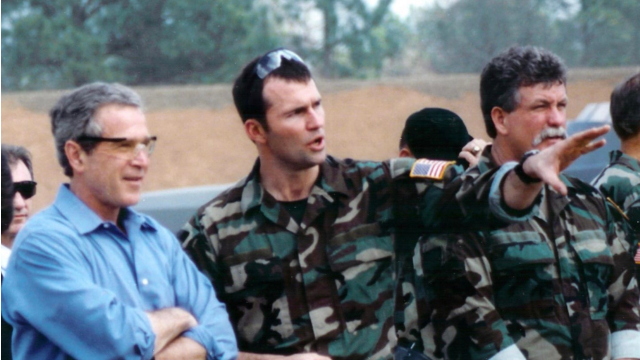
An article he ran across in a National Geographic as a child set Keith Pellegrini on a path to becoming a linchpin in Green Beret operations and campaigns for nearly three decades.
The youngest of three, Keith Pellegrini was born in the Chicago suburbs to Eugene and Patricia Pellegrini. The family lived in Bellwood until moving to Westchester when Pellegrini was in seventh grade.
Pellegrini lived close to his grandparents, aunt, uncle and cousins. “We were always at each other’s houses,” he says. “They were either at our house, or we were at their house.” Pellegrini remembers eating together, the men playing cards after dinner, the women sitting awhile before cleaning up, kids running up and down the stairs. “There was always plenty of food and multiple rounds of it,” says Pellegrini. “A very classic, connected, Italian, close family.”
His paternal grandfather emigrated from Malgolo, north of Trento, settled in Chicago and eventually became a founding member of the Trentino Alpine Club. Pellegrini’s dad later became president of the club and one of the founding members and president emeritus of the International Tyrolean Trentini Organization of North America (ITTONA). The passion they had for the club and their pride in their Trentino heritage were an integral part of growing up for Pellegrini and his siblings. “The Trentino Alpine Club and ITTONA were part of our extended family,” says Pellegrini. “Our paisanos were part of our extended family.”
Pellegrini graduated from Divine Providence Grade School in Westchester and Proviso West High School in Hillside. He next attended Marion Military Institute in Marion, Alabama. “Ever since I was a little kid, I wanted to go in the military,” Pellegrini says.
As a child playing in the basement, he discovered his father’s National Geographic magazines, with one piquing his interest. The January 1965 cover featured an Army Special Forces officer leading Vietnamese mountain people down a road. “I started looking at it, didn’t understand what it was but I was intrigued,” says Pellegrini. “I read it and I kept going back to it, and I would go to the library, and I really got hooked on the military.”
Growing up, he went through phases of becoming a police officer, fireman or pilot. “I always came back to the idea of being in the Army and, specifically, of being a Green Beret,” he says. Pellegrini’s parents saw the “writing on the wall.”
“They thought it was a positive thing that I wanted to go somewhere with discipline that would give me focus,” says Pellegrini, “but they were certainly a bit uneasy.”
Marion Military offered a program to become an officer in two years. While there, Pellegrini earned a three-year Army scholarship, contracted with the U.S. Army just before his sophomore year and participated in ROTC.
Upon graduating, Pellegrini transferred to American University in Washington, D.C., and he became part of the ROTC program at Georgetown University. Pellegrini earned his bachelor’s degree in international studies in 1990, and 10 days later was commissioned as second lieutenant through the ROTC program out of Georgetown.
Pellegrini reported to Fort Benning, Georgia, for the four-month Infantry Officers Basic Course and next completed Ranger School at numerous locations within the U.S. for various phases of training, including mountain phase, jungle/swamp phase and desert phase. Pellegrini was assigned to the 101st Airborne Division in January 1991 at Fort Campbell, Kentucky.
During the three years he served with the 101st, Pellegrini held various positions beginning with Platoon Leader, leading up to Staff Officer. “I had about four different jobs while I was there,” says Pellegrini. “Each one is sort of progressing you up as you gain more experience, get more responsibility, more broadening.”
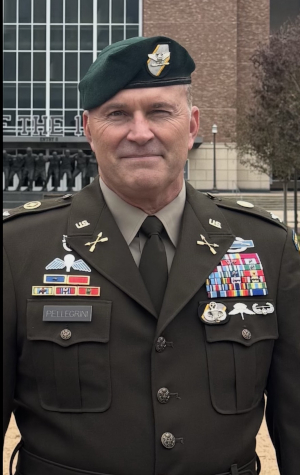 Pellegrini volunteered for Special Forces while at Fort Campbell and successfully completed the three-week Special Forces Assessment and Selection. “They put me through a series of physical and psychological challenges to test whether I had the physical, psychological profile and mental wherewithal to be in Special Forces,” says Pellegrini.
This was followed by a Special Forces qualification course. “You learn everything you need to know about how to be a Special Forces officer,” he says. “You learn your role, and you learn the roles of each of the various specialties within your unit.”
Pellegrini explains that the term Special Forces specifically describes the U.S. Army Special Forces, colloquially known as Green Berets. “Our official name is Special Forces,” Pellegrini says.
Pellegrini completed numerous training courses, in addition to language school, and then reported to the Third Special Forces Group at Fort Bragg and took command of a military freefall detachment. “Our specialty method of infiltration was military freefall, high-altitude parachuting,” he says.
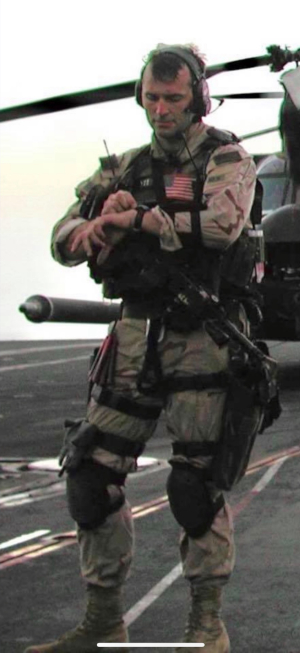 All Green Berets are static line parachute-qualified to jump out of a plane from altitudes between 600 and 1,800 feet. “My team had the additional skill of doing high-altitude infiltration, so we jumped from 10,000 feet all the way up to 25,000 feet,” he says, “either with oxygen or without oxygen, depending upon the nature of the jump.”
The young boy who once dreamed of becoming a Green Beret went on to fulfill his dreams beyond expectations. Over his 28-year career, Pellegrini deployed to numerous countries on three continents. Initially serving in Special Forces, he eventually volunteered for a Special Mission Unit conducting more specialized operations. Pellegrini led a Special Operations Assault Troop in Afghanistan as the Global War on Terrorism kicked off and, after 9/11, focused specifically on counterterrorism.
In October 2001, Pellegrini deployed to Afghanistan for the first time. As Assault Troop Commander, he took part in the first ground combat operation into Afghanistan after 9/11. “I led one of the operational elements,” he says. “We conducted the longest air assault raid, the longest helicopter raid in U.S. military history as part of that operation.”
The raid on the house of Mullah Omar was unsuccessful in that they didn’t capture Omar, but intelligence was collected. “There was a significant component to that mission,” Pellegrini says, “demonstrating to the Taliban that we could strike anywhere, any time or place.”
Pellegrini explains that his training exercises had been extremely realistic, and he and his unit were conditioned to understand the targets and had rehearsed and prepared. “So, as I was going in, I knew what we were supposed to do,” says Pellegrini. “I knew what contingencies we had so if something didn’t go right, at least I knew what the first thing I might do, what my reaction would be.”
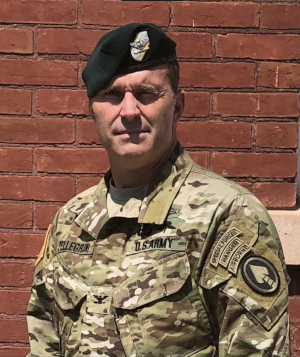 Pellegrini deployed to Iraq four times in several different roles, including Operations Officer for a Special Operations Unit, Officer in charge of Special Operations Forces and Operations Officer for the Task Force.
During the initial invasion in 2003, he took part in combat operations that attacked through the western desert towards Baiji. After major combat operations ceased, missions were conducted from an operating base. “You’d either drive out or fly off in helicopters and conduct an operation, conduct a hit and then come back and base out of wherever you were,” Pellegrini says.
He reflects on his missions. “The only thing I was scared of or worried about was letting my guys down,” says Pellegrini. “I wasn’t worried about what the enemy would do; I was worried to make sure that I was going to do everything that the guys needed me to do.”
Through the years, Pellegrini earned a master’s degree with distinction in national security and strategic studies and led troops in Bosnia and Haiti, as well as other deployments. He was with the 3rd Special Forces Group and deployed to Bosnia in 1998. “I took part in operations to bring about the full accounting of the Dayton Peace Accords,” he says.
His facility was staffed by about 20 or so Americans but because of the multi-national aspect of the mission, the camp was guarded by Italian forces. “Once a week I would go down into their headquarters and have dinner with them and they had the best chow in Sarajevo,” says Pellegrini. “And we would talk until all hours of the evening.”
In 2010, he conducted humanitarian relief operations as a battalion commander in the 82nd Airborne Division. The combat-trained soldiers deployed to Haiti to provide aid after the devastating earthquake. “These young men and women stepped up and showed compassion and restraint and represented our country in the most positive way,” Pellegrini says.
In the last years of his military career, Pellegrini, again focusing on counterterrorism, worked closely with partners from across the U.S. government and extensively with the Intel community. He also spent a year at the U.S. State Department. “I was very fortunate to have a lot of really neat opportunities over the course of that time,” Pellegrini says. “My last job in the Army was as the Senior Special Operations Advisor to the CIA.”
Pellegrini retired from the U.S. Army in 2018 as a colonel. He is a partner at the McChrystal Group, a leadership and advisory services firm founded by retired Gen. Stanley McChrystal, for whom he worked while in the Army.
Pellegrini is the proud father of twins, a boy and a girl, who share their father’s pride in their Trentini heritage. They enjoy preparing favorite family Italian meals together.
Looking back upon his successful military career, Pellegrini says: “I was able to achieve everything I dreamt about as a kid and more. Even as a kid I could not have thought about the things that I might do that I was subsequently able to do as an adult because of the unique opportunities that have been afforded to me, and sometimes the unique situations I found myself in.
“I am proud to be an American,” he concludes, “and I am extremely proud to be an Italian American, and a Trentino specifically.”
The above article appears in the November 2026 issue of the print version of Fra Noi. Our gorgeous, monthly magazine contains a veritable feast of news and views, profiles and features, entertainment and culture.
To view a sample copy, click here.
To subscribe, click here.