 Fra Noi Embrace Your Inner Italian


In last month’s blog, we learned the singular forms for questo and quello.
But there is more to this story, as the Italian plural masculine and feminine forms of questo and quello
are used to say “these” and “those.”
The ending change for questo is straightforward, while the ending change for quello is more complex.
Luckily, both follow the basic rules off Italian grammar!
How I learned to say “these” and “those” in Italian
As mentioned in last month’s blog about how to say “this and that” in Italian, as a child in an Italian-American household, I learned snippets of Italian around the dinner table from my grandmother, who would pepper her conversation with Italian phrases that always sounded so much more expressive than their English counterparts. My other relatives would also add a few Italian words at just the right time to enliven their English, and almost always embelish their sentences with a hand gesture. And, since they were a part of my everyday interactions, these Italian conversations led to Italian words that easily became a part of my vocabulary.
For instance, take the demonstrative adjectives questo and quello. Because my grandmother and other relatives used demonstrative adjectives often to point out their favorite dishes at the dinner table, I knew what these adjectives meant and how to use them before learning the official rules of Italian grammar.
At the dinner table, I learned that
if you wanted more than one of something nearby
— “these”—
you used the plural of questo, either “questi/queste.”If you wanted more than one of something further away
—“those”—
you used the plural of quello, such as quei, quegli/quelle”
When my mother was passing around the many antipasto platters, she might receive a request to dish out questi carciofi sott’olio or quelle olive verdi — these artichoke hearts in olive oil or these green olives.
Or, maybe the platter with quei calamari fritti and quelle acciughe fritte — those fried squid and those fried anchovies was placed in the center of the large table, and a request made to pass the platter to one end of the table or another. The rules didn’t matter at the time. What I did appreciate was how the identical adjective-noun endings gave Italian its lovely melodic sound.
How questi/queste and quei, quegli, quelle fit into an Italian sentence
We’ve already discussed Italian adjectives in detail in the blog How to use colorful Italian adjectives. From this blog, you’ll recall that certain Italian adjectives always come before they noun they modify, while others always come after. And some may be placed either before or after the noun, with the placement creating different shades of meaning for the same adjective.
The demonstrative adjectives questo and quello always precede the noun they modify, whether in the singular or plural. This works nicely in Italian if one wants to point out something and then add an additional description for clarification.
Back to our examples from the last section. The demonstrative adjective questi, which means these, precedes the pluarl noun carciofi. Quelle, for those, precedes the plural noun olive, and the Italian adjective green, which is verde, is added after the noun. At my mother’s house, the added reference to color when requesting a type of olive was always necessary due to the many choices on the olive platter!
For quei calamari fritti and quelle acciughe fritte, notice how not how the plural endings quei and quelle modify the masculine and feminine endings for each type of shellfish. Not only that, fritto, (the past participle “fried”) used as an adjective after the noun, changes from the masculine “i” to the feminine “e” ending as needed.
Of course, the combinations for using questi/queste and quei,quegli/quelle at the dinner table are endless! Later, when I learned the grammar behind the demonstrative adjectives, I discovered a few more “rules” which were created to help the Italian language flow even more smoothly, which were shared in the blog from last month. Let’s update our examples to include the plural demonstrative adjectives.
The Italian grammar of questo and quello
Questo and quello are called demonstrative adjectives. They mean this and that, and, as noted above in the story of my childhood, and are used to point out something that is near to the speaker — this — or far from the speaker — that.
The plural forms of questo and quello mean these and those and are used to point out groups of people or items that are near to the speaker — these — or far from the speaker — those.
Feminine Demonstrative Adjectives Queste and Quelle
The feminine demonstrative adjectives queste (these) and quelle (those) have -e endings and are used to modify feminine plural nouns. Feminine plural nouns usually end in -e, but can also end in -i if the signular feminine noun originally had an -e ending.
Let’s add the plural to complete our table from the previous blog about the singular feminine forms questa and quella. Queste and quelle are used for all feminine plural nouns, whether the noun begins with a consonant or a vowel. However, notice the ending change of amica to amiche in the plural to keep the sound of this noun the same.
| Questa Queste | |
| questa casa queste case | this house these houses |
| questa amica -or- quest’amica queste amiche | this girlfriend these girlfriends |
| quest’altra queste altre | this other these other |
| Quella Quelle | |
| quella casa quelle case | that house those houses |
| quella amica -or- quell’amica quelle amiche | that girlfriend those girlfriends |
| quell’altra quelle altre | that other those other |
Mi piacciono queste due case; non posso scegliere fra una o l’altra.
I like these two houses; I can’t choose between one or the other.
Queste amiche mie sono favolose!
These girlfriends of mine are fabulous!
Quelle olive verdi erano deliciose!
Those green olives were delicious!
Masculine Demonstrative Adjective Questi
The masculine demonstrative adjective questi (these) has an -i ending and is used to modify masculine plural nouns.
Let’s add the plural to complete our table from the previous blog about the singular masculine forms questo and quest’. Questi is used for all masculine plural nouns, whether the noun begins with a consonant or a vowel. However, notice the regular ending change of amico to amici the plural; in this case, the sound of the noun changes.
| Questo Questi | |||
| questo giorno questi giorni | this day these days | ||
| quest’amico questi amici | this friend (male) these friends | ||
Questi giorni sono molto contenta perché vivo con i miei parenti in Italia.
These days I am very happy because I live with my relatives in Italy.
Questi amici miei sono veri amici.
These friends of mine are true friends.
Masculine Demonstrative Adjectives Quei and Quegli
As noted in our last blog, the masculine demonstrative adjective quello (that) is used to modify masculine singular nouns. But quello does not follow the simple Italian gender rules when changing its ending to agree with the noun it modifies. Instead, quello follows the rules for Italian masculine definite articles — in both the singular and the plural.
Let’s add the plural to complete our table from the previous blog about the singular masculine forms quel, quell’ and quello.
For the plural masculine forms of quello: for masculine nouns that being with a consonant, the -llo is dropped and the usual -i ending is added to que to make quei.
For the plural of masculine nouns that begin with a vowel or s + consonant, z, ps, or gn, the -llo is dropped and a -gli ending added to make quegli.
Once again…
The rules for combining quello with an Italian masculine noun
are not as complicated as they may seem at first,
as they are the same rules as for the masculine definite article!
| Quello Quei, Quegli | ||
| quel giorno quei giorni | that day those days | |
| quell’amico quegli amici | that friend those friends | |
| quello zio quegli zii | that uncle those uncles | |
Quei giorni sono stati i miglior giorni della mia vita.
Those days were the best days of my life.
Quegli amici miei, nella squadra di calcio, sono forti!
Those friends of mine, in the soccer team, are awesome!
Quegli zii, da parte di mia madre, sono in affari insieme.
Those uncles, on my mother’s side, are in business together.
Remember how to use
the Italian demonstrative adjectives questi/queste
and quei/quegli/quelle
and I guarantee you will use
these words every day!
For “All the Italian you need to enjoy your trip to Italy,”® click on the links below to purchase my Conversational Italian for Travelers books – and then listen to the audiobook “Just the Important Phrases” on your favorite streaming platform! —Kathryn Occhipinti
Conversational Italian for Travelers “Just the Verbs” and “Just the Grammar”
are available on Amazon.com and www.LearnTravelItalian.com

Conversational Italian for Travelers “Just the Important Phrases” pocket travel book with audio
on your favorite streaming platform from Amazon.com and www.LearnTravelItalian.com
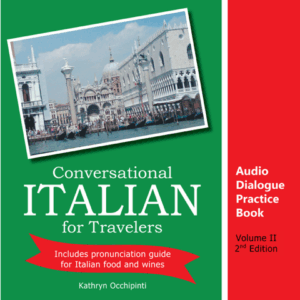
New! Practice short Italian phrases with this Audio Dialogue Practice Book.
Check out how to pronounce restaurant vocabulary in Volume 2!
Download the audio from your favorite audio platform today!
Check them out on Amazon.com and Spotify.