 Fra Noi Embrace Your Inner Italian


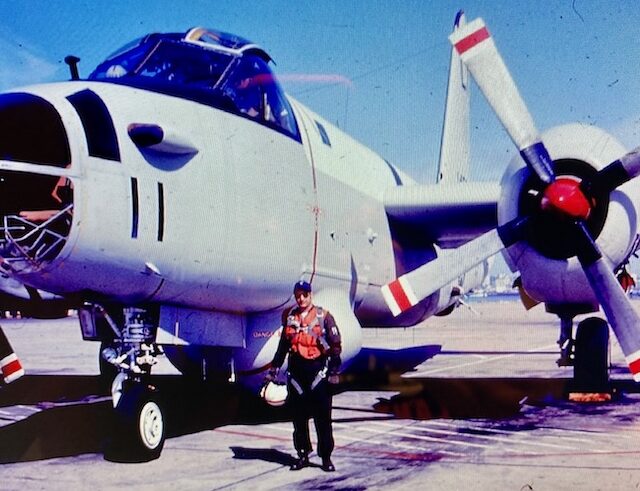
Fascinated with airplanes from an early age, Dennis Santi lost two pounds in a week to pass the physical and embark on a quarter-century career in the Naval Reverse’s aviation program.
The younger of two boys, Dennis Santi was born in Highwood, Illinois, to Ernest and Victoria Baldi Santi. His maternal and paternal grandparents emigrated from the Modena region of Italy.
Santi’s father died when he was 1 year old, and his mother worked as the city clerk in Highwood. “We were lucky to grow up in Highwood in an Italian neighborhood,” Santi says. “It was close-knit. If I got in trouble, my mother found out about it.”
His maternal grandparents, aunts and uncles lived nearby. Santi fondly remembers his grandmother’s tortellini and tortellacci. “You always had to have tortellini soup and you always had to have some kind of pasta with a meal,” he says.
Santi attended Oak Terrace Grade School and graduated from Highland Park High School. He was employed as parts manager for a local Chrysler Plymouth dealer until he was drafted into the U.S. Army in 1965.
It was the middle of the Cold War and the fighting in Vietnam was escalating. “From the very beginning I knew I wanted aviation,” he says. “I didn’t want to go in the Army and just do whatever. I wanted aviation!”
As a child, Santi watched planes flying into Glenview Naval Air Station, built model planes and could identify World War II aircraft. He looked into the Navy Aviation program, took the physical and was two pounds overweight. A few days later, he passed the Army physical. Santi starved himself for a week, retook the Navy physical, passed and immediately joined the Navy Reserve aviation program in April 1965 for six years.
Santi took part in drilling exercises, reporting in September for active duty at the Naval Air Base in Millington, Tennessee. He completed Reciprocating Engine School and returned to Glenview, assigned to a Helicopter Squadron. Santi then attended helicopter school and air crew school and became plane captain.
Santi conducted preflight and post-flight inspections of the helicopter and was responsible for daily maintenance and servicing. In addition to his plane captain duties, Santi operated the hoist and he was the sonar operator. “We had a dip sonar and we were an anti-submarine warfare squadron,” he says.
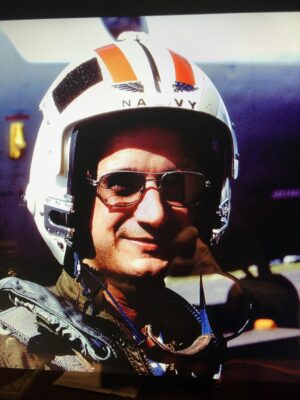 After his first five years, the Navy switched to the P-2 Neptune, an anti-submarine warfare airplane, and Santi became the flight engineer. “I sat between the pilot and the co-pilot. I would start the engines, control the fuel management and handle any emergencies,” says Santi. “I loved it, so I signed up for another six years.”
The little boy who loved airplanes grew up to serve nearly 26 years in the Naval Reserve, 25 years on flight crews. “I loved flying,” he says.” I loved getting away and the adventure of flying in the airplanes.”
Santi exceeded his one weekend-a-month commitment to stay efficient at his job. “I would spend four to six days a month flying extra and sometimes, the two weeks would be extended to a month because of different schools,” he says.
The Navy then switched to the P-3 Orion, a four-engine turbo prop with a standard crew of eight to 10 people. The long-range, anti-sub warfare plane flew with two flight engineers and three pilots, staying out for 15-18 hours. Santi acted as Second Engineer, once again sitting between the pilot and co-pilot. “They flew the airplane and I had to more or less keep it going and handle any emergency stuff,” says Santi.
In the beginning years, Santi’s two-week active duty took place in Key West, Florida, and San Diego, California, and involved conducting maneuvers with American submarines.
Once assigned to the P-3 Orion, Santi flew out of Barbers Point, Hawaii. With the P-3 Orion capable of flying thousands of miles, Santi deployed on various missions. “We would also be tasked with different things, but primarily we were anti-submarines,” he says.
Santi remembers locating Russian “fishing boats” off the Hawaiian coast. “Well, fishing boats don’t have different antennas all over; this is the cold war,” says Santi.
He flew off the coast of Vietnam, deploying to Japan, the Philippines and the Azores. “We were searching for Russian submarines and also doing surveillance for ships going in and out of Vietnam,” he says. Santi was the flight crew photographer. “We would fly down to 100 feet off the water and we had to take specific photos of ships to see if they were carrying missiles or what type of cargo they were carrying into Vietnam,” he says.
His flight crew located boat people attempting to escape from Vietnam. “We would report to the Navy and the regular ships where these people were so they could be rescued,” says Santi.
After serving 18 years, Santi transferred to a DC-9 Squadron. The plane carried 100 people, cargo or both and Santi acted as cargo load master and No. 1 flight attendant. “I had to figure out the weight and balance of the airplane,” he says. “If I put 8,000 pounds of cargo in the front, I had to have so many people in the back to balance the airplane.”
Typical weekends began on Friday afternoons, with Santi flying to various Air Force bases, picking up reservists and bringing them back to Glenview for their drilling sessions. He made the reverse trip on Sunday nights.
Another assignment might be flying to Norfolk, Virginia, to meet a squadron coming in off a carrier. “I would pick up all their cargo and the people, fly them down to their next station, maybe Jacksonville, Florida or Dallas, Texas, or even California,” Santi says. “We’d fly all over the country.”
Santi retired as E6 in 1990, amassing more than 4,000 flight hours, and went on to earn a private pilot license. “I couldn’t stop chasing clouds,” he says.
Career highlights include being on the plane that discovered the sunken Edmund Fitzgerald and flying over Mount St. Helens 30 minutes before it erupted. “I had pictures of the big bulge on the side of the mountain and we felt the air turbulence bouncing us around,” says Santi.
Santi and his flight crew visited the island of Corregidor, where they located the caves and barracks where MacArthur made his last stand. “You could see the bullet holes in all these barracks and the cannons that they had there, the barrels were melted,” he says.
Santi has been employed with Knauz Auto Group for 56 years and continues working one day a week. He and his wife, Judy Hayes Santi, have three surviving children and two grandchildren.
Reflecting on his Navy career, Santi says, “I loved it. If I could do it again, I would.” He concludes that, “I felt because I was in the Reserves and didn’t go to Vietnam that I felt more obligated to continue. I felt since I didn’t go there, I didn’t do enough for my country, and I needed to do it my way.”
The above article appears in the February 2026 issue of the print version of Fra Noi. Our gorgeous, monthly magazine contains a veritable feast of news and views, profiles and features, entertainment and culture.
To view a sample copy, click here.
To subscribe, click here.