 Fra Noi Embrace Your Inner Italian



Built at Camp Atterbury during its three-year stint as an internment camp for Italian POWs during World War II, the chapel stands today as a testament to the perseverance and faith of its creators.
Nestled among the 40,351 acres that encompass Camp Atterbury in Indiana is a tiny chapel built in a meadow. This is no ordinary chapel, not because of anything strange or unusual, but because of who built it and how it was built.
Camp Atterbury is a military complex used by the National Guard, 30 miles south of Indianapolis off U.S. Route 31 near Edinburgh. From 1943 to 1946, a 45-acre internment camp housed around 12,000 German and Italian POWs. The camp was run by the 1537th Service Unit of the U.S. Army.
The first Italian POWs arrived in April 1943. Many of the Italians were captured in northern Africa. Local residents were skeptical of and ill at ease with the POWs’ presence. The behavior of the Italians helped change their minds.
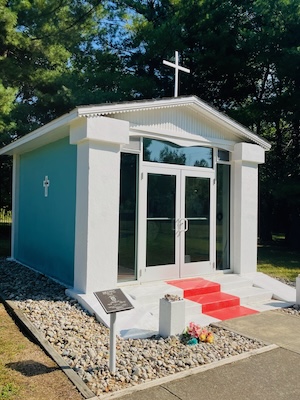 To maintain their Catholic faith, the Italian POWs asked if they could build their own chapel rather than celebrate Mass in the rec room or outdoors. Camp Commanding Officer Lt. Colonel John Gammell gave them permission but could not provide them with funding.
To compensate, the prisoners used whatever scrap materials they could find around the base. They made some paints out of wild plants and berries, and even used some of their own blood to create certain pigments.
They painted the walls a brilliant Mediterranean blue and decorated the chapel with murals and frescos of Jesus, the Virgin Mary, St. Anthony, cherubs, angels and the Holy Spirit. The altar was painted in a faux marble.
Measuring roughly 11 feet by 16 feet and 12 feet high, the original structure was three-sided with an open face at the back. U.S. Army Chaplain Lt. Maurice Imhoff oversaw the prisoners and celebrated Mass on Sundays throughout their internment. The chapel was dedicated to the Blessed Mother.
When hearing they were going to Indiana, some of the POWs thought they were going to India. After processing upon their arrival, the Italians learned basic English and military conduct as POWs.
Life at the internment camp was not exactly rough and many were assigned regular duties. Prisoners worked as groundskeepers, cooks, janitors, laundry-room workers, etc. Some even worked on local farms. Prisoners had access to soccer fields, gymnasiums, volleyball courts and bocce courts. They even cleared land and planted their own gardens. Most preferred being POWs to fighting on the front lines in a war they didn’t necessarily believe in.
Being mostly from rural areas, the Italians marveled at the modern equipment at the camp. They would volunteer to cut the grass just so they could use the lawn mower. The Italian POWs had relative freedom around the camp and were allowed to carry on their customs, even cooking for themselves because the “American” food was not to their liking. A few engaged in clandestine efforts to make wine.
Prisoners were allowed two visitors per month. Many POWs already had relatives and friends in the United States who would visit. Although POWs received regular mail, visitors would bring uncensored news of the POWs’ families in Italy.
One such prisoner, Rocco Ameduri, would meet with relatives and friends from the South Bend area. They later encouraged a local young woman, Guilia Simeri, to write to him. After being repatriated, they were married and immigrated back to the United States, founding Rocco’s Restaurant in South Bend, which has become a fixture near Notre Dame.
Because of the war, many local farms lacked young men to work the fields. The POWs were hired out and volunteers were sought. POWs earned 80 cents a day for their efforts. Some worked at a canning plant in Franklin, Indiana. The citizens of Franklin could always tell if workers were Italian vs. German as the trucks approached. The Italians would always be singing and enjoying themselves.
The Italians also formed a glee club. When the Most Rev. Amleto Cicognani visited in 1943, he was treated to a concert by a 45-piece band, ate with prisoners in their mess hall and attended a one-act play. Cicognani was the apostolic delegate to the United States and would later become Cardinal Secretary of State for the Vatican.
The Italian POWs arrived on April 30, 1943, and the last departed on May 4, 1944. Sadly, three POWs passed away while at the camp and were buried there. Their bodies were later moved to a cemetery at Camp Butler in Illinois. The Germans arrived on May 8, 1944, and the last one left on June 27, 1946. All told, there were around 3,000 Italians and 8,900 Germans.
After all the prisoners were repatriated, the chapel as well as the camp fell into disuse and disrepair. The chapel was relatively close to the camp but the surrounding buildings were torn down shortly after the camp closed. The chapel was spared because the wife of the officer in charge of demolition asked them to not raze it.
Efforts to restore the chapel by Indianapolis-area Italians in 1953 and 1963 bore some fruit. Then, in the late 1980s, Professor James J. Divita began a project to restore the “Chapel in the Meadow.”
A longtime history professor at Marian University in Indianapolis, Divita had written a history of Italians living in the area. He was aided by the Italian American Heritage Society of Indiana, based in Indianapolis; the U.S. Army National Guard; the Italian government through its Chicago consulate; and several sponsors and donors. IAHS President Pietro Ferri, Indianapolis Councilman David Page and National Guardsman Peter Iaria were instrumental in rallying funding and cooperation for the project.
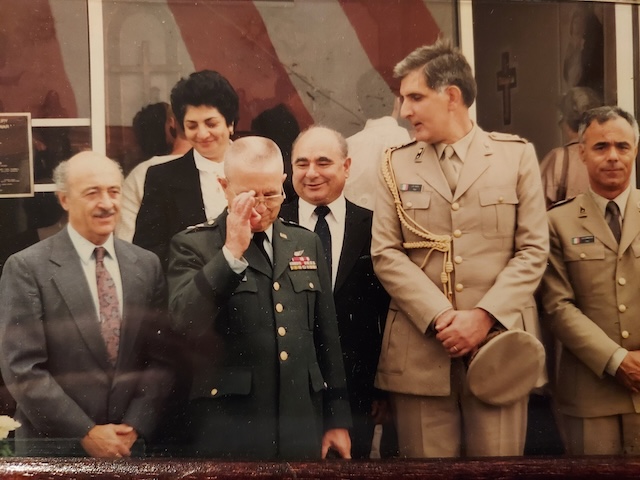
The refurbished chapel was rededicated in September 1989. Among those in attendance were Col. Jorg Stachel, base commander; a colonel and captain from the Italian army; and Pietro Agostino, Italian consular agent for Indiana. The IAHS of Indiana holds an annual Mass and remembrance at the chapel every September.
Thanks to the efforts of Camp Atterbury, the IAHS and the Indiana Historical Society, the stories of individual prisoners are being preserved as part of the “You Are There” series at the Indiana History Center in Indianapolis.
The story of former POW Fioravante Pagnucco is featured in the exhibit. His son, David Pagnucco of Detroit, appreciated that his father’s story was told in a dignified manner. The Welcome Center at Camp Atterbury houses additional chapel and internment exhibits in its museum.
A stone dedicated to and carved by the prisoners was placed at the entrance to the chapel plaza. The prison camp area is now Johnson County Park. Today, it stands as a monument to Italian perseverance and ingenuity, and a testament to their faith.
The article above appears in the December 2025 issue of the print version of Fra Noi. Our gorgeous, monthly magazine contains a veritable feast of news and views, profiles and features, entertainment and culture.
To view a sample copy, click here.
To subscribe, click here.