 Fra Noi Embrace Your Inner Italian


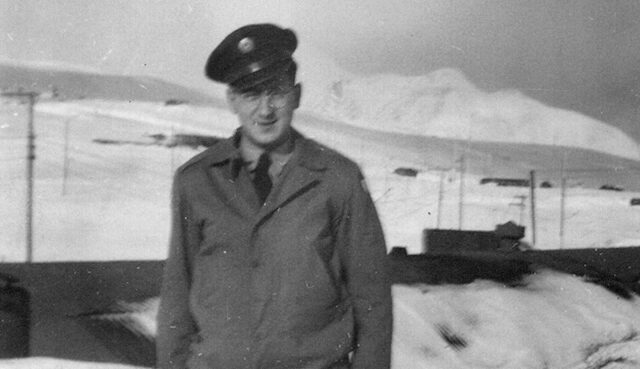
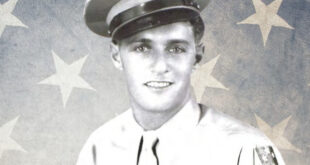
As the head of a machine-gun crew, Ralph Bertolacini helped safeguard Alaska during World War II.
The older of two sons, Ralph Bertolacini was born in Aug. 8, 1925, in Pawtucket, Rhode Island, to Pietro and Mary Cardosi Bertolacini. His father emigrated from Barga, Italy, with an older brother. His mother’s family was also from Tuscany.
Bertolacini grew up near his maternal grandparents, aunts, uncles and cousins. “I spent a lot of time with my grandmother. In fact, that’s where I learned to speak Italian,” Bertolacini says. “My father had the attitude like a lot of other Italians. You should learn to speak English.”
He recalls Sundays at his grandparents’ house. “The men played bocce with their friends and had a little wine.” Holidays were a family affair. “A typical Italian feast,” says Bertolacini. “My mother and grandmother were great cooks. They made ravioli like you wouldn’t believe.”
Bertolacini’s father and uncle owned a bakery and young Bertolacini filled his own jelly donuts. “I used to pump it so full of raspberry that when I ate it, it sort of exploded on my face,” he chuckles.
Bertolacini attended High Street Grade School, graduated from Joseph Jenks Junior High, and advanced to Pawtucket East High School. He left during his senior year to attend college classes. “Because of the war, several of us were allowed to leave high school before we graduated,” Bertolacini explains. “We went to the University of Rhode Island with the stipulation that if we didn’t make it we’d have to come back to high school and finish it off. We all made it.”
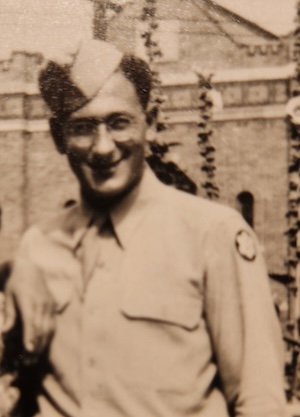 He graduated with his class in 1943 and was drafted into the U.S. Army in August of that year. His parents were not happy because he was so young and the war was still raging, but they accepted it. “It was the norm of the day,” he says. “All my relatives who were my age were in the service, so it was kind of a commonality.”
Bertolacini reported to basic training at Aberdeen Proving Ground, Maryland, in January 1944, where he also trained as company clerk. In July he reported to Shenango Replacement Depot in Grove City, Pennsylvania. “It’s where they decided where you were going to go, which theater,” says Bertolacini.
In September 1944, he boarded the Otsega in British Columbia for the four-day passage to the Aleutian Islands. The small ship rolled and bounced in rough Pacific waves. “There were 44 military people on that ship and all of us were pretty sick,” Bertolacini says. A priest handed out soda crackers. “That’s pretty much what we lived on,” he says.
Bertolacini arrived in Dutch Harbor and transferred to the island of Umnak. He lived in a Quonset hut buried in the ground for concealment against Japanese aircraft. Only the tops of the huts were visible. “We never saw any fighting at all,” Bertolacini says. “They were defeated by the Canadians and the Americans before I even got there.”
Assigned as company clerk, Bertolacini worked in the office. “The hours were always kind of loose depending on how much action we were having in the office,” he says. Bertolacini typed requisitions for any supplies and equipment that the troops might need. “Anything except food,” he says.
Bertolacini was on Umnak for six months until the military transferred all troops to the main base on Adak. “The story was they’re all volcanic islands, so there may have been some start of volcanic action on Umnak,” says Bertolacini. The active base was home to Army, Air Force, Navy and Seabees. “The Air Force used the base in Adak for reconnaissance,” Bertolacini says.
Assigned to the Quartermaster Detachment of the Alaskan Defense Command in the Aleutians, Bertolacini worked as warehouse foreman. He supervised storage of military supplies and equipment, filled requisitions and maintained all pertinent records. Any clothing a soldier might need from his shoes to his hat was available as well as bedding and household goods. “When any Army personnel needed something, they sent a requisition to the warehouse.” Bertolacini says. “We handled all items except food and munitions, no firearms.”
Periodically, a supply ship docked and Bertolacini helped unload the material. “Every once in a while we’d get a Russian ship that was handling lumber and wood from southern Alaska,” Bertolacini says. The sailors included women dressed in men’s clothing. “It was kind of interesting,” he says. Bertolacini remembers one occasion when the ship’s captain invited the soldiers onboard to have a toast of vodka with him. “We didn’t drink the vodka, but we did tour the ship,” he says.
Bertolacini was in charge of a 50-caliber machine-gun crew. They routinely participated in maneuvers and war games to maintain their skills and state of readiness. Living in a tent the first months until a Quonset hut became available, he experienced all kinds of weather conditions, from intense summertime fog to wintry cold, wind and snow. “The wind blew as much as 60 miles per hour,” he says. “You learned to lean when you walked.”
The base provided a gym, where Bertolacini played basketball, as well as two movie theaters and a church. Occasionally, USO performers entertained the troops. The mess halls were open to all the armed forces, allowing military personnel to go from one to another. “A group of us would always go to dinner on Sunday at the Navy station because the Navy station always had fried chicken,” Bertolacini says, “whereas the Army sometimes had Spam and not quite as good a menu.”
Bertolacini served his country in the Aleutian Islands from September 1944 until April 1946, when he boarded the George Washington Carver, a hospital ship, for the trip home. A troop train took Bertolacini from Seattle to Camp Devens in Massachusetts, where he was discharged as Staff Sergeant. He returned home and under the G.I. Bill resumed his studies at University of Rhode Island, earning a bachelor’s degree in chemistry in 1949. He continued his education at Michigan State, working as a teaching assistant and graduating with a master’s in chemistry in 1951.
Bertolacini enjoyed a successful career with Amoco Oil Co., first in Whiting, Indiana, and then Naperville, Illinois. Over his 39 years in the Research Department, Bertolacini held numerous positions, eventually retiring as research manager. He holds 87 U.S. patents in catalysis, has written 25 articles and has two published books.
Bertolacini married Dorothy Thompson in 1953 and has three children and two grandchildren. Widowed, Bertolacini remains active with the Amici Naperville Area Italian American Club. He recently participated in an Honor Flight to Washington, D.C., initially holding off. “I always felt that the Vietnam Vets should have gone on the Honor Flight first,” he says.
Reflecting on his Army experience, he says, “I’m like every other soldier. I saluted and said, ‘Yes, sir.’ I’m certainly not a hero.”
The article above appears in the October 2025 issue of the print version of Fra Noi. Our gorgeous, monthly magazine contains a veritable feast of news and views, profiles and features, entertainment and culture.
To view a sample copy, click here.
To subscribe, click here.