 Fra Noi Embrace Your Inner Italian


There’s a famous quote from St. Francis of Assisi that applies to the renovation of the Shrine of Our Lady of Pompeii: “First, what is necessary; then do what is possible; and suddenly you are doing the impossible.” This spring, the Shrine will be in full bloom at our newly renovated place of worship, which has been the home of Italian Americans for more than a century.
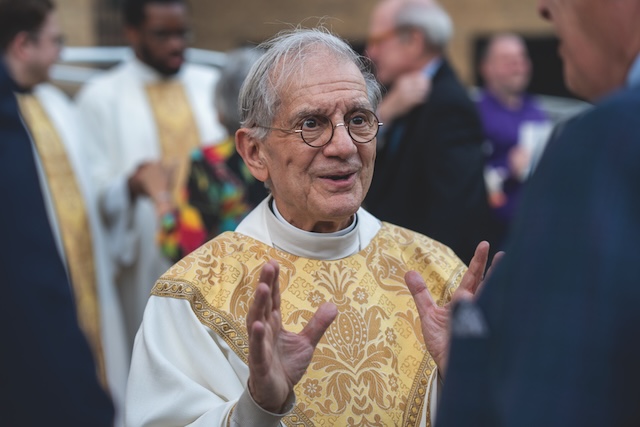
Fr. Richard N. Fragomeni, Ph.D., rector of the Shrine, always says, “The Shrine is a place where your heart has a home.” Well, this renovation wouldn’t be possible without the hearts of many. And it started more than 30 years ago.
Let’s go back to 1990. The Shrine school had closed, the neighborhood was suffering from a decline in population, and the Archdiocese of Chicago had decided to close the parish known as Our Lady of Pompeii. When it seemed as if the heritage of this sacred space would be lost, neighborhood leaders, former parishioners and alumni launched a remarkable grassroots effort, Pompeii on the Move. With a strong, united voice, they kept Our Lady of Pompeii’s heritage alive in a new form. On Oct. 10, 1994, Joseph Cardinal Bernardin proclaimed Our Lady of Pompeii Church a Shrine dedicated in honor of Mary, the Mother of God, Queen of the Holy Rosary.
Over the years, the community remained strong and vibrant, but the physical condition of the church and adjacent auxiliary hall had severely declined. Falling plaster during Mass was common, lighting was dim at best and when the ancient loud boiler went out in the winter, the Holy Water was cold enough to keep ice cubes afloat for hours.
“I would sit here on Sunday Mass, look around, and just be in awe at how beautiful this place could be,” says Dominic Stramagalia, founder of Supreme Lobster. “So, I called Fr. Fragomeni and said, ‘Let’s have lunch.’ At lunch, I asked him to tell me about past renovations and the Shrine’s plans. He told me. I looked at him and said, ‘Let’s do it!’”
“I will never forget that conversation,” Fragomeni says. “My prayers for this Shrine were literally answered. It’s been at the center of my heart for a very long time; to return this beautiful building and the hall into its shining glory, I knew it could be.”
Shining On, a new capital campaign to bring this vision to life, was launched and planned in phases. In the first phase, Stramaglia generously donated $3 million to renovate the old school hall into a multi-use space and chapel, allowing worship to continue uninterrupted. At the same time, the campaign commenced with a goal of securing donations to match the $3 million.
Thanks to the generosity of so many, Shining On exceeded its goal and reinforced the principle that the effort to restore the Shrine belongs to the entire community, not any one individual.
The campaign also represents a more comprehensive investment, focused not only on aesthetics but on rebuilding the church’s core infrastructure, including lighting, HVAC and electrical systems.
Once the new chapel was finished, the next phase of restoring the church began.
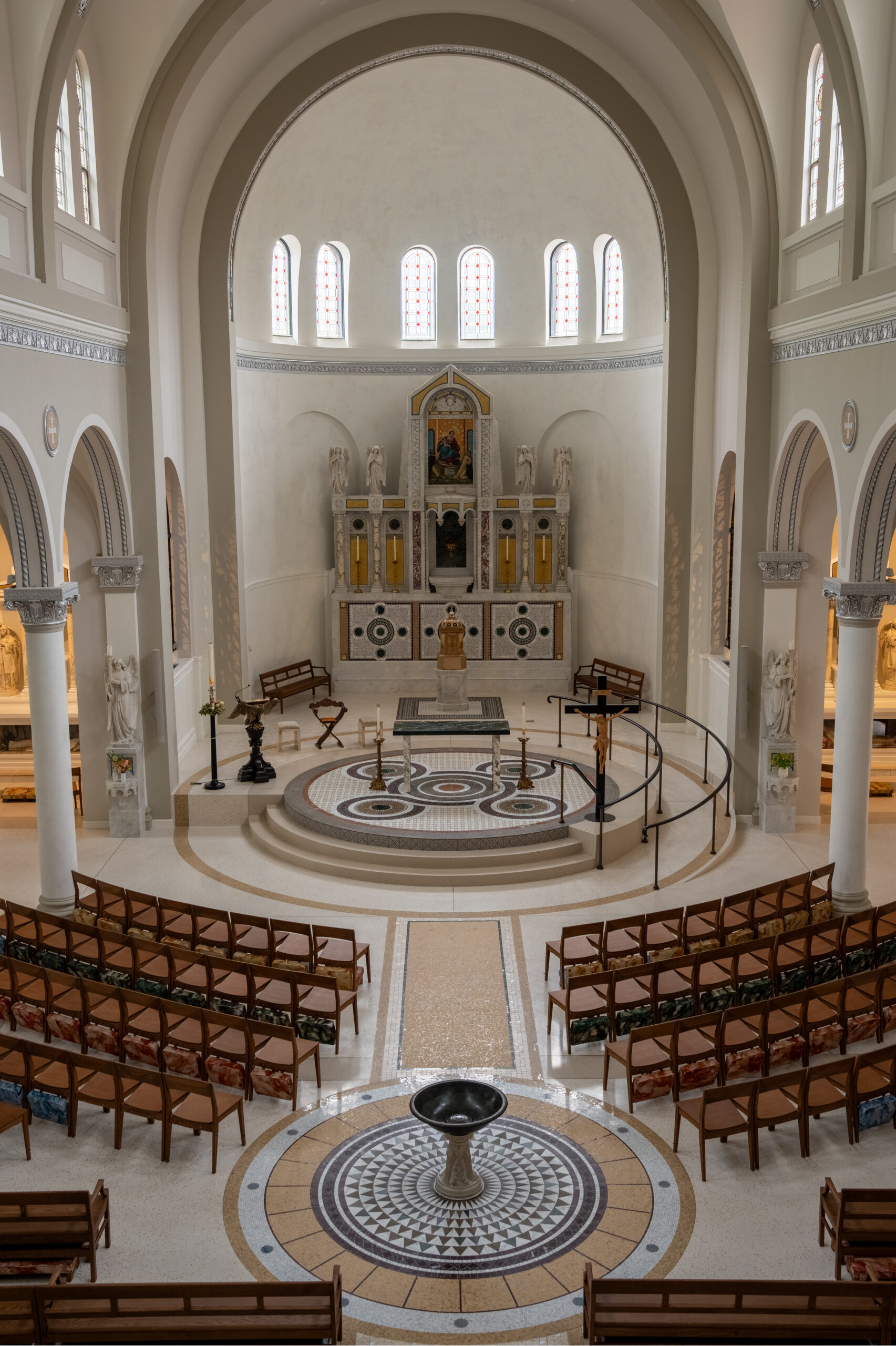
Fragomeni’s hope was to return the Shrine to the Neo-Romanesque church it once was. Over time, the building had accumulated layers of ornamentation more in line with the Baroque imagination. Typical Neo-Romanesque thick walls, rounded arches and the quiet authority of earth-toned simplicity have guided every decision in the current design.
“This restoration seeks to recover that encounter, to create a space where the Divine is met in word, in song, in silence, in beauty,” Fragomeni notes. “It is a place that gathers memory, forms community and sends forth missionary disciples, and it is a place that leads, through Christ, with Mary, into the mystery of God.
“The building now breathes again in its native grammar,” he adds. “The color palette has been reduced to essential tones, with restrained use of silver rather than gold, favoring the humility and density of Romanesque light over the brilliance of Baroque display.”
Walking in, you will immediately notice how bright it is. Many of the stained-glass windows that once adorned the top of the altar have been moved into the chapel and brilliantly backlit to preserve their beauty.
Acoustics have been treated as sacred. Every effort has been made to preserve the natural resonance of the space, ensuring that the spoken Word and sung prayer are received not as sound alone, but as presence. Even the new HVAC system is so quiet that silence, the first language of God, remains undisturbed.
Seating has been made movable, with chairs in the front and benches in the rear. This restores the flexibility of Romanesque space, so that the assembly is not fixed; it gathers, adapts and participates.
“The central aisle, rendered in mosaic inspired by Ravenna and the Cosmati tradition, becomes a path of pilgrimage,” Fragomeni says. “It draws the body forward toward the altar, the table of the Eucharist, the place of continual conversion and renewal, and the gift of life is offered to us in Christ and the Spirit.”
The central image of Mary, Our Lady of Pompeii, Our Lady of the Rosary, reflects that of the Shrine in Pompeii, Italy, uniting this community with its spiritual homeland. And, at the threshold of the Shrine will stand future bronze figures of Italian immigrants, those whose faith gave birth to this place.
Now that the Shrine doors are open once again, in the absence of diocesan funding, the last phase of Shining On is the establishment of a long-term endowment. This building and hall will need tender loving care for generations to come. And there are more structural improvements to make, including adding a roof between the church and school and improving handicapped accessibility between the buildings.
“When I walk into the Shrine and look around, I think the impossible was possible, thanks to Dominic Stramaglia and this wonderful, heartfelt community,” Fragomeni says.
The Shrine of Our Lady of Pompeii now stands as a space where past and present meet. It is a place shaped by memory, sustained by community and oriented toward the future.
Most importantly, it remains what it has always been at its core: a sacred place of prayer and reconciliation with God and each other.
A place to gather.
A place to reflect.
A place to turn to Mary and encounter Christ.
For more, click here.
The above article appears in the July 2026 issue of the print version of Fra Noi. Our gorgeous, monthly magazine contains a veritable feast of news and views, profiles and features, entertainment and culture.
To view a sample copy, click here.
To subscribe, click here.