 Fra Noi Embrace Your Inner Italian


Although little-known today, Enrico de Tonti carried the rich heritage of Italy into the annals of European explorers. His Italian roots of resilience and tenacity — traits forged in a region long ruled by foreign empires — were keys to his survival in the wilderness of 17th-century North America.
Tonti was born around 1649 in a coastal town near Naples to Lorenzo de Tonti and Isabelle di Lietto. The family moved to Paris soon after his birth so his father could escape persecution after an unsuccessful revolt against the city’s Spanish viceroy.
Raised in Paris, Tonti grew up among émigrés. At 18, he enlisted in the French military, serving during the Franco-Dutch War. His military career took a dramatic turn in Sicily, when a grenade explosion severed his right hand while he was battling Dutch troops in the village of Gesso, near Messina. Undeterred, he fashioned a metal prosthetic — often gloved — and earned the nickname “Iron Hand.” Back in France after the war, Tonti was unable to obtain employment at court even after participating in seven campaigns. With his trademark resilience, he pivoted from soldier to explorer, joining La Salle for a venture that would etch his name into history.
 Arriving in Canada, Enrico de Tonti — now Henri de Tonti in French service — became La Salle’s trusted lieutenant. Their mission: to explore and secure the vast interior of North America for King Louis XIV. In 1680, Tonti helped build Fort Crèvecoeur on the Illinois River. Left in command when La Salle returned east, Tonti faced mutiny from disheartened men who razed the fort and deserted. Undaunted, he rallied a loyal few and took refuge with the Illini tribe.
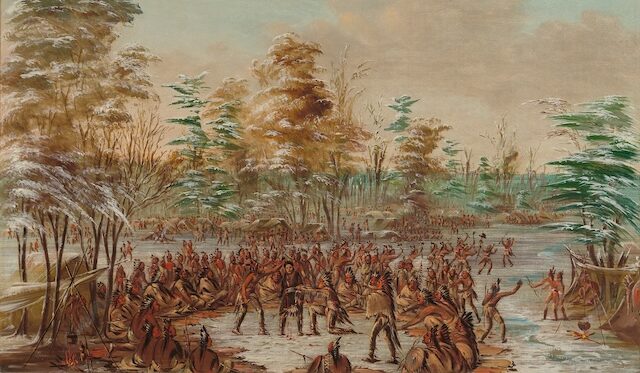
Displaying diplomatic finesse when the Iroquois attacked the smaller Illini tribe, Tonti fearlessly strode forward between the warring sides and demanded that the Illini be left in peace. Slashed with a knife and threatened, he refused to back down. (There are stories that he used his metal prosthetic to smash a table, which put the attacking chiefs in awe.) A fragile peace ensued that allowed some of the Illini bands to flee from the marauding Iroquois.
In December 1681, he rejoined La Salle for their crowning achievement: descending the Mississippi River to its mouth from the Chicago portage. The canoe trek covered 1,500 miles before the existence of locks and canals, and he completed the trip five more times! By April of that year, they claimed the vast Louisiana Territory for France.
Tonti’s role grew after La Salle’s 1683 departure for France. Commanding Fort Saint-Louis (now known as Starved Rock) on the Illinois River, he held the frontier against Iroquois threats, forging a Native American alliance to secure trade routes from Quebec to the Mississippi Valley. Learning of La Salle’s new expedition to the Gulf in 1686, Tonti sailed downriver to rendezvous. At the Arkansas River’s mouth, he started a trading post — the first permanent European settlement in the Lower Mississippi Valley — earning the title “Father of Arkansas.”
After searching in vain for the new Gulf outpost and learning of La Salle’s murder, Tonti launched a rescue mission for the lost French colony, which, due to poor navigation, had landed in Texas. Tonti never found the colony of 180 souls, which had been destroyed by disease, desertion and Indian attacks.
Tonti joined the Biloxi colony in 1700, settling into leadership roles. His knack for fair dealing and diplomacy shone again in 1702, when he negotiated peace between the Choctaw and Chickasaw. In August 1704, yellow fever claimed him near Mobile, Alabama, ending his adventurous life at age 55.
All but forgotten, his name is marked only by a square in Mobile; a couple of tiny streets in nearby Wildwood and in Chicago; and Tontitown, Arkansas, founded in 1898 by Italian immigrant plantation workers.
His career was distinguished by his fair treatment of the tribes he encountered, something quite different from most other interactions between Europeans and Native Americans. For this approach he should be remembered and honored.
The article above appears in the October 2025 issue of the print version of Fra Noi. Our gorgeous, monthly magazine contains a veritable feast of news and views, profiles and features, entertainment and culture.
To view a sample copy, click here.
To subscribe, click here.