 Fra Noi Embrace Your Inner Italian



As the readers of this beautifully produced book will learn, the Arch of Titus is anything but uncomplicated. Most travelers to Rome who encounter the arch on their visits to the Roman Forum make a number of assumptions about it, all of which turn out to be wrong. Despite being called the Arch of Titus, it wasn’t built by that emperor, but by his younger brother, Domitian, shortly after Titus’ premature death in 81 A.D. The most famous sculpture on the arch is a panel on the inner portion that shows Roman soldiers carrying the spoils of the empire’s successful war against the Hebrew kingdom of Judaea: sacred golden objects looted from the temple in Jerusalem. This is often misinterpreted by modern visitors as showing Jewish prisoners of war being forced to carry these precious items. The arch itself, which looks elegantly intact, is in fact the result of a total rebuilding in the early 1820s. And finally, the monochrome white marble, which we tend to assume was the original state of the entire arch, has recently been shown to be inaccurate. The sculpted panels were once brightly painted.
The editor of this volume, Steven Fine, headed the Arch of Titus Project, an ambitious program sponsored by Yeshiva University in New York City. In 2012, members of the project used highly sophisticated micro-photography to discover remains of the original yellow pigment used on the Menorah in the Spoils panel, to make it appear to be gold. The group went on to create a hypothetical reconstruction of that panel, restoring both lost and broken elements and its original coloring.
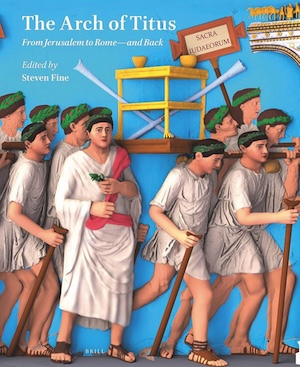 The project also focused on the many interpretations of the arch, from its creation ca. 82 A.D. to the present, from ancient Rome to medieval Europe, the Enlightenment, the Counter-Reformation papacy, modern nationalism, and on to its transformative use by modern Israel. Throughout most of its 2,000-year history, the Arch of Titus has been a sculptural symbol of Europe’s original sin: anti-Semitism. But as this book shows, the founding of Israel resulted in a radical reinterpretation of the arch, turning it into a symbol of Jewish triumph. The menorah pictured in detail on the arch as an emblem of Jewish humiliation and defeat, has become the official symbol of the State of Israel.
The authors also dissect and demolish one of the most persistent stories concerning the Arch of Titus: the belief that the Jews of Rome had always refused to walk under it, due to its reputation as a symbol of Jewish defeat. The way the story was told, on the day the state of Israel was founded, the Jewish community of Rome spontaneously descended on the arch and jubilantly walked under it. This book shows that this story is an urban legend. There is no trace in any historical record, Jewish or Roman, of any self-imposed prohibition of Jews walking under the arch. There were, however, several organized Jewish demonstrations near the arch during the period when Israel was coming into existence, but no record of that spontaneous outpouring of people on the day that Israel was founded.
Although expensive, this is a high-quality work, with many excellent and rare illustrations.
“At first sight, the Arch of Titus strikes the viewer as a rather uncomplicated monument. Unlike the three-bayed Arch of Constantine with its intricate and much-discussed inclusion of earlier reliefs, the Arch of Titus comes across as a solid one-bayed monolith bearing a single, self-evident message. The Arch of Titus, handbooks and guidebooks tell us, stood on the triumphal route and was built with one specific aim — to celebrate the triumph held by Vespasian and Titus over the Jews in 70 CE … . Visitors are even invited into the procession itself as timeless partakers of the triumph.”
“The Arch of Titus: From Jerusalem to Rome — and Back”
Editor: Steven Fine
Pages: 224
Cost: $189 (hardcover)
ISBN: 978-90-04-44778-3
Buy: amazon.com
The article above appears in the September 2025 issue of the print version of Fra Noi. Our gorgeous, monthly magazine contains a veritable feast of news and views, profiles and features, entertainment and culture.
To view a sample copy, click here.
To subscribe, click here.
