 Fra Noi Embrace Your Inner Italian



In memoriam, Virginia Ciavolella D’Epiro (1926-2025)
“Guests, like fish, begin to smell after three days,” said Ben Franklin, but one of the qualities I admired most in my parents was their unstinting hospitality toward family members. Some didn’t yet have a place of their own in the U.S. or needed to save money by staying with us awhile, or were just passing through on their way to somewhere else.
The most colorful of our many guests arrived periodically not from Italy but Lock Haven, Pennsylvania — the various members of a clan headed by my great-uncle Ernesto, who had emigrated long ago from Italy to New York. After a streak of bad luck, he went to Penn Station one day and showed the ticket agent all the money in his pocket.
“How far away from New York City can I get with this?”
“Uh, let’s see here, young fella. Why, I’d say it was Lock Haven, Pa.”
“Fine — I’ll take a one-way ticket.”
After landing in the middle of Pennsylvania, Uncle Ernie began working for the railroad, met a suitable woman, and settled down to have a large number of children with her. After her death, he remained unmarried, so his life became a routine of working for a skimpy salary, cooking, cleaning, stretching a dollar and attending to his young tribe, the eldest of whom pitched in to help raise the youngest.
When Uncle Ernesto’s progeny were middle-aged, a carload of them would descend on us every couple of summers for a weekend or more, partly so they’d have easy access to Yankee Stadium. That venue was a short drive from our apartment, and in those days half a dozen people could get grandstand seats for a total of $7.80.
There would always be Uncle Ernie, but the rest of the roster varied. His son Louie, a Franciscan friar, seemed to get a decent amount of time off for family visits. Two of Uncle Ernie’s other sons sometimes showed up, or a pair of his daughters might visit, as well as a taciturn grandson called Bucky. On occasion, they were too disorganized and lackadaisical to give us a call to tell us they were on their way, so they’d just show up at our door as a surprise.
Uncle Ernie was always the first to walk in the door in his big Panama hat, short-sleeved white shirt, flowery tie and gold wire-rimmed glasses, holding a cigar in one hand while he hugged us all in turn with his free arm and boomed out in his excellent English,
“Tony! Virginia! Hello, hello, hello! My dear, dear, much-loved nephew and niece! It’s so wonderful to see you — you’re both looking splendid. And here are the beautiful, lovely children, too. I’m so glad to see you — God bless you all!”
Though well into his 60s, he radiated serene suntanned health and looked like a burly but kindly Harry Truman. Brother Louie, in his ecclesiastical garb and with his jocular manner, much like his father’s, was my favorite. I’d ply him with questions about his brown robe, why he wore a rope instead of a belt, and anything else I could think of until he’d say, in a mock-Italian accent, “Hey, no scoocha the banana.”
My mother’s private name for the whole unwieldy crew was “the Alley-Olies,” from the way they mispronounced, and clamored for, her spaghetti made with aglio e olio (tossed with olive oil and sautéed garlic). This was what Uncle Ernie had raised them on — quick, easy, and cheap pasta meals — and my mother’s serving of the dish reminded them of their hardscrabble but generally happy youth. Besides, that was far from all she served them.
After my father went off to work in the morning, my mother spent her day cleaning up, lugging food up to our sixth-floor walkup, and cooking it, while the Alley-Olies went to the Yankee game or visited our relatives in the area, but swooping back like homing pigeons in time for supper and sleep at our place. They could have spent the evening more comfortably if at least some of them dined and slept with other relatives (not to mention at some inexpensive motel by Yankee Stadium), but they preferred the accommodations at our homey D’Epiro Inn.
Having the Alley-Olies visit was like hosting a small convention of hillbillies who enjoyed a good laugh, a good meal and a good drink, and were content to sleep strewn about the apartment. They snoozed soundly on our sofa, our two living room chairs, an old Army cot and even on the seaman’s trunk in my room. My bed went to the undisputed head of the clan while I squeezed into my toddler sister’s crib.
Seeing my mother running from one chore to another, placid old Uncle Ernie would sometimes plead with her, “Virginia, my dear, you’re working much too hard. You can’t go on like this!”
But go on like that she did, for the Alley-Olies and many other family members who wandered to our little four-room apartment in search of a welcoming place to stay in a time when family was family.
Rest in peace, best of mothers!

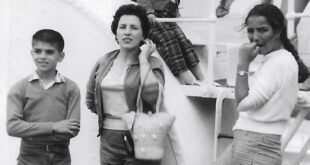
As a high school friend of Peter D’Epiro, I had the honor of meeting Virginia. She was a beautiful, kind, and simpatica lady who made you immediately feel welcome and special. Having read Peter’s memoir, I acquired a richer sense of her background, a young woman hiding in caves to escape the Germans in Lazio and surrounding areas. One might never suspect that such a pleasant and happy woman had experienced such horrors in her youth. I think of Virginia as a kind-hearted and caring Italian lady who graced her home with an innate fondness for people – we were not for a moment strangers, but almost adopted additions to the famiglia.
Thanks for the kind words, Tom. My mother knew you were a special person from the start, both from the interest and respect you accorded her and from how I described to both my parents the value I placed on our friendship. Long may it continue!
Such fine descriptions of familial dependency, sprinkled with picturesque phrases. I, too, grew up on oil and garlic pasta, (my Irish mom called it ooo-yay-oy-yay) as she made it as a Friday night special (with no meat, of course). Thanks, Pete, for this introduction of a wonderful mom, worker, relative and friend. So many great stories lie in your memories for sure.