 Fra Noi Embrace Your Inner Italian


It is tempting to think that all Italian words with an -are, -ere, or -ire ending are only verbs and lack any other function. Piacere, for instance, is the Italian verb that means to like, and most students feel that they have mastered its use once they learn its tricky conjugation. But piacere pops up in many common expressions as a noun as well, especially in polite phrases!
How do we recognize when piacere is being used as a noun? This is easy! Like any other Italian noun, piacere will be preceded by a definite article (the Italian word for “the”). Piacere is a masculine noun in Italian, and therefore to say “the pleasure,” piacere is preceded by il, for il piacere. Piacere the noun has a regular plural definite article and ending; the pleasures are i piaceri.
Remember that Italian nouns are always preceded by a definite article, even in cases when English does not require the word “the.” The rules for combining an Italian definite article with a proposition, such as di, also need to be followed when piacere is used as a noun. As do all the other rules for nouns and their definite articles! In this case, [di + il] piacere = del piacere. If you need a refresher on how to combine di with a definite article to say “some,” visit the blog, “How to Say ‘Some’ (Part 1).”
To use piacere in a general sense, to say “a pleasure,” place the indefinite article un before piacere, just as you would before any other masculine noun.
By the way, many other Italian verbs can be used as a noun.
This use is easily recognized by the definite or indefinite article that precedes them!
Il piacere can take on several meanings as a noun. For instance, as already mentioned, il piacere can mean “pleasure,” in reference to the sensation of pleasure. Along these lines, piacere can also mean “a pleasure,” as in “a delight” as part of a routine greeting for a new acquaintance or an old friend. Piacere is often used when speaking on the phone in a formal situation .
If you’ve left someone’s presence you can use “un piacere” to say, “It’s been a pleasure.” Finally, piacere can mean “favor” or “courtesy,” and is used when asking another for something we need. We’ve probably all used piacere as a noun in these situations without even realizing it!
Sometimes, Italians will use, “a piacere” to indicate that a statement is really only a suggestion, which is to be fulfilled based on another’s preference or desire, or to give another the opportunity to make a choice. An English speaker might say the equivalent of, “at your pleasure,” although today this English expression is used only in formal situations.
And finally, to complete our discussion of alternate uses for the Italian word piacere, if we change the ending a bit, we can describe someone or something that is pleasing or entertaining with the Italian adjective piacevole. A person who is attractive can be described as piacente in Italian.
On the other hand, one can change the ending of piacere to make the noun il piacione, and speak ironically about someone who is too eager to please, or someone who tries too hard to please others.
See the next section for a summary of important phrases that use piacere as a noun, piacevole, piacente, and il piacione. Many will be useful to commit to memory for easy use in different social situations!
Expressions that Use Piacere
as a Noun
1. Use piacere with the meaning of “pleasure”
- As noted in the introduction, the verb piacere can be used as a noun — il piacere — to describe the sensation that is pleasure. It is simple to use piacere in this way to make a general statement about someone seeking out an activity that will give them pleasure. Just substitute the Italian noun for the English noun!
- Remember that some Italian verbs must be followed by di. If the noun piacere follows one of these verbs, it’s definite article il will be combined with di to make del. These verbs often describe speaking, thinking or an activity that needs an additional verb or phrase to complete the idea under discussion. If need a refresher on these important verbs that are always followed by di, check out the recent blog in this series, “Avere” and “Essere” and “How to Use ‘Di’ in Italian.”
- If one wants to say “some pleasure,” the preposition di will also need to be combined with the definite article il to make del for “del piacere.” If need a refresher on how to use the preposition [di + definite article] to say “some,” check out the blog, “How to Say ‘Some’ (Part 1).”
Il più grande piacere di Anna è stare in giardino in un giorno pieno di sole.
Ann’s greatest pleasure is to be in the garden on a sunny day.
È sempre un piacere andare a trovare la mia famiglia in Italia.
It’s always a pleasure to visit my family in Italy.
Pietro vive per i piaceri della vita.
Peter lives for the pleasures of life.
Penso spesso di tutti i piaceri di visitare l’Italia.
I think often of all the the pleasures of visiting Italy.
2. Use piacere when greeting someone, socially, and also as a guest when taking your leave
- When introductions are made, it it common to respond in the affirmative with piacere. How to make introductions in Italian and common responses were listed in a previous blog, The Holidays in Italy – An Italian Christmas.
- After an introduction has been made, Italians may say, “Piacere di conoscerla“ or “Piacere di conoscerti.” The first phrase is formal and the second phrase is informal. However, in most situations, Italians will usually abbreviate both phrases and just say, “Piacere,” which is understood to mean, “It is a pleasure (to meet you).” And, of course, the routine answer is, “Piacere mio,” for, “The pleasure is mine.” See the table below.
- “Lieto!”or “Lieta!” are also commonly used in present day Italian after introductions are made, although the English equivalent “Delighted!” has fallen out of fashion today. The full phrases using lieto, which must be changed to reflect the gender of the speaker, are given in the table below.
- Piacere can express the “joy” or “delight” one has when meeting a good friend with the phrase, “Per me, è sempre un piacere vederti,” which means, “For me, it is always a pleasure to see you!” Another common, shorter phrase in a similar vein is, “Che piacere vederti!” with the meaning, “How wonderful to see you!” To address a group you are delighted to see, say, “Che piacere vedervi!”
| Piacere di conoscerla. Piacere di conoscerti. |
Pleased to meet you (pol.). Please to meet you (fam.). |
| Piacere mio. | The pleasure is mine. |
| Lieto di conoscerla. Lieta di conoscerla. Lieto di conoscerti. Lieta di conoscerti. |
Delighted (masc. speaker) to meet you (pol.). Delighted (fem. speaker) to meet you (pol.). Delighted (masc. speaker) to meet you (fam.). Delighted (fem. speaker) to meet you (fam.). |
“Per me, è sempre un piacere vederti.”
“For me, it is always a pleasure to see you!”
“Che piacere vederti!”
“How wonderful to see you!”
“Che piacere vedervi!”
“How wonderful to see you all!”
“A cosa devo il piacere?”
“To what do I owe the pleasure?”
- While at an event, or simply chatting with a friend, the expression, “Mi fa piacere!” is helpful to affirm the positive feeling you have after hearing good news. Literally, the expression goes something like, “It’s / You (polite) have made me very happy,” but in translation it is the way Italians say, “I’m happy to hear that!” or “I’m happy for you!”
- When taking one’s leave from a friend’s home or a gathering, a common Italian phrase in a formal situation is, “È stato un piacere,” for “It has been a pleasure.” Of course, other, less formal phrases can be made with divertente (entertaining), such as, “È stato molto divertente!” for “It has been a lot of fun! / entertaining!/ a blast!”
3. Use piacere when speaking on the phone in a formal situation
- When calling a business, the person on the other end may use this common formal phrase to ask who is calling: “Con chi ho il piacere di parlare?” for “With whom do I have the pleasure of speaking?”
- If you are uncertain about the intentions of the caller, you might use another formal English and Italian phrase, “A cosa devo il piacere?” for, “To what do I owe the pleasure?”
4. Use piacere with the meaning of “favor” or “courtesy” when making a request
- Piacere can also mean “favor” or “courtesy.” Along these lines, then, it is no surprise that “Per piacere” and “Per favore” are the phrases Italians use to say, “Please.” These phrases are interchangeable. The literal Italian meaning can be thought of as, “for a pleasantry/nicety” or “for a favor,” although the direct English translation is simply, “Please.”
- To ask a friend or relative to do a favor for you, simply say, “Mi fai un piacere?” or
“Mi fai un favore?” for “Could you do me a favor?” If the answer is “yes,” follow with your request, such as “pick me up at…” or “get (something) at the grocery, pharmacy, cleaners…” The formal request would be, “Mi fa un favore/piacere?” - To ask a favor as a polite command, use the subjunctive of fare, which is faccia, for “Mi faccia un favore/piacere!” Of course, the familiar command can be used with family or friends as well. This may be in an ironic tone, as in, “Fammi il piacere. Stai zitto!” for, “Do me a favor! Be quiet!” To say, “Give me a break! use the expression, “Ma fammi il piacere!”
- When accepting the duty connected to the favor, one might downplay the responsibility by saying, “È un piacere!” as in “(Don’t worry) It’s a pleasure!” Or, “Con piacere.” meaning, “Gladly. Happily. With pleasure.” The same meaning is expressed with, “Volentieri!” Finally, a formal phrase we sometimes use in English is also common in Italian, “Il piacere è tutto mio,” for, “The pleasure is all mine.”
- After returning with the job completed, once again the past tense phrase, “È stato un piacere!” may be of use.
- The English noun “courtesy” has fallen out of favor today. It might be written in a formal invitation with the phrase, “Would you do us the courtesy of joining us for dinner?” The Italian equivalent in this situation uses piacere as a verb in the conditional tense and is, “Vi piacerebbe andare a cena con noi?” To be complete, the Italian nouns used most often with the meaning of “courtesy” are la cortesia or la gentilezza. These words are still often heard in Italy today.
5. Use “a piacere” to signify a suggestion that is to be fulfilled based on another’s choice
- Sometimes, an Italian will use, “a piacere” to indicate that a request is really only a suggestion, to be fulfilled based on another’s preference or desire, or to give another the opportunity to make a choice. An English speaker might say “at your pleasure,” although today this expression is used only in formal situations. “A piacere” is more properly translated as “of your choosing” or “as you like” in today’s English.
- We have certain phrases in English that convey the nuance behind “a piacere,” which may be heard in certain situations. For instance, a teacher may assign a research paper but at the same time give his/her students the opportunity to write about a topic of their choice. Representatives of a hotel often inform guests that they may use certain facilities if they desire. In the same way, a host may advise his/her guests that breakfast is ready and they can “serve themselves” as they like.
Scegliete un topic a piacere per l’ultimo paper.
Select a topic of your choosing for the last paper.
Abbiamo una piscina e un campo da tennis a vostro piacere.
We have a swimming pool and tennis court if you all desire.
Servitevi a piacere; la prima colazione è pronta.
Serve yourselves as you like; breakfast is ready.
- Important Italian expressions that use “a piacere”:
| condire a piacere | to season to taste |
| domanda a piacere | a free question/choice |
| una domanda a piacere | a subject of your choice |
- And a saying to remember:
“Non si può piacere a tutti!”
“You can’t please everyone!
6. Important Italian phrases with piacevole, piacente, and il piacione.
- The adjective piacevole can be used to describe a person, experience, or something that is pleasant, pleasing, or enjoyable.
- When used to describe someone’s personality, piacevole can be translated as nice, likeable, or congenial. In other words, piacevole refers to a person’s inner qualities.
- Piacente is an adjective the refers to an individual’s pleasing outer appearance; it means pleasing in the sense of attractive or handsome.
- Piacione and piaciona are nouns that refer to an individual’s character, with the first masculine and the second feminine. These nouns have the same root as piacere and an -one ending that signifies something larger or grander than just piacere. In this case, the -one ending gives the word piacione a negative connotation. If someone is too pleasant, they may be considered un piacione — too eager to please, or someone who tries too hard to please others. Presumably, this is to gain an advantage with another and at the expense of expressing their true self.
- One last thing… un simpaticione is a “funny guy.”
I hope this blog has pleased you
and provided many expressions that use
piacere as a noun
for you to use every day!
For “All the Italian you need to enjoy your trip to Italy,” click on the links below to purchase my Conversational Italian for Travelers books – and then listen to the audiobook “Just the Important Phrases” on your favorite streaming platform! —Kathryn Occhipinti
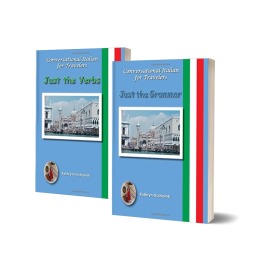

Conversational Italian for Travelers “Just the Important Phrases” pocket travel book with audio on your favorite streaming platform from Amazon.com and www.learntravelitalian.com

New! Practice short Italian phrases with this Audio Dialogue Practice Book. Download the audio from your favorite audio platform today! Check it out for free on Amazon.com