 Fra Noi Embrace Your Inner Italian


Many years ago, I was a Pullman volunteer who served the community by giving 1 p.m. Sunday tours of the Pullman Factory site. As I got accustomed to making my presentations, I would interject points of interest based on any new information I’d been given or interesting historical details I recalled.
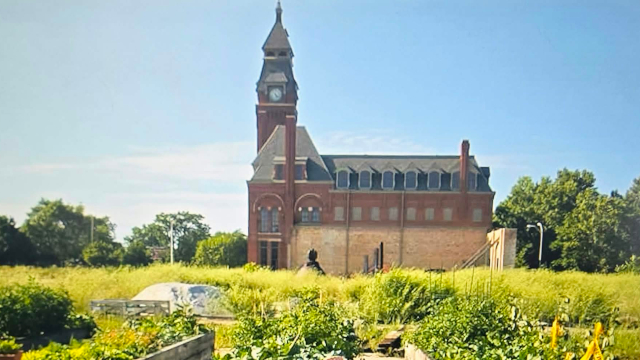
For instance, considering the ongoing drive to make Pullman a national park, I would start the tour at what had been the factory entrance on 111th Street and head toward the administration building. As we approached the building, I would dramatically stop the tour group, have them turn around toward the southwest corner of the fenced property at 111th and Cottage Grove, and tell them to take note of the tall grasses and weeds.
Then I would tell them, “Within the next five years or so, the weeds and tall grasses will be gone, and this will be a beautifully landscaped area. Have you ever seen a National Park that was not beautifully done? That is the future of Pullman.” That was always followed by exclamations of surprise and a lot of excited conversation. (Today, that is the view one has at that corner of the Pullman National Historical Park!)
After that, we would head toward the main door to the administration building with its black painted plywood doors, loose stone floor and growing indoor weeds. For us community volunteers, the visions we held in our minds were based on the information and planning we were privy to. Looking to the future was what we based our faith in Pullman on.
One Sunday, as I was giving a tour, I referenced the Pullman Factory’s past and happened to mention the fire that had destroyed or damaged many of the onsite buildings. I pointed out a sample of the brick construction to show the masonry capabilities of the company hired to rebuild the administration building. Someone asked, “When did the fire take place?” I promptly answered as I had many times before, “December 1, 1998.”
 For some reason, that bit of information struck me differently that day. I realized that the fire had taken place not too many years before! It immediately spurred my investigative and historical instincts. It turned out the fire put a halt to the magnificent restoration and future museum plans that had been the community’s focus.
The fire was arson and the arsonist was caught and arrested the night of the fire. No, it wasn’t the result of quick investigative police work! The arsonist was across the street from the factory as the blaze tore through the Pullman buildings. Not only was he watching the fire, but he was telling the firemen how he had set the fire!
As you can see in photos, there were many buildings on the Pullman property that were damaged or demolished in the fire. The fire was a five-alarm blaze, the highest fire alarm rating in the city. The arsonist had listened to the voices in his head, which told him to gather all the rags and flammable material in each building and ignite them with cans of combustible chemicals that he found.
The arsonist had been sitting in a local bar and started talking about the fire he had started. That was when people realized the Pullman Factory was on fire. Unfortunately, the blaze had been burning for a couple of hours by that time. That fact contributed to the serious extent of the damage done to so many buildings and the destruction of the administration clock tower building.
The tragedy didn’t halt the plans the community had to ensure the Pullman Factory would have a bright future. It only altered them and increased the community’s efforts. The new plans now included obtaining rebuilding funds from the state of Illinois. The restoration plans began immediately!
The arsonist turned out to be a person with mental health issues who had been on medications. His family testified that he was not himself the night he set Pullman ablaze because he had stopped taking his medications. There was medical testimony at his trial that stated his medications were the only thing that kept him in a normal state of mind. When he stopped taking his medication, his behavior became subject to his bipolar tendencies.
The arsonist was found not guilty by reason of insanity and sentenced to behavioral health supervision and medication. He passed away a few years ago, having lived normal life in a Chicago suburb thanks to his medication.
The rebuilding of the Pullman clocktower and the designation of Pullman by President Obama as a National Monument placed Pullman was well on its way to becoming a part of the National Parks Department.
On December 29, 2022, Pullman became the official Pullman National Historical Park. The distinction of being a “historical” park is due to the large number of buildings that comprise the park. As an official national park, Pullman National Historical Park became eligible for congressional funding.
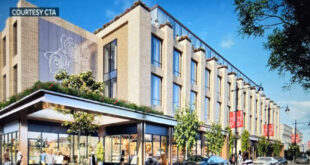
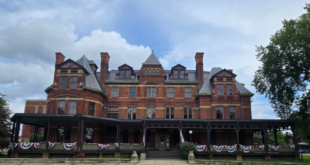
With the major investment in the Hotel Florence in the coming months, Pullman will be well on its way to becoming the major tourist attraction the many Pullman volunteer organizations have had as their goal along with keeping Pullman a historically relevant place to visit.
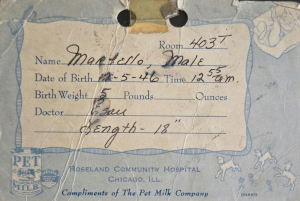 While writing this month’s column, I would also like to take the opportunity to celebrate my 80th birthday with all of you! I was born at Roseland Community Hospital on December 5, 1946, at 12:55 a.m., weighing 5 lbs., at 18” long, Dr. Esau delivered. The accompanying photo is the reason I can remember these facts as I join the ranks of my fellow octogenarians. Roseland Community Hospital closed its Labor and Delivery Department as of October 2026.
“Petals from Roseland: Fond Memories of Chicago’s Roseland, Pullman and Kensington Neighborhoods” is available from me for anyone interested in sharing or revisiting Roseland, at $20 + $5 s&h via check, cash, or Zelle. Contact me at petalsfromroseland@gmail.com or 11403 S. St. Lawrence Ave., Chicago, Ill. 60628; 773-710-3559. My book is also available at D & D Foods, 1023 S. Halsted, Chicago Heights, at Bookie’s New and Used Books, 10324 S. Western Ave, Chicago and at Miles Books, 2819 Jewett Ave., Highland, Indiana.