 Fra Noi Embrace Your Inner Italian


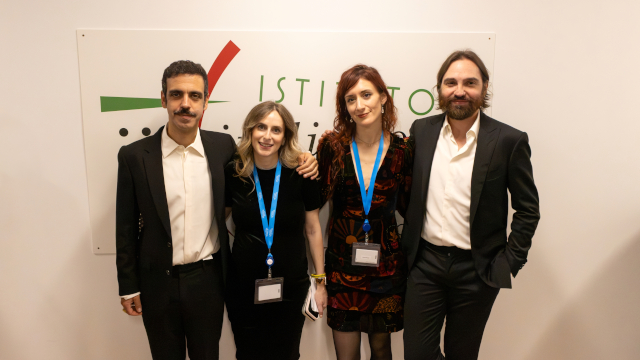
With a passion for global languages and culture, Chiara Avanzato is proud to be able share Italy’s vast contributions as the director of Italian Cultural Institute of Chicago.
The Italian Cultural Institute of Chicago is one of six such institutes of the Italian Ministry of Foreign Affairs and International Cooperation that are dedicated to sharing Italian culture and language in the United States.
The ICI organizes and collaborates in a variety of projects and initiatives on an ongoing basis.
In October, for example, the ICI offered a residency for a young Italian jazz singer who spent a month in Chicago. The same month, it also participated in the first edition of DYNAMIKfest for young chamber musicians, which included an Italian concert and Italian artistic director. November featured the launch of the “Il Design del Gusto” exhibit at the Design Museum of Chicago focusing on Italian kitchen design.
The ICI also collaborates with the Chicago International Film Festival, which always includes an Italian program, Italian directors coming to town for screenings and a special Italian Night with representatives from Rome’s Cinecittà Studios.
The ICI’s director is Chiara Avanzato, a native of Sicily who previously worked for the Italian Ministry of Education as an Arabic language and culture teacher and as projects and communications manager at the Italian Chamber of Commerce in Dubai.
Avanzato talks to Fra Noi about the ICI’s recent move to a new space at 150 N. Michigan Ave. in downtown Chicago, her background and her work as director.
ELENA FERRARIN: Who does the IICC serve exactly?
CHIARA AVANZATO: The ICI is for everyone. We organize a wide range of initiatives, including film screenings, concerts featuring all genres of music, exhibitions, book presentations, conferences, and much more. And the school ItalCultura offers Italian language classes at the Institute. There’s something for everyone. Whether you already have a connection with Italy or are simply curious to learn more, the Institute is a place where you can explore Italian culture in many different ways. Our community is very diverse in terms of nationality, age, interests and sensibilities.
EF: Does the ICI differ from its counterparts in New York, Washington, Miami, Los Angeles and San Francisco?
CA: Each Institute has its own programming, but we work together on projects that can travel to different cities and reach a wider audience, creating a greater impact across the country. Also, our work is part of the broader coordination of the U.S. Embassy and contributes to the cultural dimension of the broader relationship between Italy and the United States.
EF: Why did the ICI move and how is the new space different for staff and visitors?
CA: The building where the Institute was previously located was converted to residential use, which meant that we had to find a new place to house the Institute. Rather than seeing this only as a necessity, we saw it as an opportunity to think about the future of the Institute. The new location brings us closer to the heart of the city’s cultural district and gives us a wonderful opportunity to open a new chapter — to welcome new audiences, bring audiences together, develop new partnerships and create an even more vibrant space for Italian culture.
EF: What is your focus as director?
CA: The inauguration of our new premises reflected my focus and what I want the Institute to be: open to different forms of Italian creativity and open to different audiences. For the occasion, I decided to organize an exhibition and a concert: “A Palm of Victory” is the first exhibition in Chicago by Italian artist Emilia Faro, and the performance by singer-songwriters Colapesce Dimartino is their first in the United States. I want to create these kinds of first encounters — welcoming people with different interests, tastes and sensibilities. I don’t expect one exhibition or one concert to tell the whole story of Italian contemporary art, music or culture. I want to give people a first encounter that makes them curious enough to keep exploring.
EF: What is your educational background?
CA: I got my bachelor’s degree in Languages and Cultures of Europe, the Americas, Asia, and the Middle East from the University of Catania, and my master’s degree in Languages and Economic and Legal Institutions of Asia and Mediterranean Africa from Ca’ Foscari University of Venice. I was also lucky to take part in several university projects and training programs, including a project on human rights and immigration in Tunisia, teaching Italian as a second language at a high school near Venice, an internship at the UAE National Pavilion at the Venice Biennale. These experiences, together with my studies, have been very valuable for my personal and professional growth, and for my current job.
EF: What prompted you to become an Arabic language and culture teacher?
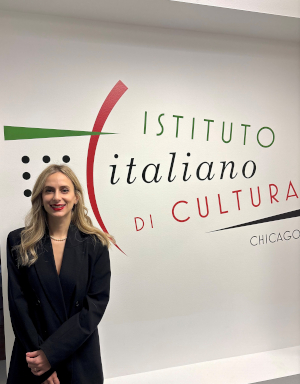
CA: I studied Arabic at university. Arabic is such a beautiful and rich language, and sharing that knowledge with my students was incredibly rewarding. Studying other languages and cultures opens your mind and broadens your horizons, teaches tolerance, allows you to see the world through different eyes. Above all, I strongly believe in the value of education and in the important role teachers play, not only in teaching their subjects, but also in their students’ lives.
EF: When did you join the Italian Ministry of Foreign Affairs and why? What roles have you held?
CA: The opportunity to take the competitive exam for the Ministry came up, and I decided to go for it. I joined the ministry at the beginning of 2020 and started working in the department responsible for the promotion of Italian science and research. In July 2021, I started my post as director of the Italian Cultural Institute in Edinburgh, where I spent four wonderful years before starting my current post here in September 2025.
EF: The ICI website lists four staff members. Seems like a lot of work for four people!
CA: We are supposed to be a team of five when we are fully staffed, and even then, we are a small team. Unfortunately, there is no cultural attaché working alongside the director. So, there are many ideas and projects that could be developed, but I also have to be realistic about what we can accomplish with the resources we have. I do my best and don’t mind taking on several different roles because I really like what I do. So, if I had to mention one challenge of the job, I would say this is definitely one of them.
EF: What would you like people to know most about the ICI?
CA: We want the Italian Cultural Institute to be a home for anyone interested in Italy. You don’t need to be Italian, and you don’t need to speak Italian, to walk through our doors. Whether you are interested in art, cinema, literature, music, design, architecture, language, food or simply curious about Italy, we want you to feel that there is a place for you here.
The above article appears in the December 2026 issue of the print version of Fra Noi. Our gorgeous, monthly magazine contains a veritable feast of news and views, profiles and features, entertainment and culture.
To view a sample copy, click here.
To subscribe, click here.