 Fra Noi Embrace Your Inner Italian


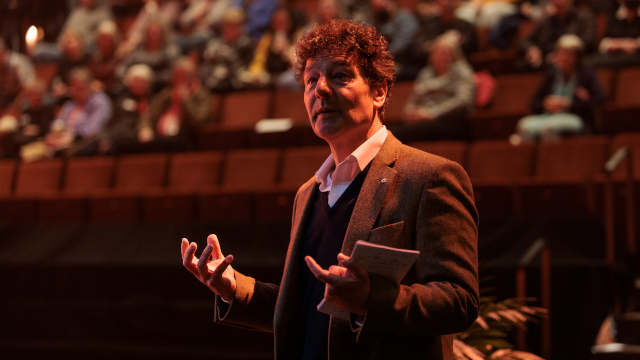
A Canadian theater luminary and Stratford Shakespeare Festival icon, Antoni Cimolino looks back on his illustrious career as he prepares to take a break from the stage.
In the firmament of Canadian theater, few luminaries shine as brightly as Antoni Cimolino. A mainstay at the Stratford Shakespeare Festival in Stratford, Ontario, for nearly four decades, Cimolino enjoys a north-of-the-border acclaim akin to that of Andrew Lloyd Webber.
Joining the renowned festival in 1988, he worked his way up from actor and general director to executive director and general manager before ascending to the post of artistic director in 2013. Since then, he has overseen the production of 145 plays, directing 20 of them, while shepherding the festival through a remarkable transformation.
In his first season as artistic director, Cimolino introduced The Meighen Forum, a season-long series of more than 150 events illuminating the themes of the playbill and illustrating their relevance in today’s world.
In 2014, he and executive director Anita Gaffney launched Stratford Festival on Film, a project aimed at cinematically capturing all of Shakespeare’s plays. And in 2018, he and Gaffney launched a $100-million campaign to build a new Tom Patterson Theatre. The campaign exceeded its goal, yielding a venue that has earned several architectural awards.
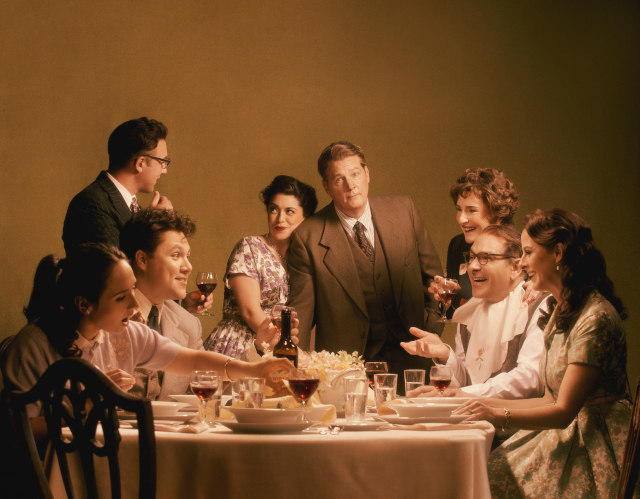
In his 39th and final season as artistic director, Cimolino will helm the festival’s productions of Shakespeare’s “The Tempest” and an English-language adaptation of Eduardo de Filippo’s “Saturday, Sunday, Monday,” both of which run well into October.
The theme of the 2026 season is “This Rough Magic,” with Cimolino tellingly noting in the program that, “the title … comes from a line in ‘The Tempest,’ spoken by the sorcerer Prospero, as he takes leave of his ‘so potent art’ and embarks on a new phase of life.”
Cimolino recently sat down with Fra Noi to talk about his very Italian upbringing, his fateful decision to pursue theater instead of the law, the great joys the choice has brought him and why it’s time for a well-earned hiatus.
Linda Maffiola Piatkiewicz: Tell me about your early life. You were born in the province of Ontario, correct?

Antoni Cimolino: I was born here. I was the only person in my family born in Canada. My parents were born in Italy (his mother is from San Quirino, and his father is from Dignan, both in Friuli Venezia Giulia). They came to Canada in the late ’40s, and then they went back. My sister was born there, and either they changed or Italy changed, so they came back to Canada.
LMP: Growing up in America during the ’60s there was pressure to assimilate. We were a melting pot. Was that similar in Canada?
AC: There was less pressure in Canada. There was more of a sense of integration as opposed to assimilation, so my parents spoke Italian with us to get us to learn Italian. I was a little unhealthy as a kid, I had a heart murmur, and so they sent me to Italy to live with my relatives in the mountains for a while. When I came back and started school, I didn’t speak any English at all.
LMP: Do you remember that time in your family’s hometown?
AC: I remember that little town always. And I would go back regularly. My aunt became like another mom. And I also had an aunt in Sudbury (a city in Ontario, Canada) who was like one of the characters in “Saturday, Sunday, Monday.” She insisted that we all get culture, that we understand what it was to be Italian, that we took dance and music, that culture was important, and she supported that.
LMP: I read somewhere that your parents wanted you to become an attorney, but you decided you were going to be an actor.
AC: I went to a Catholic boys’ school, and there was a priest there that would bring us to debating tournaments all over North America. It was fantastic in many ways. I did a lot of public speaking and debating, and I did well at that, and I think it was sort of understood that I would go to law school like my cousin. But I had been doing theater at school with friends, and I was happiest when I was acting and directing and working on plays.
I had to tell my dad that I wasn’t going to go to law school, that I wanted to study theater, and that was not an easy conversation. (My parents) came to Canada so that we’d become professionals, my sister and I. We had two choices. One was to go to university, and the other was death (he says with a laugh). He couldn’t comprehend that I wanted to be an “artista.” When he said “artista,” it was like a combination of pimp and car thief! But in the end, they were very supportive. They were really fantastic.
LMP: What brought you to Stratford?
AC: I’d seen plays here when I was a teenager, and I always wanted to come here. I went to theater school in Windsor, which had a very good theater school at the time, and after a number of years I ended up here.
LMP: Do you remember the first show you saw there?
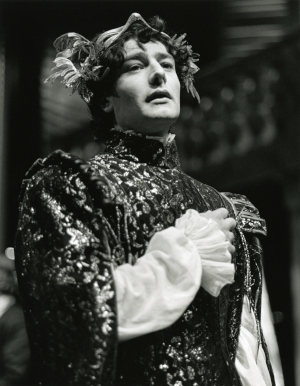
AC: I saw a number of things here, but it was the production of “Love’s Labour’s Lost” that really was life changing, it wasn’t like in a movie theater, where they turn off the lights and you’re looking at a screen. The play was 400 years old, but it was about four young guys, and I was reflecting on my life. I could see the audience laughing along with me, and we were laughing at something that was written so long ago. I felt a profound connection in that moment that I had never felt. I kind of went, “Wow, this thing called humanity is pretty amazing.”
LMP: As a young actor, did you dream of directing, or did you just fall into it?
AC: No, I was directing both in high school and then the years after. I ran a theater company that was part of the university in Sudbury. I would work there as an actor, and I would also direct plays and eventually ran the company. In a funny way, I was training for something I would do later. I was already preparing for it.
LMP: What is the significance of the title of “Saturday, Sunday, Monday”?
AC: People say to me, ‘What play are you doing Tuesday, Wednesday, Thursday?” And so Saturday, Sunday, Monday sound like they’re just days of the week, they’re all the same, but they’re not. Saturday is the end of the work week, and also one of the last days of the marriage. On Sunday, which is a special day, there’s an eruption. And on Monday, a new work week begins, but also a new marriage, a new life.
LMP: I was just thinking as you were talking that the ragù was so important. It’s the blood of life.
AC: That’s right. It’s the love. It’s family, it’s nourishment. It’s how she expresses her love for her family. So beautiful, right? And it’s about a particular time. It’s 1959, pre-legal divorce, when the role of women was more limited. Also in 1959, De Filippo’s marriage was coming to an end, so I think the play is in part about how things might have gone differently. What might we have been able to do to salvage this marriage and stay together and work through? In the play, everybody tells little lies, but eventually truth is told here. I love his humanity, his ability to make us laugh at our own quirks, foibles, weaknesses. But at the same time, he has a great love for what it means to be human.
LMP: “Saturday, Sunday, Monday” is your fourth adaption of a De Filippo play. What draws you to him?
AC: De Filippo had a complicated life from the onset. His father, Eduardo Scarpetta, was a huge playwright and farceur (a writer who specializes in broad, satirical or slapstick humor). At a certain point, Eduardo decided that he wanted to use his talents not simply to make people laugh, but also to explore ethical and moral questions through theater. And to center it around people’s homes, so the pots, pans, windows, doors of everybody’s house became the backdrop of his work.
There’s a gentleness, a humanity to the comedy, and also an exploration of things that are very emotionally moving. Unlike his dad, who simply wanted to knock out funny stuff, to purely entertain, De Filippo set himself a higher benchmark.
LMP: Professor Donato Santeramo was your translator for all your De Filippo plays. How did that come about?
AC: John Murrell, who was a famous American-Canadian playwright, was interested in working on the translation (of the first production), but he wanted to work from a literal translation, because translations are always adaptations to some degree, right? So, I called the Italian Cultural Institute and asked if they knew anybody who could do a good literal translation, and they recommended Donato, who was the head of the languages department at Queen’s University in Kingston, Ontario. We got together, and we hit it off immediately. He worked on the literal translation, and it was very helpful, and he has become a wonderful partner to us ever since.
LMP: You recently staged a stage reading of Dante’s “Inferno.” Does staging works by Italian writers and playwrights have special meaning for you?
AC: Of course! Yes! I’m sorry I never got to do a Pirandello here. But I so love De Filippo that I kept coming back to him.
LMP: Over your long and illustrious career, what plays stand out for you?
AC: They’re all my favorites. I loved doing Shakespeare’s “The Winter’s Tale” last year. I loved one with a Chicago connection, “The Grapes of Wrath.” It started at the Steppenwolf Theatre, and Frank Galati was doing something else here at the time, so it was wonderful having Frank here.
LMP: You’ve worked with so many fabulous actors and directors over the years. What impact did they have on you?
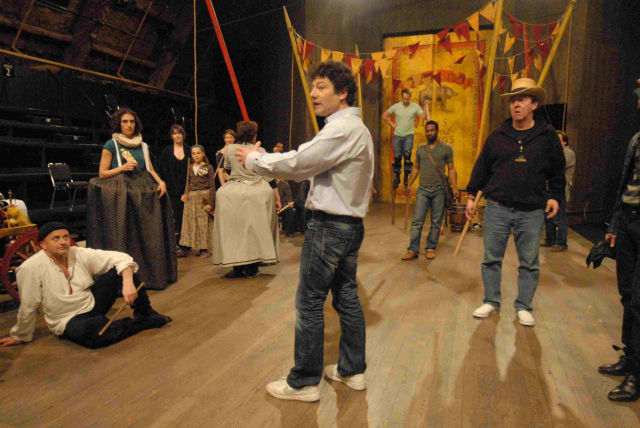
AC: I was really fortunate. I had a lot of people who were very kind, but no one more than Richard Monette (a Canadian actor and director who served as director of the Stratford Festival from 1994-2007). He was half-Italian, and he was a bit of a hero to me. He was kind enough to see something in me, to give me opportunities. Now that I’m on the other end of this, I think of all the people I was fortunate enough to say yes to and hire and do things for because I believed in them. To see them really take off is just the best thing.
LMP: What are your plans for the future?
AC: I’m going take a big gap year so I can spend time with my family. They always took second place to the theater. I get on great with my kids, and I love them and they love me, but the reality is, I wasn’t around a lot, and I want to change that. I love directing plays, and I love being in the theater, and I suppose I will do that in the years ahead. But right now, I want to discover all those other things.
LMP: The transition in “The Tempest” that you talk about in your liner notes — the idea of coming to peace with certain things and discovering others — and the connection to your personal theme, of moving on in your life with your family, is so beautiful.
These plays, they do something to you. They’re not just entertainment. They work on a very deep level, and they reflect our lives. We all go through this stuff. We all have the same themes. They’re hundreds of years old, and the themes stay the same, you know?
To purchase tickets to “The Tempest,” “Saturday, Sunday Monday” or any of the other of this season’s offerings, click here.
The above article appears in the October 2026 issue of the print version of Fra Noi. Our gorgeous, monthly magazine contains a veritable feast of news and views, profiles and features, entertainment and culture.
To view a sample copy, click here.
To subscribe, click here.