 Fra Noi Embrace Your Inner Italian


General Italian Pronunciation
Although Italian is a phonetic language, with words that are easily sounded out by the letter, the correct syllable to stress often remains an enigma. The main reason for this is the lack of accents in written Italian. In the few cases where the very last syllable of an Italian word is stressed, the vowel at the end of the word will be given a grave (`) accent, as in città (city) or caffè (coffee). The commonly used adverb, perché (why), takes an acute accent. Otherwise, accents are infrequently used in Italian and pronunciation is learned by listening!
Most Italian words are stressed on the second to last syllable, which is easy to remember if the word contains only three syllables — just stress the syllable in the middle of the word. In general, a syllable in Italian is usually made up of a vowel or consonant group with its vowel. For most Italian words, just look for the vowel in the middle of the word and stress this syllable by making your intonation a little higher and more forceful. The word ragazzo, for instance, which means boy, will place the stress on the /gaz/ sound.
ragazzo: ra/GAZ/zo
There are many exceptions to this rule, however. The first syllable is stressed instead in many cases for words with three syllables, such as sabato (Saturday), while the second syllable is often stressed in words with four syllables, as in domenica (Sunday).
sabato: SA/ba/to domenica: do/ME/ni/ca
Remember that a vowel alone can also make up a complete syllable in Italian. Abito (I live), is a verb with three syllables, where the first syllable, the vowel /a/, is stressed.
abito: A/bi/to
Speaking of the Italian verb abito… it should be noted that Italian verbs follow their own rules of pronunciation, which differ for each tense. In the present tense, for instance, the stress falls on the first syllable for the first, second, and third person singular forms — io (I), tu (you familiar) and Lei/lei/lui (you polite, she, he). The stressed syllable moves to the second to the last syllable for the plural forms noi (we) and voi (plural you), but returns to the first syllable for the third person plural loro (they). Interestingly, even though the conjugated verb for loro is generally a long verb with many syllables, the stress still falls on the very first syllable! This can be tricky for the student of Italian, as there is no accent in written Italian to guide one back to the very first syllable of this long verb conjugation.
Here is the conjugation for the verb parlare, which means “to speak,” with the stressed syllables in capital letters:
Parlare — To speak
| io parlo | PAR/lo | I speak |
| tu parli | PAR/li | you (familiar) speak |
| Lei/lei/lui parla | PAR/la | you polite/he/she speaks |
| noi parliamo | par/LIA/mo | we speak |
| voi parlate | par/LA/te | you all speak |
| loro parlano | PAR/lano | they speak |
The Melody of Italian Double Consonants
Since Italian rarely uses written accents, the key to proper pronunciation from the written word is often the double consonant. That one extra letter not only brings out the music in an Italian word but even changes its entire meaning!
For nouns and adjectives with double consonants, the first consonant belongs to the syllable before and the second to the syllable after. When speaking, emphasize the first syllable that ends in the double consonant and hold onto the sound of the double consonant a little longer as you pronounce the second syllable. This additional emphasis and pause over one syllable helps to give Italian its beautiful melodic sound. When speaking, Italian words should not be chopped up and rushed through like a sequence of Morse code, but flow smoothly from one syllable to the next. With double consonants in the center of many Italian words and a vowel at the end, spoken Italian sounds almost like singing!
It should also be noted that, for similar words, adding an extra consonant changes the meaning. It may be difficult for the untrained ear to hear the difference between the word casa, which means house, and CAS/sa, which means cash register. But, of course, these words refer to two completely different things!
Even Italian school children must focus on the correct spelling and pronunciation of words with double consonants. Although Italian is a phonetic language, the words with double consonants do get emphasis to help Italian children with the little bit of “la scrittura” or “lo spelling” that they do need to learn. Often their teachers come up with clever rhymes or songs that stay with the children for a lifetime!
Meaning Variations with Italian Double Consonants
Let’s go through some common Italian words that are identical except for a double consonant. You probably already know most of them, but may not have realized that a small change in spelling is the reason for their different meaning. Now that you know, practice saying each word out loud, and make sure to enunciate the double consonant to add the melodic sound to each word that makes Italian the beautiful language it is!
Papa, il papà, la pappa
(Notice how an accent is used in the first variation, and a double consonant in the second, to change the meaning of the noun papa.)
Il Papa prega sempre. The Pope is always praying.
C’è anche il papà che aiuta la famiglia. There is also dad who helps the family.
Ma, la pappa è per i bambini! But the baby food is for the children!
nono, nonno
Il numero ordinale nono è prima del numero decimo.
The ordinal number ninth comes before the number tenth.
Mio nonno mi porta molti regali.
My grandfather brings me many presents.
dona/donna
(Sometimes an Italian verb can sound similar to a noun that it is not related to.)
Lei dona alla chiesa ogni domenica. She donates to the church every Sunday.
La donna è molto bella. The woman is very beautiful.
note, notte
Lei canta tutte le note alte molto bene. She sings all the high notes very well.
Di notte, canta una ninna nanna. At night, she sings a lullaby.
sera, serra
Ogni sera mia figlia torna a casa alle sei. Every evening my daughter comes home at 6 PM.
Abbiamo una serra in giardino. We have a greenhouse in the garden.
(Speaking of night-time, although nana means dwarf, nanna is the word used to tell children “beddy bye.”)
sete, sette
Ho sete perché fa caldo. I am thirsty because it is hot.
Forse alle sette di sera farà fresco. Maybe at 7 at night, it will be cool.
pena, penna
La pena è troppo forte! The pain is too strong!
Ho scritto una bella lettera con questa penna. I’ve written a nice letter with this pen.
cane, canne
Il mio cane è un buon amico. My dog is a good friend.
Le canne sono legali a New York. Joints are legal in New York City.
pala, palla
Ho dovuto spalare molta neve con la mia pala quest’inverno.
I had to shovel a lot of snow with my shovel this winter.
Mi piace giocare a calcio con questa palla.
I like to play soccer with this ball.
ecco, eco
Guarda! Ecco le belle montagne dell’Italia tutto intorno a noi.
Look! Here are the beautiful mountains of Italy, all around us.
Senti l’eco suonare nelle montagne!
Hear the echo ringing in the mountains!
capello, cappello
(We almost never use the singular of capelli, capello, but we all remember cappello!)
Non ho solamente un capello sulla testa, ma tanti capelli.
I don’t have just one hair on my head, but many!
Un cappello è perfetto d’inverno.
A hat is perfect for winter.
rosa, rossa (rose, rosse)
(Remember that the adjective rosa (pink) is invariable.
La rosa, the flower rose, is a noun and changes to le rose in the plural.
The adjective rosso (red) changes to match the noun it modifies in gender and number, for rossi, rossa,rosse.
These rules can create some interesting tongue twisters!)
Questa rosa è di colore rosa. This rose is the color pink.
Quella rosa è di colore rossa. That rose is the color red.
Le rose potrebbero essere rosa o rosse. Roses can be pink or red.
Un mazzo di rose rosse è bellissimo! A boquet of red roses is very beautiful!
Remember how to pronounce
Italian words with double consonants
and I guarantee you will speak melodic Italian
every day!
For “All the Italian you need to enjoy your trip to Italy,”® click on the links below to purchase my Conversational Italian for Travelers books – and then listen to the audiobook “Just the Important Phrases” on your favorite streaming platform! —Kathryn Occhipinti
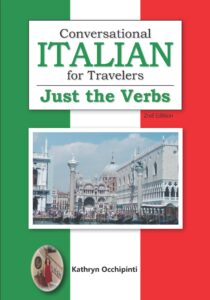
Conversational Italian for Travelers “Just the Verbs” and “Just the Grammar”
are available on Amazon.com and www.LearnTravelItalian.com

Conversational Italian for Travelers “Just the Important Phrases” pocket travel book with audio
on your favorite streaming platform from Amazon.com and www.LearnTravelItalian.com
New! Practice short Italian phrases with this Audio Dialogue Practice Book.
Check out how to pronounce restaurant vocabulary in Volume 2!
Download the audio from your favorite audio platform today!
Check them out on Amazon.com and Spotify.