 Fra Noi Embrace Your Inner Italian


Credit: Marina Samovsky
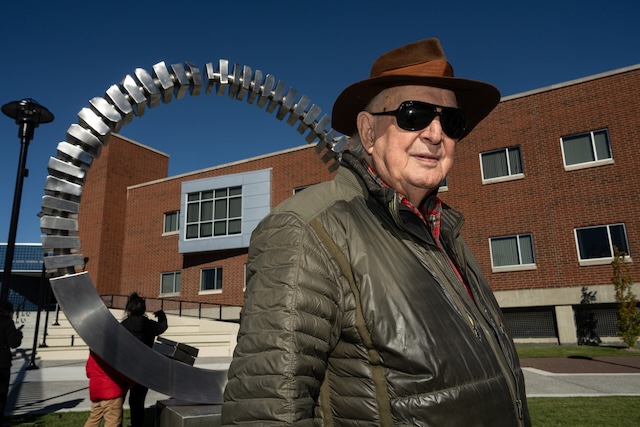
Trained in classic techniques, Verona-born sculptor Virginio Ferrari now expresses universal themes through elemental forms from his home and studio in Chicago.
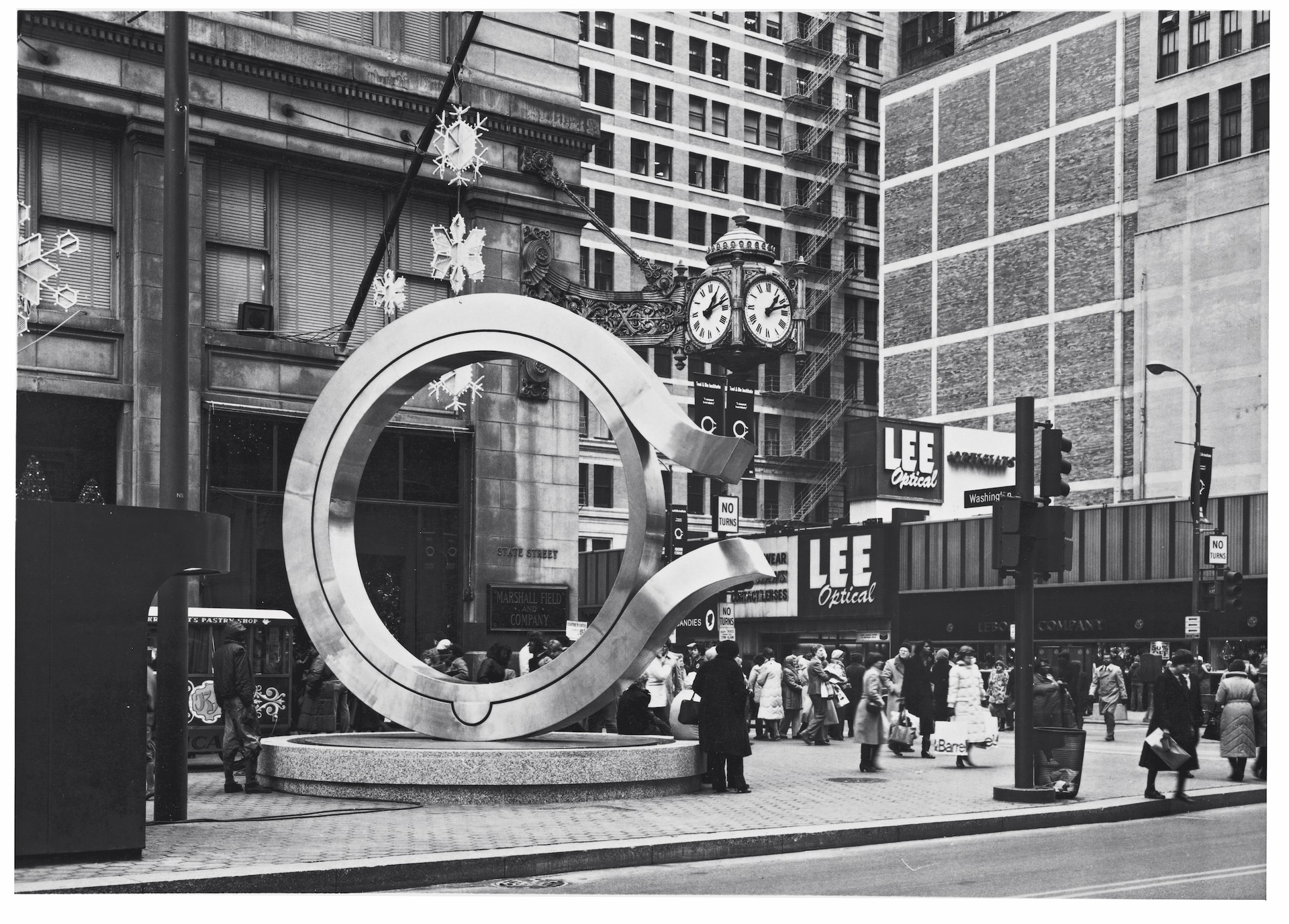
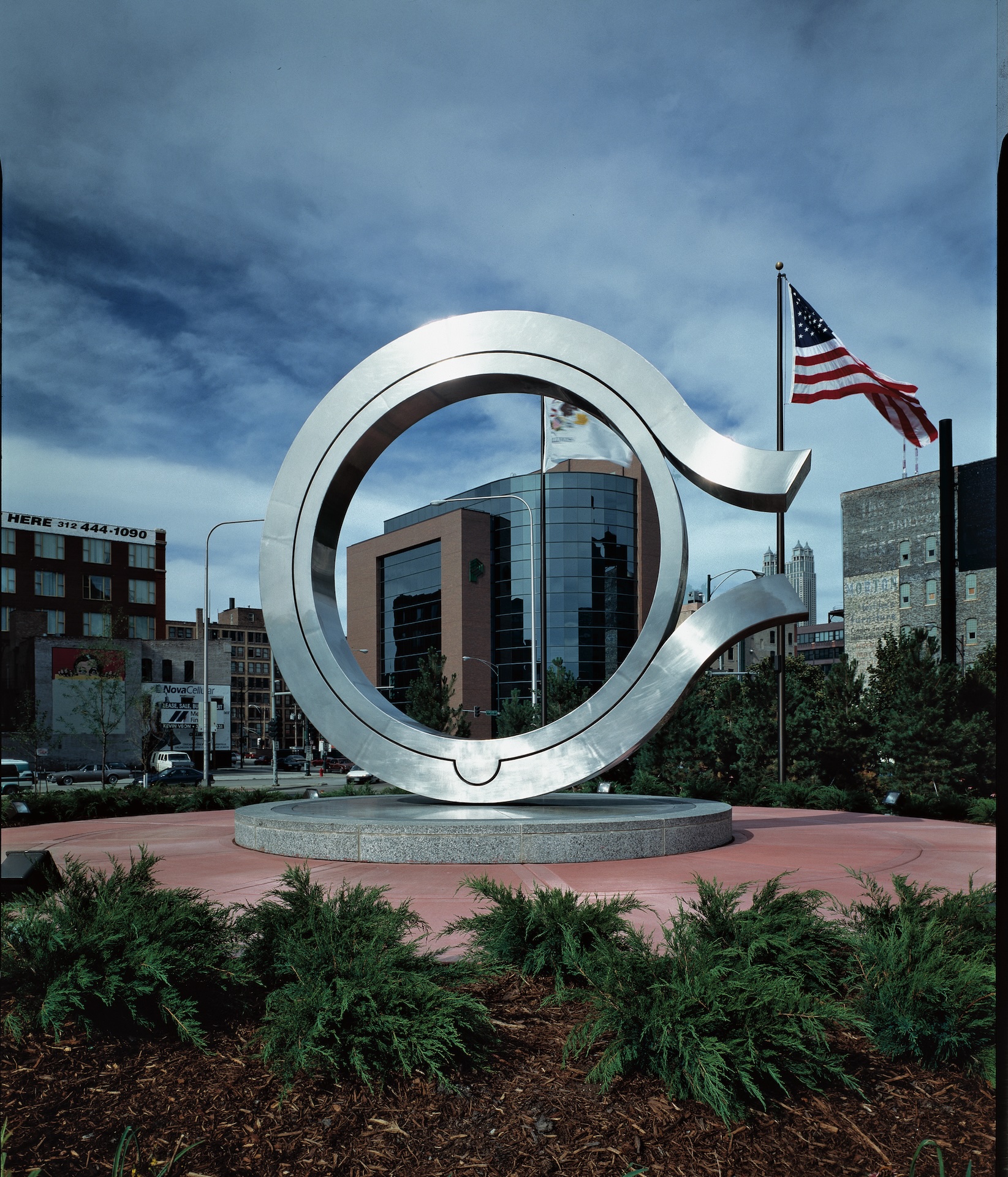
As the sun rises over Chicago every morning, thousands of drivers on the Kennedy Expressway see light reflecting off the elegant curves of a sculpture that sits right where the expressway ends at Orleans Street.
Credit: Marco G. Ferrari
The prominent location of this serene 1983 work, called “Being Born,” reflects the city of Chicago’s high regard for its creator, sculptor Virginio Ferrari, who is from Verona but lives in the Windy City.
Over a seven-decade career, Ferrari has created countless works of art, including more than 30 public sculptures in Chicago alone. He has earned praise from admirers on four continents, and his works are also displayed publicly and in collections in Italy, northern Europe, China, Ecuador and many cities in the United States.
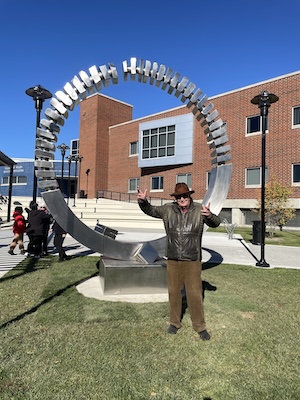
Most recently, the village of Niles — hailing Ferrari as an internationally acclaimed artist — commissioned him to create the monumental “Open Symmetry,” which was unveiled in October 2025. The sculpture graces the plaza in front of the village hall, 1000 Civic Center Drive, which is accessible via Oakton Street near Waukegan Avenue.
“The sculpture reflects our natural desire for balance and oneness — a harmony that is both personal and universal,” Ferrari told the Chicago suburb at the time.
Ferrari, 88, continues to design and create art, through which he often expresses universal themes, from nature, to love, to healing.
Born in 1937 into a family of stone carvers in Verona, Ferrari learned to carve marble the classic way, sculpting human forms and other traditional subjects. But after World War II, modernism blossomed in the art world, and Ferrari began experimenting with materials and paring down shapes to elemental forms that nevertheless expressed ideas and feelings.
“In Verona, there was a facility to work in marble; my dad and grandpa had a stonecutter shop,” Ferrari said in an interview with Fra Noi. “I learned from them how to do marble, and then gradually I discovered there were five or six good foundries for bronze, and I was able to go and work there.”
His son, Marco G. Ferrari, a visual artist and filmmaker who participated in the interview, noted that Virginio created a sculpture called “Caring” at the University of Chicago in 2015.
“It was a 10-foot block of Carrara marble that you carved,” he said to his father. “You chose it because of the meaning — of doctors, caring for people — coming from a block. Sometimes your ideas are connected to the material.”
Virginio reflected that Michelangelo, when he looked at a block of marble, said he could already see what was inside. “Then you take it out, you excavate it out,” he said. “There’s this connection of the idea inside of you and what’s inside the block. It’s a dialogue.”
As a young man in Verona, Virginio created some of his sculptures in wax. Three Venetians spotted his work, were impressed and asked to show it in Venice. The young sculptor acknowledged he didn’t have the money to cast his wax models in bronze.
“The foundryman said, ‘Ferrari, we’ll do the work, you pay us back,’” Virginio recalled.
After a successful show in Venice, Virginio said some American patrons insisted he show his work in New York. Virginio and his sculptures crossed the Atlantic, but a dockworkers’ strike there prevented his crated art from being unloaded. Three or four months passed without the artist having a stable place to live.
“That was frightening to be there,” Virginio said. Eventually, he got his sculptures back, and admirers urged him to show them in Philadelphia. There, an art lover gave him a check for seven sculptures, and he bought a ticket back to Italy.
“So, I was at the foundry, and they said ‘Ferrari, you should come to this party.’ I went, and the first person I saw was this beautiful lady, and I fell in love. I couldn’t move my eyes from her.”
Unfortunately, it was an engagement party for the woman and her fiancé. But when the sculptor was able to approach her, he told her he wanted to marry her.
Marco explained that, though Virginio was previously shy, the successful show had given him confidence.
Virginio won over and married Marisa, and they had three children, including Marco. Through the marriage, Virginio met a key friend and supporter, since Marisa’s aunt was married to a relative of a wealthy American hotel executive and philanthropist, Albert Pick.
Pick and his wife, Corinne Frada Pick, “embraced my parents and wanted to support my dad’s work,” Marco Ferrari said. After viewing Virginio’s work in Verona, the Picks encouraged the newlyweds to come to Chicago, which they did in the 1960s.
“Chicago was a fantastic city, so contemporary,” Virginio recalled. “My work started to change completely. Before, my work was more organic and then it became more linear, more minimal, more like the architecture of Chicago.
“Chicago was open for my work,” he added. “That was my impression.”
Marco interjected: “There was possibility here for you. It was different in Verona. It was more traditional (there).”
The Picks introduced Virginio to people at the University of Chicago, which invited him to teach and be an artist in residence. He did that for 10 years, through about 1975, according to the University of Chicago’s website.
Virginio created several sculptures on campus, including “Dialogo,” a favorite of his friend Manfred Raiser, a gastroenterologist and art collector.
The sculpture contains “two heads, very simplified, which meet, and above the heads is a crown … Many interpretations are possible,” Raiser said.
After Raiser and his wife came to the Chicago area from Germany in the early 1970s, they saw many of Virginio’s works around town and arranged to meet him. Virginio created a table for their home that was essentially a piece of modern art, Raiser explained, and later, when a group of chefs fundraised for a bust of the late Chicago chef Charlie Trotter, Virginio created a more traditional sculpture for them.
“So, this is how we got to know the genius and the talent of this man,” Raiser said, emphasizing Virginio’s versatility.
In Evanston, Albert Pick had teamed with his brother-in-law to fund the Pick-Staiger Concert Hall at Northwestern University, which opened in 1975, according to the university’s website. Ferrari created two freestanding sculptures located near it on campus: “Forme in volo,” started in 1963 and installed in 1975, and “Prism into Two Elements 1979-1980,” according to Marco Ferrari.
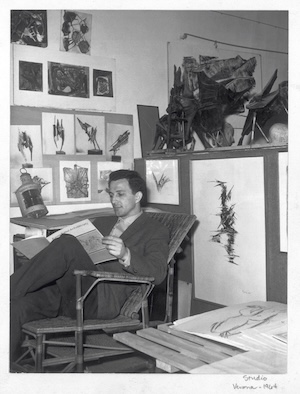
Credit: Marisa Boccaccini Ferrari
Virginio has spent the period from 1960s to the present in a creative fever, making art for civic, museum and corporate collections and individual collectors. He has designed and realized public sculptures in Atlanta; Deyang, China; Florence’ Guayaquil, Ecuador; Los Angeles; Milan; Philadelphia; Parma; Rome; Shanghai, and Verona. He has had more than 50 solo art exhibitions and participated in more than 150 group shows, according to virginioferrari.com.
Marco named other works he finds notable, including “Super Strength” (1995-96), located on Roosevelt Road on the University of Illinois at Chicago campus. And Chicago’s Newberry Library so prizes Virginio’s “Umanità,” displayed outside the building, it gives out miniature models as awards, Marco said.
“Earth Form” is showcased in the lobby and is visible from the outside of the Mies Van der Rohe building on DuSable Lake Shore Drive, and Vanderbilt University in Nashville boasts the 30-foot bronze sculpture “Cylinder in a Prism.”
Asked what he wants viewers of his art to know about him, Virginio mused: “The form and the concept of (a) piece is what I want for them to know. Those are me.”
“So, what they know about him is what they see in the sculpture,” Marco contributed. “It’s the celebration of life, energy, all these themes of nature that are in the different piece.”
“Yes,” Virginio agreed. “For me that piece is alive. You see it now, you see it six months from now, and it’s different, it’s a new experience. It’s alive.”
The above article appears in the May 2026 issue of the print version of Fra Noi. Our gorgeous, monthly magazine contains a veritable feast of news and views, profiles and features, entertainment and culture.
To view a sample copy, click here.
To subscribe, click here.