 Fra Noi Embrace Your Inner Italian


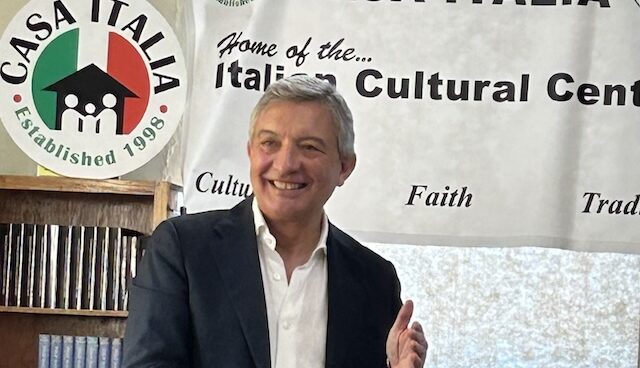
On Oct. 11, the Florentine Room in the Italian Cultural Center at Casa Italia was packed to capacity to hear Enrico Benedetti M.D., FACS give his first-ever public presentation about his work and life. The lecture was titled “Reflections of an Italian Medical Immigrant in the U.S.” and it was received with rapt attention.
Dr. Benedetti grew up in the countryside near Gubbio, first studying at the University of Florence from 1979-85 graduating cum laude with his medical degree and then continuing his residency into 1989.
He desired to practice medicine in the United States so he applied to 110 Surgical Programs in 1987 receiving 4 negative responses and no response from the other 106. He knew it would be difficult to get accepted but was confident in his academic credentials and the meritocratic selection methods practiced in the U.S.
His persistence was rewarded in 1989, when he began a surgical residency at the University of Minnesota where he earned an Abdominal Organ Transplant Fellowship.
He was offered a permanent position in Minnesota but decided he wanted to work in the urban environment of a city hospital so he began a second residency in General Surgery at UIC in Chicago at a much lower rate of pay.
After toiling for 80 hours a week over the course of four years and conducting more than 1,200 surgical procedures, he went on to become the Warren H. Cole Chair in Surgery at UI Health in Chicago, specializing in living donor bowel transplants and pioneering transplants for people with BMIs (Body Mass Indexes) above 35, which had previously not been considered feasible. He published the results that demonstrated that these transplants could be performed with good results and BMI limits were pushed higher across the country allowing more people to have access to these life-saving operations.
He is a recognized leader in robotic surgery, which is much less invasive and more successful than non-robotic methods. After a generous $10 million donation by Bruno Pasquinelli, The Bruno & Sallie Outpatient Surgical Center was opened in 2022 at UI Health.
UI Health is in the early stages of developing insulin-producing islet of Langerhans transplants, that will eliminate the need for immunosuppressants for Type 1 diabetics or transplant an entire pancreas. This would be a great leap forward for people with brittle diabetes or insulin level insensitivity. Spearheading this is Jose Oberholzer, M.D., MHCM, FACS. Dr. Oberholzer is the founding coordinator of the Chicago Diabetes Project and he has been heading the UIC and Pancreas Transplant Program since 2003. “In 1998, UI Health built on my request a state-of-the art isolation lab, and I found the right person to head it in Dr. Oberholzer,” Benedetti said. “2017, he submitted the results of 15 years of studies to the FDA for approval of our islet cells transplant Ppeparation. All of the 58 objections to the findings in the studies were overcome and we were approved to have the first cellular therapy to treat patients with Type 1 Diabetes.”
Another colleague of Dr. Benedetti is Dr. Lorenzo Gallon, a nephrologist who went to medical school at the University of Padua and whose residency was at Bingham and Women’s Harvard Medical School. He is the director of the Abdominal Organ Transplant Program at UI Health. He works with patients who are in need of kidney transplants or simultaneous kidney/pancreas transplants and is passionate about providing care to patients who may be ineligible for an organ transplant at other centers.
When asked about the differences between the medical systems in Italy and the United States, Dr. Benedetti replied, “Italy has better training, but the U.S. has better post graduate training and facilities and more money and grants for research. The life expectancy is five years longer in Italy because all people in the U.S. do not have access to medical care as they do in Italy.”
One of the benefits of working at a state hospital such as UI Health is that there is no discrimination based on a patien’ts income or insurance. The doctors there are passionate about caring for underserved segments of the population.
He does see a difference in many of the young interns whose knowledge is no longer as rooted in memorization. Instead, many of them turn to the internet for on-the-spot knowledge, which doesn’t work especially well when dealing with medical emergencies.
When asked why he wanted to be a researcher, he replied, “I am not one. I’m a surgeon and I live for the personal interaction and communication with my patients.”
He concluded his remarks saying, “Medical research 50 years ago would take 35 years to double our medical knowledge and now our medical knowledge doubles in 8 months, so the sky is the limit.”
When we reflect on this Italian immigrant, whose work affects thousands of people and that will continue to reap benefits in the future for countless patient, we can count ourselves very fortunate that he persevered in his desire to practice medicine in the U.S. despite the initial rejections and obstacles that he faced.