 Fra Noi Embrace Your Inner Italian



Tucked in the corner of an unassuming monastic church, the Brancacci Chapel helped give birth to a style of painting that held sway for centuries.
The shabby exterior of the monastic church of S. Maria del Carmine in Florence looks so unpromising that visitors might be tempted to walk right past it. But if they do, they’ll miss one of the city’s greatest treasures: the spot where Renaissance painting was born. Inside, in the right transept, is a chapel endowed in the mid-1300s by a family of wealthy silk merchants named Brancacci. It was dedicated to St. Peter, the name-saint of Pietro Brancacci, the chapel’s founder.
Secular motives as well as religious ones often played an important part in the decision to commission the decoration of a chapel. The commission gave public notice of the patron’s wealth and high social status, and sometimes signaled his place in the Florentine political hierarchy as well. The sacred subjects chosen by the patron to appear on the chapel walls could also convey specific messages, most of them religious, but some surprisingly political, as seems to be the case with at least one of the frescoes in the Brancacci Chapel.
It wasn’t until the 1420s that a member of the family, Felice di Michele Brancacci, dedicated energies and funds to decorating his family’s chapel. At that time, he was both a successful businessman and a prominent figure on the Florentine political scene. He’d held a number of important offices, including governor of two of Florence’s subject cities, Pisa and Livorno, and between 1422 and 1423 he served as the head of a Florentine embassy to Egypt. He had endured some harrowing trials and dangers in the East, which he recounted in his diary, and he was extremely grateful to have come home alive. Perhaps he undertook the decoration of his neglected family chapel as a thanks offering to God for his safe return.
To decorate his chapel, Brancacci hired two painters, both named Tommaso. As a way of distinguishing them, one was called Masolino (Little Tommy) and the other acquired the peculiar nickname Masaccio, which could be translated as Ugly Tom, Bad Tom or even Tom the Slob. Whatever the meaning of his nickname, his significance as an artist is undisputed: Masaccio is the founder of Renaissance painting, and his masterpieces in the Brancacci Chapel helped set the course of Western painting from the mid-1400s until the late 19th century.
To his contemporaries, what seemed so exceptional about his art was its realism. Even modern viewers, accustomed to photographs and all the advances in realism painters have made, can see how accurately this artist captured the appearance of both human beings and the natural world. But this doesn’t exhaust his achievement. Like all great artists, Masaccio was more than merely a craftsman. He was also an interpreter of the human psyche and spirit.
The wall paintings in the Brancacci Chapel have a complicated history. Although work began in the mid-1420s, Masaccio and Masolino left the project incomplete a few years later. Masaccio went to Rome where, only in his late 20s, he died in 1428. Then, in the early 1430s, Brancacci found himself on the losing side in the struggle for power between the Albizzi and the Medici. He was married to a daughter of one of Cosimo de’ Medici’s chief rivals, Palla Strozzi, and Cosimo had both Strozzi and Brancacci exiled in 1435. Brancacci was declared a “rebel” in 1458 and, although the date of his death is unknown, we know he died in exile. The ban on the family wasn’t revoked until 1474. The chapel decoration was finally completed in the 1480s by a third artist, Filippino Lippi, on commission from another member of the Brancacci family.
As originally executed, the paintings on the walls of the Brancacci Chapel formed a biography of St. Peter, beginning with his spiritual birth, when he first became a follower of Jesus. Due to fire, dampness and the changing tastes of later generations, many of the Brancacci frescoes were damaged or destroyed. All those on the ceiling and upper walls are gone, replaced in the 1600s by mediocre frescoes in the florid Baroque style. What remains of the original paintings is one scene of Christ’s ministry that involves Peter, a series of scenes devoted to Peter’s own ministry during the early days of Christianity, and two paintings of Adam and Eve, whose sin, according to Christian doctrine, made Christ’s sacrifice necessary. Recent restorations have made visible glowing colors and expressive details long covered by layers of soot and dirt.
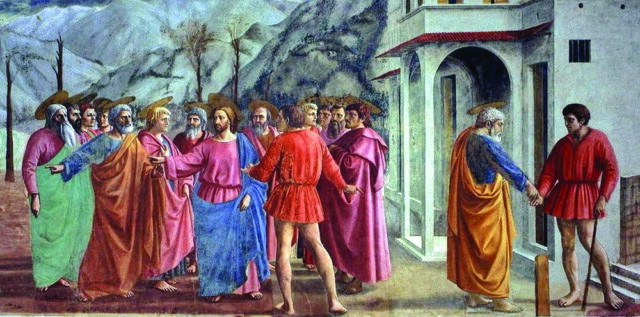
The most famous painting in the chapel, in the long upper register on the left side, is Masaccio’s masterpiece, “The Tribute Money.” Found only in Matthew 17:23-26, this is a seemingly trivial episode in which Jesus performs what could almost be described as a magic trick rather than a miracle. When Christ and his apostles came to Capernaum, an official demanded they pay a tax, or tribute, before entering the city. Jesus told Peter to go to the nearby lake and catch a fish, and that the fish would have a gold coin in its mouth, which it did. Peter then paid the tax collector, and the little group entered the city.
The story isn’t dramatic or inspiring, and is rarely illustrated, so we might wonder why the patron included it. Possibly the episode held political significance for him, although exactly what significance isn’t certain. One possibility is the controversy that erupted in Florence in the mid-1420s concerning the right of the state to tax church properties. During previous decades, the Florentine government had often imposed heavy taxes on church properties to help finance its wars against Milan, Pisa and Naples. In the middle of the 1420s, members of the Florentine clergy approached Pope Martin V Colonna to protest the taxation of their church by the State. Additional levies, they warned, would have dire consequences, resulting in “the total destruction of many churches, hospitals and monasteries.”
Another taxation controversy also was taking shape. Florentines were engaged in a lively debate over whether their government should institute the “catasto,” an early example of a graduated income tax, to finance its decades-long war against Milan. The catasto was a kind of financial census, in which every Florentine citizen declared his income, the number of people in his household and his expenses. His tax rate would be calculated on the basis of that declaration. The system went into effect in 1427. Like any new form of taxation, it wasn’t popular with most citizens, but there were those who insisted it was necessary. Brancacci’s choice of “The Tribute Money” as a major subject in his cycle devoted to the life of St. Peter suggests that, although he was a wealthy and powerful man, he supported one or both sources of revenue. He may have selected the rarely represented story because it shows that even Jesus paid his taxes.
Masaccio transformed the incident into a drama played out by vivid, individual personalities inhabiting a real space. Since Masaccio was the first painter to whom the architect Brunelleschi taught his new technique of one-point perspective, a system for correctly rendering three dimensions on a two-dimensional surface, the figures move in an environment that contains a perfectly rendered building on the right side and a mountainous landscape that extends for miles into the background. The sturdy figures cast shadows in a light that seems to come from the actual windows of the chapel. In this rationally constructed work, we’re looking at the earliest example of a true Renaissance painting.
At the exact center of the composition stands a serene Christ faced by the tax collector, who — with an easy-to-recognize gesture — extends his open palm toward Jesus. Witnesses to this confrontation of sacred and secular authority, the apostles gather around their leader in a semicircle. They are rough, intense types who react with emotions ranging from perplexity to anger. The apostle framed between Jesus and the tax collector curls his lip in a snarl. Jesus gestures toward Peter, who frowns and looks incredulous, pointing toward the lake as if to say, “You want me to do WHAT? Are you crazy?” Nonetheless, Peter obeys, and on the left he crouches by the lakeside, taking a coin from a fish’s mouth. The narrative then skips over to the far right where a glowering Peter hands the coin to the tax collector.
A curious feature of the painting is the inconsistency of costumes. Jesus and 11 of his apostles wear traditional antique robes, while the bare-legged tax collector, portrayed twice — first demanding the tribute money and then receiving it — sports a short, belted tunic similar to those worn by men in Florence in the 15th century, although with tight-fitting hose, not bare legs. Instead of being swathed in biblical robes like the other figures, the apostle to the right of the tax collector wears a magnificent rose-colored cloak. This, too, like the tax collector’s tunic, is Renaissance clothing, the kind of wool cloak a rich Florentine gentleman might wear on a chilly day. The man’s short, neatly trimmed beard also distinguishes him from the other followers of Jesus, who have long, shaggy beards or are clean-shaven. Although legend has it that this figure is Masaccio’s self-portrait, it’s more likely a portrait of the patron, Felice Brancacci, deliberately planted right next to the tax collector. If the figure really is Brancacci, his presence is a clear indication of where his sympathies lay on the contentious political issues of taxation of the church by the state, and the taxation of citizens through the catasto.

Masaccio’s other masterpiece in the Brancacci Chapel is his “Expulsion of Adam and Eve from Paradise,” which appears near the entrance to the chapel, just to the left of “The Tribute Money.” The painting is extraordinary both for its conspicuous placement on the entrance arch and for the nudity of the figures. No other Italian chapel is introduced by realistic, life-size nudes. This visual howl of despair is among the most powerful renditions of the theme ever painted, a heartrending and terrifying image of humanity’s separation from God.
As they stumble through the gate of the Garden of Eden and out into a desolate world, Adam and Eve convulse in anguish. Eve, frantic with shame, attempts to cover her nakedness with her hands. Lifting her face in a sobbing scream, she is crying so hard that her features seem almost to dissolve. Overcome with remorse, Adam hunches over, his stomach sucked in with sobs, burying his face in his hands and weeping. A recent restoration removed the fig leaves that a later and more prudish generation had added, revealing that Masaccio had truly exposed Adam’s nakedness, depicting his sexual organs with an accuracy unheard-of in earlier art. The angel who hovers above the couple doesn’t prod them but merely points the way out — Masaccio’s way of showing Adam and Eve’s understanding of the ultimate tragedy that has overtaken them.

Masaccio’s three further contributions to the chapel program are smaller scenes that flank the altar. Across from Masolino’s scene of “St. Peter Preaching” is Masaccio’s marvelous evocation of Peter baptizing, the “Baptism of the Neophytes.” The future saint stands at the edge of a river, pouring water over the head of a rapt, kneeling man, while other converts mill about. They stare into space, worry about when to remove their clothing and, in the case of a man who has stripped to a loincloth, shiver with cold. But the man being baptized is oblivious to physical discomfort. His magnificent physique and beautiful solemn face, visible behind his dripping-wet curls, make him resemble an ancient statue come to life and converted to Christianity. Rarely has the transforming experience of Baptism been so vividly conveyed.
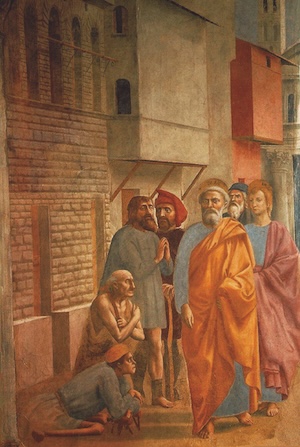
On the lower register of the altar wall on the left, “St. Peter Healing the Sick with His Shadow,” is an event described in Acts 5:12-14. The saint moves toward us down an ordinary Florentine street, staring straight ahead as if in a trance, while a row of disabled men gaze toward him with faces full of poignant hope, trying to move their bodies into the saint’s miracle-working shadow. On the opposite side of the altar is “St. Peter Distributing Alms to the Poor,” ignoring Ananias sprawled at his feet, struck dead by Peter for refusing to give the proceeds of a sale to the Christian community. The recipients of Peter’s charity have a dignity and individuality comparable to that of the apostles in “The Tribute Money.”

Masaccio’s scenes have a freshness, a degree of accurate observation, and an insight into human nature and behavior that set them apart from all previous paintings. By the 1500s, Masaccio had become a revered figure to later Renaissance artists. The Brancacci Chapel had become his shrine, a “school” where many celebrated artists of succeeding generations studied Masaccio’s paintings. Among them were Leonardo da Vinci and Raphael, as well as Michelangelo, who claimed to have learned more from Masaccio’s paintings than from any living teacher. Despite Michelangelo’s celebrated indifference to mere realism, he recognized in Masaccio a kindred spirit, a bold and creative intellect whose work changed the course of Western art.
The article above appears in the October 2025 issue of the print version of Fra Noi. Our gorgeous, monthly magazine contains a veritable feast of news and views, profiles and features, entertainment and culture.
To view a sample copy, click here.
To subscribe, click here.
