 Fra Noi Embrace Your Inner Italian


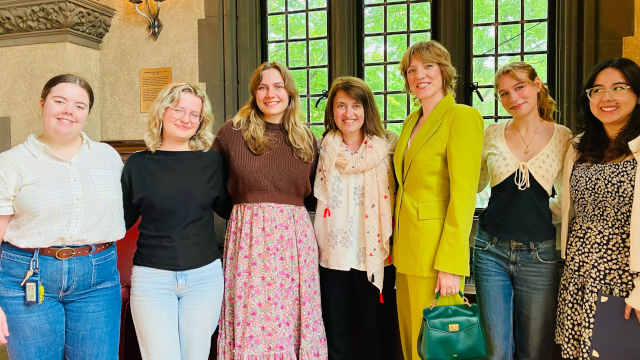
For Maria Teresa Bonfatti Sabbioni, teaching Italian has always raised another question: How do students actually learn a new tongue?
“I became passionate about researching how students learn and practice my native language,” she says.
Bonfatti Sabbioni has called the United States home for almost 21 years now, but her story began in Pianello Val Tidone, a small town in northern Italy’s Emilia-Romagna region. She attended a liceo classico, an Italian high school that emphasize ancient Greek, Latin and classical and medieval Italian literature.
Before earning her university degree, Bonfatti Sabbioni worked as a teaching assistant for children from Albania, Kosovo and Romania living in Italy, none of whom initially spoke Italian.
“That was my first introduction to teaching Italian as a second language,” she recalls.
Bonfatti Sabbioni graduated from the University of Pavia in Lombardy with a degree in medieval art history. There, she studied Latin paleography as well as classical and medieval Latin.
After graduating, Bonfatti Sabbioni began her career doing freelance work in the Italian State Archives, reorganizing and transcribing ancient documents written on parchment.
Then, in 2004, she traveled to Bemidji, Minnesota, for a summer teaching at Concordia Language Villages, where she helped develop the curriculum for the first year of its Italian-language camp, Lago del Bosco.
“It was a fabulous experience that made me desperately want to return to the United States,” she says.
Bonfatti Sabbioni eventually returned stateside and began teaching Italian at Language Stars, a private language school for children in Chicago. She remembers it as a “beautiful experience,” during which she met students from all over the world.
Her teaching career then took Bonfatti Sabbioni to Ohio University in Athens, Ohio, where she became a visiting lecturer. There, she met Molly Morrison, a professor and expert in medieval Italian literature who, she says, “opened the doors to the joys of teaching Italian as a foreign language in the United States.”
Next, Bonfatti Sabbioni, began teaching as a visiting lecturer at Northwestern University in Evanston while earning her master’s degree in linguistics at Northeastern Illinois University in Chicago.
With classroom experiences fueling her research, she decided to continue her studies at the University of Wisconsin-Milwaukee, earning a Ph.D. in second language acquisition and further developing her expertise in the methodology of teaching modern languages.
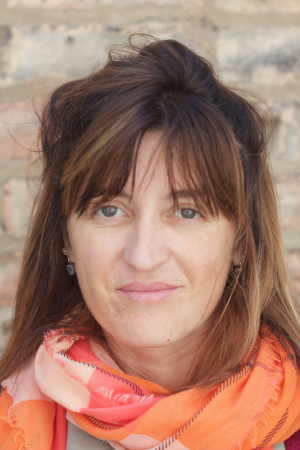
Bonfatti Sabbioni says one of her favorite parts of teaching is being asked intelligent questions about grammatical structures and elements of Italian language that she, as a native speaker, had never considered.
Her students’ questions push her to search for answers that go beyond textbooks and are instead rooted in research. At the same time, her work allows her to explore second-language acquisition and even how the brain processes and retains information.
Much of Bonfatti Sabbioni’s research focuses on the mistakes students make while learning another language. To her, an error is not simply something to correct.
“Errors are never, ever random,” she explains.
Instead, repeated patterns in those mistakes can reveal how a student is learning a second language. Those patterns, she says, can lead to broader conclusions about how people acquire and produce language, including their native language.
Today, Bonfatti Sabbioni teaches at DePaul University. Her courses include beginning and intermediate Italian as well as upper-level courses in phonetics and phonology and Italian for business. She also teaches a discovery course on Italian culture in Chicago that focuses on understanding the characteristics of Italian American culture.
Her approach to teaching begins with oral practice and exposure to Italian, but Bonfatti Sabbioni is also a strong believer in learning by doing. Her students often play short games, give small performances or use flashcards to play charades.
She also brings her interest in error analysis into the classroom, comparing aspects of a student’s native language with the Italian he or she is learning. She acknowledges that contrastive analysis is considered an older approach, but believes it remains “absolutely valid and productive.”
For Bonfatti Sabbioni, cultural exchange goes both ways.
“I love hearing students talk about their own culture and ask questions about Italian cultural aspects, and I love interacting with them and learning about the differences between American and Italian culture from their perspective,” she says.
Her interest in language acquisition has also led Bonfatti Sabbioni to teach linguistics and train future language teachers through Ca’ Foscari University of Venice. She hopes to find more opportunities in the United States to continue that work.
Bonfatti Sabbioni sees challenges ahead for foreign-language education. As artificial intelligence and other digital tools become increasingly capable of translating languages, some question whether learning another language is still necessary. She strongly disagrees, noting that foreign-language education is not always given the value she believes it deserves.
Through it all, her enthusiasm for teaching has not changed.
“I always, always enjoy being in the classroom,” she says. “That is the easy part.”