 Fra Noi Embrace Your Inner Italian


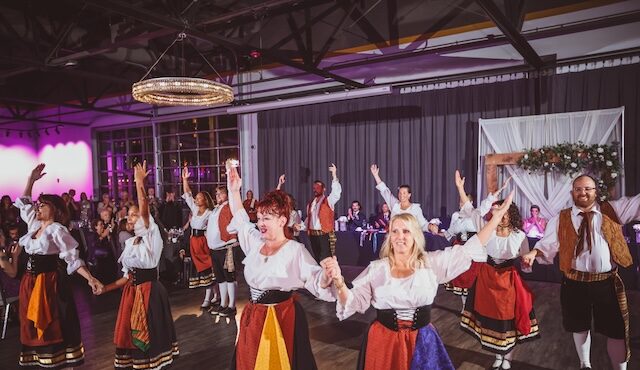
Starting at age 5 as a dancer and now as dance director for nearly 30 years, Mark DeSanctis has invested a great deal of time, energy and resources into his volunteer work with the Milwaukee-based nonprofit dance group Tradizione Vivente.
None of it ever felt like a burden, DeSanctis says.
“It is a labor of love,” he explains. “The reward is seeing our traditions continue, watching our kids grow into adult dancers, seeing audiences connect with their heritage, and knowing that something meaningful is being passed from one generation to the next.”
Founded in 1945 in Milwaukee, Tradizione Vivente’s repertoire is based on authentic Italian folk traditions, with dances performed by an adult group with 30 to 40 members, and a children’s group, I Bei Bambini, with about 25 to 40 members.
Tradizione Vivente performs year-round, mostly throughout the Milwaukee and Chicago areas, with 14 performances booked for the year as of late June. The calendar includes major Italian festivals, cultural events, community celebrations and private performances.
“Groups like ours make heritage alive and real,” DeSanctis says. “We know that Italian culture is mostly shared through food, language and family, but folk dance adds something different. It brings together music and costume and history and regional connection and community in a way people can truly ‘feel.’”
Tradizione Vivente’s repertoire features more than 50 dances, including several styles of tarantella from southern regions such as Napoli, Sicilia and Calabria, and northern styles such as polkas, waltzes and mazurkas. A recent addition was pizzica from the Puglia region.
“We even try to include lighter numbers, such as a fun choreographed version of ‘Mambo Italiano,’” DeSanctis says. “But our primary focus is always on preserving and presenting Italian folk traditions in a way that is both authentic and engaging for audiences.”
One of the greatest things about Tradizione Vivente is its multigenerational nature, with longtime members joined by sons, daughters and even grandkids, DeSanctis says.
In fact, his own family is a prime example of that.

DeSanctis’ father, who immigrated from Italy at 18, joined the group as a dancer. When DeSanctis was growing up, his mother led the children’s group and his father became dance director.
“Some of my earliest memories are of being at practices, watching performances, and seeing my father downstairs sewing costumes or studying old VHS tapes to learn more about Italian dances and traditions,” DeSanctis recalls.
Now, DeSanctis’ sons, Dominic and Vinny, are members of the children’s group — as are his nieces and nephews — and his wife, Ashley, helps out. The family lives in suburban Milwaukee with their dog Manicotti Mozzarella and cat Amethyst.
DeSanctis became Tradizione Vivente’s dance director as a teenager, after his father began to exhibit early signs of dementia. “I could see then that the group would need someone to step up and help carry the tradition forward, so I began assisting wherever I could,” he recalls.
After earning the trust of veteran members, DeSanctis helped establish a co-director role to ease the transition for his father. By the time he was 18, he was formally elected dance director.
“My father passed away shortly after I took over. That made my new responsibility feel even more personal,” he says. “What began as a way to help the group through a difficult transition became one of the great honors of my life. Nearly 30 years later, I am still in the role, still carrying forward the traditions he helped pass down to me.”
DeSanctis has spent most of his career in technology and serves in an executive role for a reliability engineering organization. Aside from his professional life, Italian folk arts have become a major part of his life’s work.
“Over time, Italian folk dance has become an area of passionate study for me and I have worked hard to become a knowledgeable resource in this field,” says DeSanctis, a past president of the national nonprofit Italian Folk Art Federation of America.
While he holds deep respect for the artistry and cultural aspects of Tradizione Vivente, he is also constantly thinking about how to sustain the group’s future as it relates to membership and leadership, he says.
“Many of our longtime dancers have carried this group for decades, and over the next 10 to 15 years we will need the next generation to step up. That is why our children’s group is so important. I Bei Bambini is not just a cute addition to the adult group. It is truly a pipeline of new members, the future of our traditions.”
Tradizione Vivente recently received 501(c)(3) nonprofit status and is working to grow support through donations and grants. To learn more, visit tradizionevivente.org or email mark.desanctis@gmail.com.