 Fra Noi Embrace Your Inner Italian


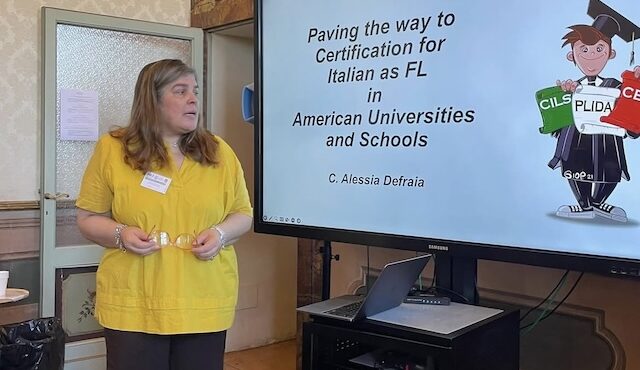
When Italian teacher Alessia Defraia earned a scholarship for an internship at the Italian Cultural Institute in Chicago, she thought she’d spend about three months in the city.
Eighteen years later, she is still there, having amassed an impressive breadth and depth of experience in her field.
“I jokingly say I’m like the ‘Nutella of Chicago’ because I’m everywhere in the Italian teaching scene,” she says.
Defraia is a part-time instructor at the University of Loyola Chicago, where she has taught elementary, intermediate and advanced Italian, teaching methodologies and Italian linguistics.
She teaches Italian at the nonprofit ItalCultura, the Italian Cultural Institute of Chicago’s language school.
She helps students prepare for the Certificate of Italian as a Foreign Language offered by the Università per Stranieri di Siena, for which she is a licensed administrator.
She works with a national team of colleagues from various universities and high schools to score Advanced Placement Italian Exams across the United States.
She has taught at Sentieri Italiani, an Italian school in the north side of Chicago, and helped at another Italian language school, teaching Italian to the students’ parents.
Finally, she has worked on numerous translation projects for books, articles and more, from Italian to English and vice versa.
Defraia lives in Chicago with her three adopted cats — she is passionate about supporting animal shelters — and became a U.S. citizen in June.
“For now, I want to stay here,” she says. “I love Chicago, I love the American culture, and I really appreciate everything this city has offered me.”
Defraia grew up in Cagliari, in the region of Sardinia, where she lived until age 19.
She decided to become a teacher after spending a year in Finland through International Christian Youth Exchange, and then being asked to help the organization work with foreign students in Italy.
“I started teaching in the so-called ‘language camps,’ working with exchange students for a month, right before the start of the school year, and introducing them to the Italian language and culture,” she says. “I was young, but I absolutely loved the experience.”
Defraia started teaching Italian to foreigners in the early ’90s, working for the Associazione per la Formazione, gli Scambi e le Attività Interculturali, which promotes and supports short and long-term exchanges throughout the world.
She served as director of the Sardinian branch of the association and oversaw the long-term exchange program for students staying in Italy for a year. She also organized and managed several short-term exchange programs throughout Europe.
To make ends meet as a university student, she worked jobs such as cook and dishwasher, eventually earning a master’s degree in language teaching methodology and linguistics from the University of Cagliari, followed by a scholarship to study at the School for the Teaching of Italian as a Second Language at the University for Foreigners of Siena.
She then spent a couple of years as a visiting scholar at the University of Massachusetts in Amherst before moving to Chicago.
One of the greatest challenges in teaching Italian is recognizing that every learner is different, Defraia says.
“You have students who thrive on grammar rules and others who just want to dive into conversation and pick it up naturally. Some people are learning because they’re moving to Italy or they love the culture, while others are looking for a sense of community or are exploring their roots,” she says. “Understanding these motivations and adapting to different learning styles is a huge part of the job.”
Teaching linguistics is about helping students engage in the scientific study of language, including its structure, how it’s acquired, its role in society and its use by the mind.
In fact, her sociolinguistic studies and coursework in educational linguistics have been an asset as a teacher in Chicago, she says.
“I have always had sympathy for the Italian American students who have asked me if sentences they heard their relatives say make any sense at all,” she says. “I explain that dialects and linguistic varieties of Italian have great inherent value, while encouraging them to pursue their study of standard Italian so as to be able to communicate with a wider group of people.”
Defraia recently started training as a tour guide to offer immersive Italian cultural experiences in regions like Sardinia, Campania, Liguria, Umbria and Sicily. Her goal is to allow travelers to experience real human connection, which is so needed in today’s digital world, she says.
“I’m offering travel companionship, sharing the experience of sitting together over a coffee in Italy, sharing laughter and authentic Italian meals, enjoying the scents and sounds of a piazza together, walking along the cobblestones, and all those real-world moments that you just can’t experience on a screen.”
In her spare time, Defraia enjoys reading, walking and tending to her sunroom full of greenery. She is also passionate about building community.
“I organize events for the Italian American community — like dinners that start small and suddenly have 60 people showing up!” she says. “I really believe that now, more than ever, people need that sense of connection, and I love creating those opportunities.”