 Fra Noi Embrace Your Inner Italian


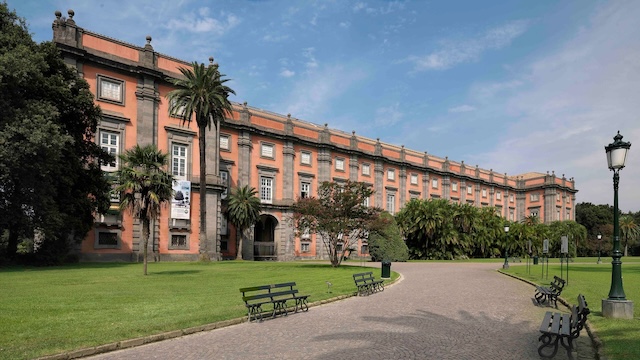
As a driving force behind the American Friends of Capodimonte, Cristina Del Sesto has helped increase stateside awareness and support for “Europe’s least-known great museum.”
Creating wider public access to the Capodimonte Museum has been the opportunity of a lifetime, says Cristina Del Sesto.
Located in Naples and boasting more than 47,000 works of art spanning the Middle Ages to the 21st century, the museum was described as “Europe’s least-known great museum” in a Financial Times article in 2023.
Del Sesto serves on the board of American Friends of Capodimonte (including just over one term as president until earlier this year) and has been involved with the organization since its inception 10 years ago.
After working as corporate relations senior officer for the National Gallery of Art for nine years, she has been devoted to the AFC full time for the past three years.
Del Sesto, who lives in Washington, D.C., with her partner, talks to Fra Noi about the growth and accomplishments of the organization, and why it all matters so much.
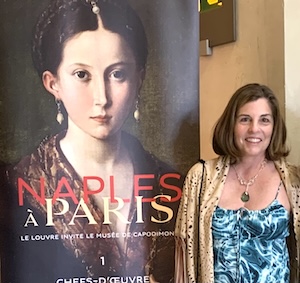 Elena Ferrarin: Can you tell us about the AFC and its mission?
Cristina Del Sesto: Individual Americans receive tax incentives to be philanthropic, and there are several “American Friends” groups that raise funds for foreign museums. At the request of the Museum of Capodimonte Director Sylvain Bellenger, an American nonprofit organization was created to support Museo e Real Bosco di Capodimonte in Naples and serve as the sister organization to Amici di Capodimonte.
EF: What was your role in starting the organization?
CDS: Tasked by AFC co-founder and president Vincent Buonanno to assess Capodimonte’s needs and what this nonprofit might be able to do, I went to Naples in early 2016. I was given full creative license to invent whatever I thought would be possible and useful. Looking at the landscape of other “Friends” groups and the limited time and resources with which we were starting, we had to be scrappy to launch. I did the initial assessment, designed the mission, identified the first AFC Fellow, developed the board from three founding members to 11, wrote press releases and newsletters, planned trips and events, and was, in essence, “chief bottle washer.”
EF: How has the organization grown in the last 10 years?
CDS: I am extremely proud of the fact that we have sent four postdoctoral curators and two senior fellows to Capodimonte. Their scholarship on Capodimonte’s extraordinary collection is already making a significant impact and bringing awareness not just to art historians but to museum-goers worldwide. There have been art trips with directors Bellenger and Eike Schmidt (appointed in January 2024), loans to U.S. museums and two noteworthy U.S. traveling exhibitions: “Flesh & Blood: Italian Masterpieces from the Capodimonte Collection” (2020) and “Art & War in the Renaissance: The Battle of Pavia Tapestries,” which closed recently at the Museum of Fine Arts, Houston. The AFC is propelled by a devoted board of volunteers. This has been a huge collaborative effort, and everyone participates fully.
EF: Did you grow up connected to your Italian heritage?
CDS: Growing up in Rhode Island, we had spaghetti or ravioli every Sunday and lasagna on Christmas Day. I shopped with my father on weekends at Italian markets. All four grandparents were proud of their heritage and were keenly aware of the sacrifices their parents had made to start a life in this country. Coincidentally, my grandfathers were from small villages 14 miles apart in Campania. My father, Ron Del Sesto, an attorney, served as honorary vice consul for Italy in Rhode Island and was a board member of the National Italian American Foundation. I studied Italian in college, and my junior year I lived outside of Florence in Fiesole. I’ve been to Italy many times since then, and I always long to go back. Almost 20 years ago, my son and I became Italian citizens.
EF: You have a B.A. in art history from Georgetown University and M.F.A. in English literature and creative writing from Bennington College. Where does your passion for the humanities stem from?
CDS: My passion for the arts was nurtured by my parents and extended family members. My mother indulged every artistic endeavor I wanted to pursue. She took me on my own to museums. She hung my artwork up! As a family we went to plays and musicals.
EF: You covered the arts for the Washington Post for many years, first as a staffer, then as a freelancer. What was the job like?
CDS: I started as a copy aide on the night shift in the general newsroom and then moved over to the Style Section to be the classical music critic’s assistant. Ultimately, I had a weekly column in the Home Section on art, architecture and design, and I contributed to other sections. My big break was writing a lengthy story about the double Dutch jump ropers at the Smithsonian Folklife Festival.
EF: In 2004, you authored “At the Ansonia Hotel: A Broadway Landmark Turns 100” and organized the corresponding exhibition of photography by Tom Wolff at the Municipal Art Society. Why write a book about this hotel?
CDS: The Ansonia at the time I lived there was undergoing a massive shift. Tenants in rent-controlled apartments from the ’70s were elderly and dying and/or being forced out so that renovations could be made and condos sold. Most of the older residents who lived there were artists. Many were musicians because the walls are thick, and their leases included a clause that allowed them to practice from 9 a.m. to 9 p.m. I knew we were witnessing the end of an era, and I wanted to document the history of my neighbors and the building they called home.
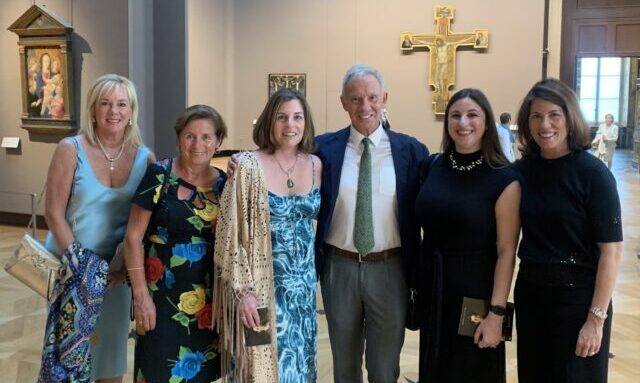
EF: Do you have a favorite art destination?
CDS: Capodimonte, of course! Not only is the collection bigger than the one at the Uffizi Galleries, it is arguably as good or better. Guido Reni’s “Atalanta and Hippomenes” from around 1620 is one of my favorites. Next might be Parmigianino’s “Antea” and El Greco’s “A Boy Blowing on an Ember to Light a Candle,” because it reminds me of my son. The Porcelain Room created for Queen Maria Amalia of Saxony is another highlight, as is Michelangelo’s “Cartoon with a Group of Soldiers for the Crucifixion of Saint Peter,” an enormous drawing that was a study for the Pauline Chapel at the Vatican.
EF: Why do organizations like AFC matter so much?
CDS: The very definition of “civilization” is a culturally advanced society. Italy is committed to its cultural heritage, but there are 60 UNESCO World Heritage Sites in Italy alone — more than any other country — and UNESCO estimates that over 60% of the world’s art treasures are in Italy. While there’s no doubt the Italian government is trying to preserve and conserve its treasure trove, it is a very expensive undertaking, and I believe it has to be a commitment by all of us to preserve art in Italy for all civilization. Our humanity is at stake.
For more, click here.
https://www.americanfriendsofcapodimonte.info/
The article above appears in the September 2025 issue of the print version of Fra Noi. Our gorgeous, monthly magazine contains a veritable feast of news and views, profiles and features, entertainment and culture. To subscribe, click here.