 Fra Noi Embrace Your Inner Italian



He was born Jewish, became a priest, fathered seven children and was tried and found guilty of vice.
He was a poet, playwright, linguist, professor, opera impresario and grocer. He lived in Venice, London and Vienna, but spent the last 30 years of his life in New York, where he became an American citizen.
He knew Casanova, Mozart and Salieri and dined with James Fenimore Cooper, Henry Wadsworth Longfellow and Washington Irving. His portrait was painted by the code-developer Samuel Morse.
Thousands attended his funeral, but no one knows where his grave is. He is Mozart’s librettist, Lorenzo da Ponte, who helped bring opera to America.
 He was born Emanuele Conegliano near Venice in 1749. Jewish by birth, he became Catholic when his father converted the family. Emanuele became Lorenzo da Ponte, the name of the bishop who baptized him.
In 1773, da Ponte finished a classical education at a seminary, was ordained and moved to Venice. There he wrote poetry while tutoring wealthy young noblemen in Latin and Italian. He also fathered two children with a mistress and became a close friend of Casanova, who shared his libertine inclinations.
Six years later, he was defrocked, found guilty of “offences against religion and morality” and banished from Venice. For the next quarter of a century, da Ponte traveled around Europe, supporting himself as a tutor and writer.
In Trieste, he met a young Jewish woman with whom he eventually had five children but never married. Two years later, in 1781, he moved his family to Vienna where he met Antonio Salieri, Emperor Joseph II’s influential opera composer. Salieri hired him as a librettist for the court’s Italian opera company and helped him become court poet.
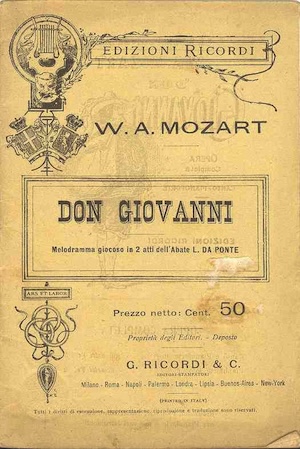
In Vienna, da Ponte also met Mozart. Their collaboration resulted in “The Marriage of Figaro” (1786), “Don Giovanni” (1787) and “Così fan tutte” (1790).
After the emperor died, da Ponte lost his post and moved to London in 1792, where he stayed for 13 years, adding English to the Latin, French and Italian he spoke fluently.
He supported his family as a grocer, then Italian teacher, and finally librettist until bankruptcy caused him to immigrate to America in 1805, only 22 years after the country had won its independence from Great Britain.
In New York City, by pure chance, he met Clement Clarke Moore, a young scholar and wealthy real estate developer who was impressed by da Ponte’s erudition and illustrious European connections.
Moore often invited him to dinner parties, where da Ponte met the city’s richest men and important literary elite, including Longfellow and Irving. As a trustee of Columbia College (now Columbia University), Moore secured him a position as Columbia’s first professor of Italian language and literature in 1825.
The next year, da Ponte introduced New York to opera when he produced the first complete American performance of “Don Giovanni,” followed by Rossini’s “Barber of Seville.”
In 1828, at age 79, he became an American citizen. Five years later, with backing from wealthy friends, he founded the Italian Opera House, the first opera house in America entirely dedicated to Italian productions. Debt-ridden, it closed after only two years and eventually burned down.
After three decades in New York promoting Italian language, literature and opera, da Ponte had become a cultural icon. When he died in 1838 at age 89, the city gave him an elaborate funeral. He is buried in Calvary Cemetery in Queens, which has more than 3 million graves. No one knows where his is.
In all, da Ponte wrote 28 libretti for 11 composers, but he is remembered for Mozart’s three masterpieces. His knowledge of literature, experience as a writer and talent as a poet made him one of opera’s greatest librettists.
Significantly, da Ponte means “bridge.” Through his championing of Italian language, literature and opera, Lorenzo da Ponte was an influential bridge between Italy and America.
The article above appears in the October 2025 issue of the print version of Fra Noi. Our gorgeous, monthly magazine contains a veritable feast of news and views, profiles and features, entertainment and culture.
To view a sample copy, click here.
To subscribe, click here.
